
Is Textile Chemistry Strategy Now Starting With Toxicity?
Textile chemistry and textile wastewater treatment are no longer different problems. Earlier, the former belonged to product and R&D teams, while the latter was on the agenda of plant engineers and compliance officers.
This distinction is now blurring as regulatory ropes tighten around effluents and their impact on living organisms. It is no longer about how transparent or clean the wastewater looks but about how upstream the consequences travel from every dye to pigment, mill purchases, as well as R&D roadmaps.
This edition delves into the pressure of these developments at the outfall and how companies can turn this pressure into an R&D advantage. Two major signals describe one shift visible from both ends of the value chain.
Signal 1: The outfall is shifting the goalposts
Clear water is not enough anymore. China enforced GB 4287-2026 this September and added a zebrafish-embryo toxicity limit to textile effluent. So, now effluents that pass every COD and color test can still fail. The revised EU Industrial Emissions Directive also raises minimum fines for serious breaches to at least 3% of annual EU turnover as compensation for people who lost their health because of it.
The chemistry well explains this shift. Nearly 70% of synthetic dyes are azo-type, and about 10-50% of them leave the bath unfixed. When mixed with wastewater, these molecules may break down into aromatic amines, a major cause of DNA damage in human beings. Thus, color removal doesn’t necessarily guarantee elimination of harmful substances.
To conclude, verified detoxification is the new strategic capability that will map the emerging toolkit and commercialization capabilities of companies in this sector.
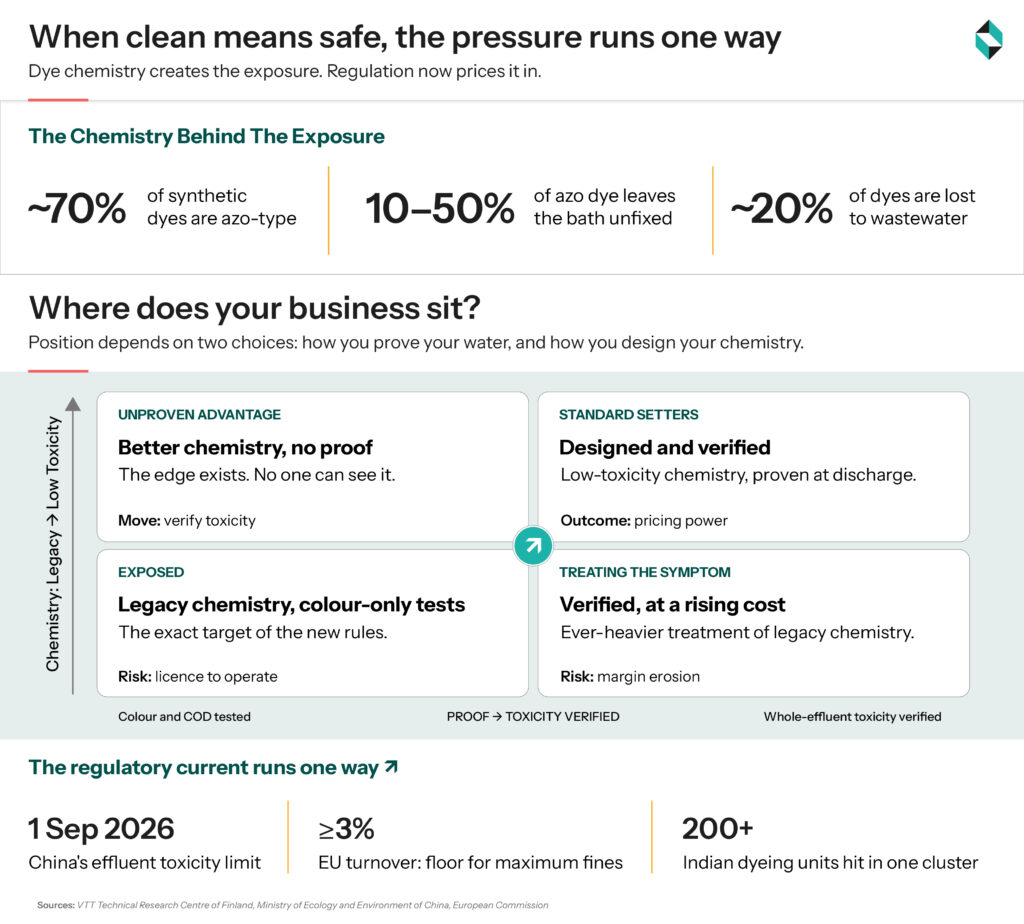
Signal 2: R&D prioritization is the answer
The test set by outfall can be answered by new R&D strategies. We recently helped a diversified specialty chemical company resolve a similar challenge. It aimed to navigate the rapidly changing, crowded innovation landscape. They had no consolidated vision of the most pragmatic solutions, near- and long-term answers, and the gaps.
Challenges like cost, energy and carbon footprints, water constraints, and end-of-life problems were affecting the complete wet-processing chain. We mapped emerging innovations against various technology readiness levels (TRLs) for each challenge.
The comparative view of market maturity, gaps, and white spaces that the client gained helped them redirect their R&D towards pathways to meet unmet consumer needs and align technical readiness with commercial potential. The final recommendations included a carbon and energy roadmap, a structured step-by-step PFAS transition plan, along with design-for-recycling criteria integrated into product specifications.
Bottomline
The shift indicated by these signals draws the following strategic conclusions:
- Compliance risk is now the biggest R&D criterion: A toxicity limit at the outfall is a specification for the chemistry upstream. Companies lowering the toxicity of their dyes, pigments, and finishes will gain an edge in the market.
- Maturity is far more crucial than novelty: Both signals strongly warn against chasing technology. Capital will work best where needs and readiness align with each other.
- Advantage will move to those who connect the chain: Chemical brands, mills, and suppliers all hold the key to these challenges. Businesses successful in aligning treatment strategies with product development will set the benchmarks for others to follow.
More importantly, the questions that leadership teams need to find answers to include:
- Do their products and processes also perform on toxicity or just color?
- Is the R&D portfolio prioritized by unmet need and readiness, or just by internal momentum?
- Which whitespaces can be owned before regulations or competition closes them?
How are we helping
We are working with R&D teams, chief technology officers, and strategy heads across the textile value chain and helping them prioritize R&D with confidence, scout & benchmark technologies, anticipate regulatory changes, and map IP and partnership landscapes. Looking to turn regulatory pressures into an innovation edge? Let’s take the conversation forward.