Executive Summary:
In the world of textile production, the benchmark has now moved from color to toxicity. China’s GB 4287-2026 has added a zebrafish-embryo toxicity limit effective from September 2026. It implies that effluent that looks clean may fail now too. At the same time, the revised EU Industrial Emissions Directive has imposed maximum fines, which amount to more than 3% of EU turnover annually. In India, more than 200 dyeing units have been closed by regulators. It is a structural problem; technology is shifting from removal to recovery.
Most research now indicates that mills, chemical suppliers, brands, and shared treatment investors and operators must develop verified, evidence-backed detoxification as a strategic capability. Regulators are no longer asking about how clean the effluent looks but how safe it is. This single shift is making dye decolorization a costlier process and moving it into the core of corporate strategy.
Introduction
For the last few decades, a clear discharge from a treatment plant was the proxy that textile producers needed to satisfy auditors, signal compliance, and keep local communities aligned. But evolving sustainability concerns and regulatory frameworks are now breaking away from and going beyond that proxy. Treatment plants that were once specified, sized, and procured around this visible outcome now must rethink their modus operandi.
In the last two years, the largest textile-producing economy turned whole-effluent toxicity into national law. The EU strengthened its industrial emissions regulatory framework with turnover-linked penalties, while Indian regulators demonstrated a preference for halting discharge for complete processing clusters rather than individual units.
All these developments underline one big risk: decolorization that eliminates color doesn’t remove toxic breakdown products. It is a liability that needs to be addressed by decision-makers who need to move beyond cost-effective ways to remove color and find better ways to prove that the effluent is also harmless.
Why Decolorization is So Critical Now?
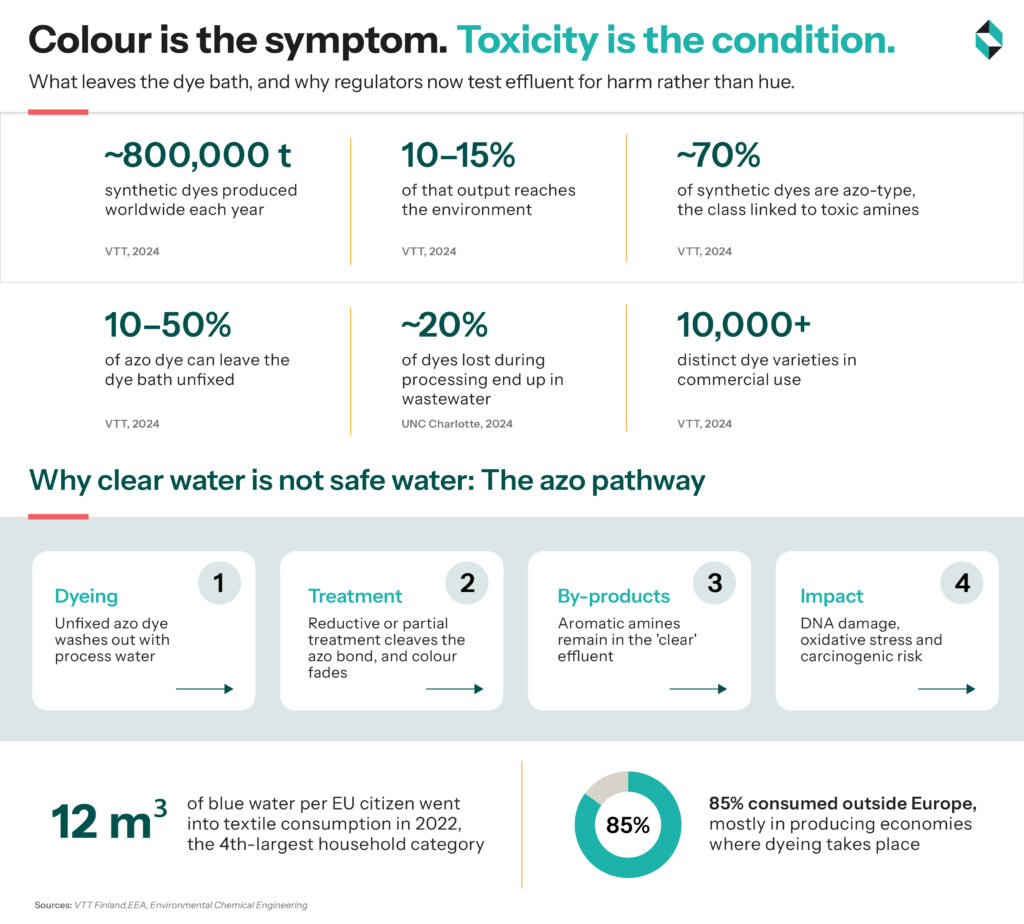
The statistics behind the process explain why regulators are scaling their efforts. Globally, 800, 000 tonnes of synthetic dyes are produced annually, and nearly 10-15% of them are released into the open. Over 10, 000 varieties of dyes are in commercial use, and about 70% of them are azo dyes.
Azo chemistry is at the center of this problem. Dyeing inefficiency implies that 10 – 50% of azo dye may leave the bath unfixed. When it mixes with wastewater, its molecules may break into aromatic amines. Amines have been directly linked to DNA damage, carcinogenesis, and oxidative stress. Color is more of a visible symptom; however, toxicity is the underlying condition.
The problem gets further complicated due to the water footprint. Textile consumption in the EU required roughly 12 m3 of water per person in 2022. Nearly 85% of that water was used outside Europe, mostly concentrated in economies taking care of textile dyeing. It is a geographic equation. While European companies are bearing the reputational exposure, Asian dyeing units are carrying the operational exposure.
Lastly, energy consumption is turning into an operating-cost battleground. More and more evidence is surfacing, signaling an expansive but navigable energy landscape specific to technology selection and operational ecosystem. Here is a summarized version:
| Innovation/Technology | Color-removalEffectiveness | Energy or Operating Intensity |
| Electro-oxidation | 99.93% within ten minutes | 0.0932 kWh/m3 |
| Electro-oxidation (Ti/Pt, Acid Yellow 17) | Optimized through RSM; energy minimized at 0.266 kWh/m3 | 0.266 kWh/m3 under lab or optimized conditions |
| Ozonation | Very effective | 8-15 kWh/m3 |
| Adsorption | 589 mg/g capacity, especially for Acid Blue 113 | Low |
| Nanocellulose membranes | Up to 2,282.3 mg/g adsorption and 87-100% rejection | Flux-dependent |
Scaling Regulations are Changing the Game
Three jurisdictions that are directly involved in this game are constantly working to rewrite the rules.
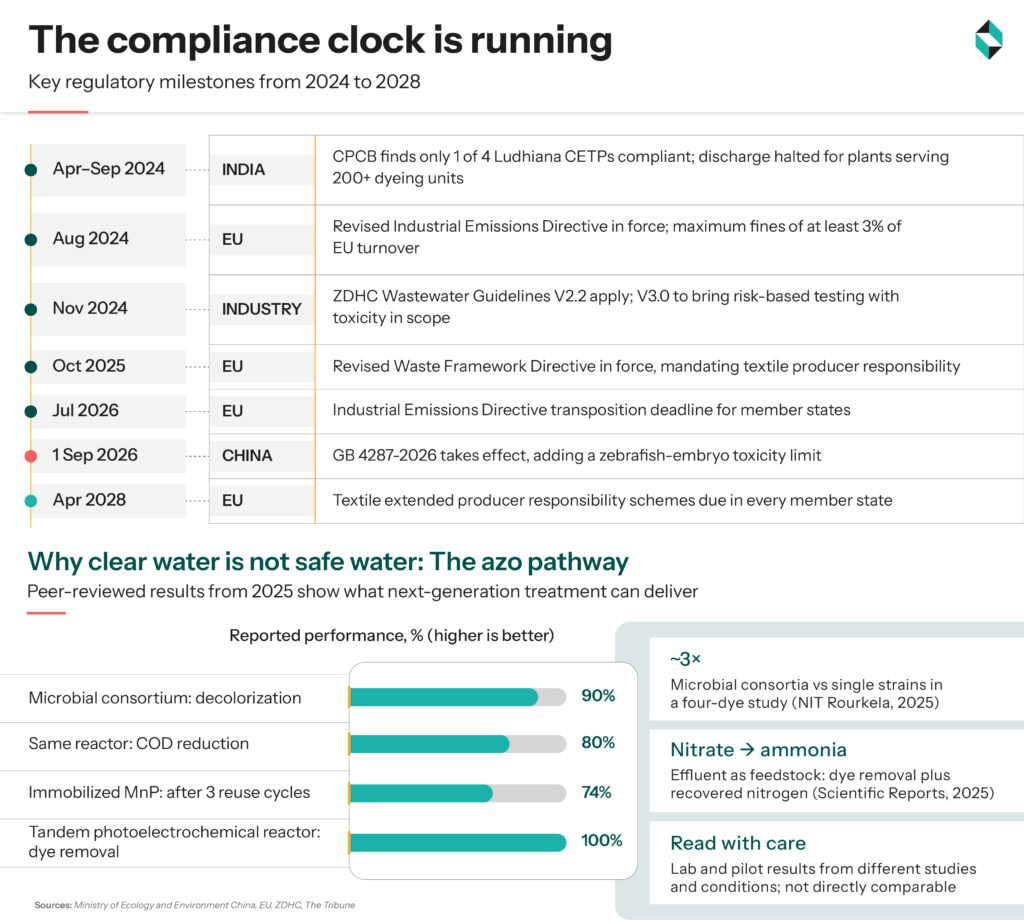
- India: The Central Pollution Control Board levied a USD 291,000 penalty on over 200 dyeing units when they failed to meet three out of four effluent discharge standards.
- The European Union: The revised Industrial Emissions Directive now requires environmental management systems at large installations, not less than 3% of annual turnover for serious breaches. The penalty will be sent to people whose health is negatively affected by violations as compensation.
- China: The GB 4287-2026 issued by the Ministry of Ecology and Environment consolidated a new discharge standard for the textile sector. The biggest highlight of this change is the addition of a new zebrafish-embryo acute toxicity limit. It means effluent could fail even after meeting every color and COD threshold.
Emerging Technology Frontier: From Removal to Recovery
Most conventional responses to these processes are unable to address this problem. Most physical and chemical treatments that produce sludge are costly. Ozonation, Fenton, and UV/H2O2 are effective; they are costly but may generate secondary contaminants. About 20% of dyes are lost during processing. But studies urge treatments that also address toxicity and COD along with color. Recent research outputs point in three directions:
- Data-driven Discovery: A review by Universiti Tanega Nasional demonstrated how machine learning can be used to predict photocatalyst performance from previous experimental data. It is accelerating the search for effective materials and also highlighting gaps in standardized datasets, along with cost assessment, that industry needs to close.
- Treatments that Promise Return: A tandem photoelectrochemical reactor can eliminate 100% of model dyes along with nitrate in the same water into ammonia. It is a lab-based experiment, but the principle is very significant commercially. It will allow companies to use effluent as feedstock instead of paying for it.
- Biology at Industrial Scale: A recent NIT Rourkela review demonstrated microbial consortia outperforming single strains. A consortium in a constant anoxic-oxic reactor achieved nearly 90% decolorization along with 80% COD reduction.
Who Is Building the Commercial Landscape of the Decolorization Economy?
- DyeRecycle: Working through a proprietary solvent platform that can extract dyes from post-consumer fabric waste and generates “spin-ready” decolored polyester and cotton as it recovers dyes for reuse.
- Indorama Ventures: They are working in collaboration with Jiaren Chemical Recycling to build a platform that includes “de-color” as a core process step in its chain of operation. This joint venture is aiming to reach up to 100, 000 tonnes of textile-recycled PET spinning capacity on a yearly basis.
- Viridis Research: Their electrochemical oxidation platform fully mineralizes organic contaminants without transferring them as a concentrate or sludge stream.
- Arvia Technology: They are commercializing the Nyes™ process, a system that couples an electrochemical oxidation system with adsorption via a graphite-based adsorbent, regenerated in situ by low current.
- Greenathon Technologies: They developed BIOZYME, a patented enzyme- and microbial-based formulation that biodegrades and detoxifies dye contaminants.
How Industry Leaders Can Translate It into a Competitive Edge
Industry leaders need to adopt a new set of priorities to reduce their exposure:
- Establish New Compliance Targets: Now, treatments against toxicity and COD need to be on top, keeping color as a secondary check. Commissioning whole-effluent toxicity testing before any regulatory or customer action would definitely be key to long-term advantage.
- Reprice the Investments: Compare expenditures on treatment against the risks associated with avoiding turnover-based fines, compensation claims, and cluster shutdown, instead of cost per cubic meter alone.
- Secure Control of Shared Infrastructure: Co-invest in upgrades, build dedicated capacities, and pick up governance roles in places where production relies on common treatment plants.
- Transform Performance Data into a Commercial Asset: Constant monitoring and auditable records place suppliers under risk-based testing and buyer due diligence.
Bottomline
The window of opportunity to act is narrowing for industry players. Before regulatory thresholds tighten any further, manufacturers must find answers to some critical questions:
- Is their effluent or the effluent of their suppliers merely colored or toxic? Depending on COD or visual data alone carries high risk.
- Is their compliance depending on assets that they do not control?
- How strong is their treatment strategy; does it mean to recover value only or avoid penalties?
The economics will favor those who act to gain first mover’s advantage. Capital commitments made now can be seamlessly structured, evaluated, tested, and de-risked. But capital committed after regulatory actions will be spent under pressure to align with others’ timelines. Companies working on these questions and addressing these concerns will align better with evolving regulatory frameworks, customers, and investors. Late movers will have to settle with terms dictated by others.
Where does Stellarix come in
From apparel brands to fabric processors, fibers, reverse logistics, and yarn, we are supporting players across the textile ecosystem. We are assisting leaders in moving towards value-generating, verified disposal systems. Our major areas of focus span dyeing and colorants, risk and compliance, technology scouting, sustainable textiles, operations, and cost optimization.
Looking for expert guidance on turning such challenges into a competitive edge? Connect with our Textile Industry consultants now.