South Korea’s AI Data Farms: The Hidden Infrastructure behind K-Tech
Executive Summary:
South Korea is swiftly weaving the backbone of its next-generation infrastructure. These upscaled, well-purposed data centers will power AI at a sovereign scale, catalyzing the nation’s shift to Industry 4.0. As Korea transitions from a manufacturing hub to a data-driven innovation powerhouse, this article examines the key drivers, strategic motivations, investments, government policies, and global implications of Korea’s ambition to become the premier AI infrastructure center of Asia. For global tech giants, Korea’s transformation offers unique market entry and co-development opportunities. To harness its impact, they must contribute to green infrastructure objectives, local data governance, and navigate the outsized positions of domestic and government champions of this landscape. As for Korean stakeholders, this initiative will reflect this nation’s scaling ability with global interoperability as they transform infrastructural investments into a lasting competitive edge.
South Korea is now a major player in the world of technology. Building AI data farms, the largely unseen engine behind AI capabilities, is becoming the next critical frontier in this industry. Countries that want to be technologically independent and competitive in the digital world need these big data centers that are made for AI tasks.
The country is becoming a global center for AI infrastructure, driven by its strong semiconductor industry, thriving ICT ecosystem, and government efforts to compete with China and the US. This goal is more than just a national plan; it means a change in industrial policy and continues the country’s long history of using technology to change the economy.
AI as the Core of the Fourth Industrial Revolution
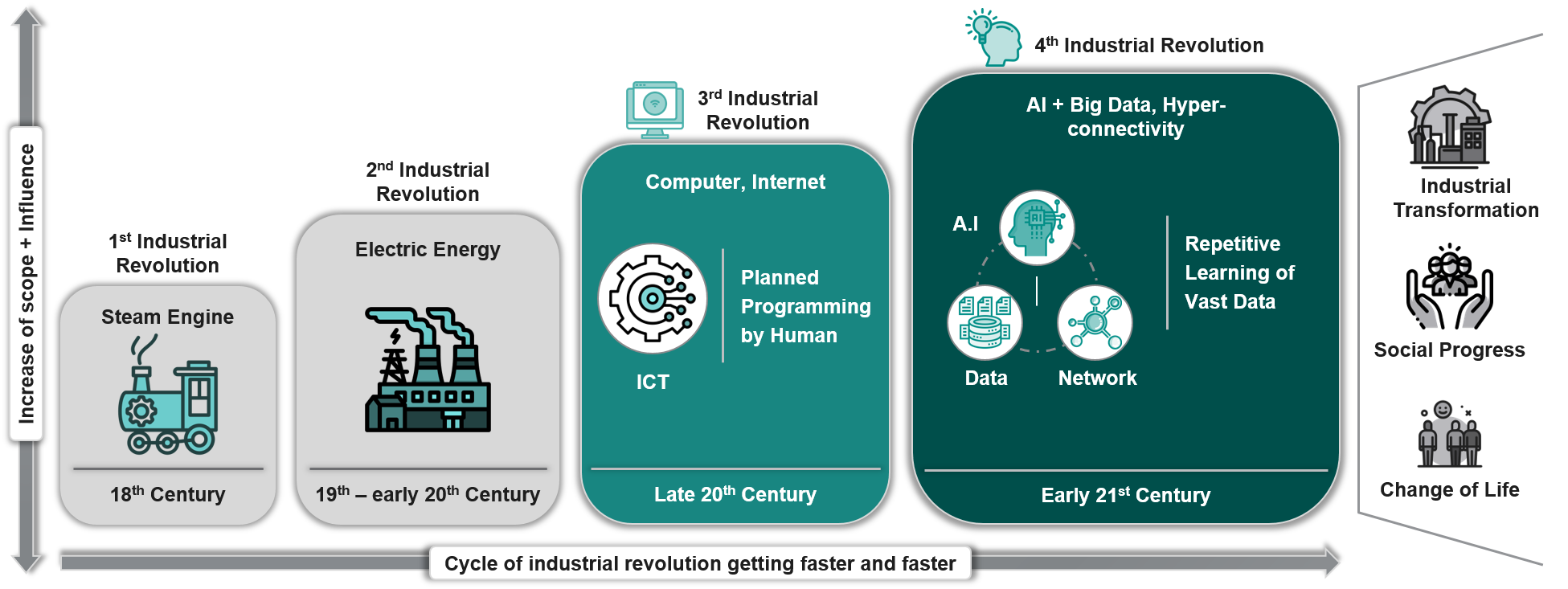
South Korea is really committed to intelligence. This is not happening on its own. It is an extension of the country’s industrial development. The Korea National Strategy for Artificial Intelligence from 2019 states that each industrial revolution has had a driving force.
- In the 18th century, steam power made machines work.
- Electricity drove mass production in the 19th century.
- Computers and automation in the 20th century reshaped industry, and
- Now, artificial intelligence, big data, and hyperconnectivity will drive the Fourth Industrial Revolution.
So, artificial intelligence data farms are not places where data is stored. They are like the factories that help make the economy smart. Just as steam engines powered the first factories, South Korea believes that artificial intelligence will power the industries of the future, like fueling autonomous systems, predictive manufacturing, digital twins, and smart cities.
This historical background shows that South Korea’s AI data farm plan is essential to its future industrial framework. The plan is to increase the country’s productivity and global competitiveness. It is not about technology but about growing the nation’s economy. The main goal is to make South Korea more globally competitive by leveraging an AI data farm.
South Korea’s Pursuit of AI Sovereignty through Data Infrastructure Leadership
South Korea wants to be independent when it comes to technology. This is why they are trying to build artificial intelligence data farms. Data independence is increasingly seen by government officials and business executives as essential to both economic stability and innovation leadership.
“AI competitiveness will be determined not just by algorithms, but by who owns and controls the data infrastructure beneath them”, said Minister of Science and ICT Lee Jong-ho in a policy speech in 2024. This statement reflects the national view that data is a fundamental component of sovereignty rather than merely a resource. There is a lot of inspiration in a number of areas:
- South Korea wants to reduce its dependency on foreign cloud giants like Amazon Web Services, Microsoft Azure, and Google Cloud. This can be done by building local data farms, so that sensitive public and industrial data can remain within the country. This will help keep the country’s cyber resiliency strong and more digitally independent.
- The country is also working on making its own artificial intelligence semiconductor ecosystem. Companies like SK Hynix and Samsung Electronics are already making memory chips and next-generation artificial intelligence semiconductors.
- Seoul has a plan called the “Digital Strategy 2030”, which aims to make the country the center of artificial intelligence in Asia. The plan is to connect the Indo-Pacific economy with cloud infrastructure that is environmentally friendly and scalable.
- They are also trying to be a leader in energy and the environment. New data farms are being built with more energy-efficient systems and better cooling, so they do not harm the environment. This is part of the country’s plan to achieve carbon neutrality by 2050, as outlined in the 2050 Carbon Neutral Roadmap.
South Korea’s efforts go beyond just building more data centers. It’s about using infrastructure to create digital sovereignty. This will ensure that Korean data supports the next generation of AI developments, which will be “Made in Korea”.
Current Landscape: Collaborations, Investments, and Accelerated Expansion
To achieve this vision, South Korea is executing a multi-front strategy that blends public investment, private sector alliances, and aggressive R&D in AI hardware and cloud computing.
- Government Support: The Ministry of Science and ICT is providing over $1.6 billion to Artificial Intelligence data infrastructure projects until 2027. This money will be used for high-performance computing, Artificial Intelligence data hubs, and green data centers.
- Private Company Partnerships: Big tech companies like Naver, Kakao, SK Telecom, and LG CNS are leading in expanding their businesses. Naver’s “Gak Data Center” in Sejong is already one of the most energy-efficient Artificial Intelligence facilities in Asia, and a second one in Chuncheon aims to handle petabyte-scale AI workloads.
- International Partnerships: South Korea is forming partnerships with companies from Japan and Europe to develop cooling and chip optimization technologies, showing Korea’s desire for scalability and sustainability.
- Merger & Acquisitions: SK Group is acquiring startups that specialize in Artificial Intelligence, cloud management, and liquid cooling systems. And LG CNS is investing heavily in tools that use Artificial Intelligence to manage data.
- AI Semiconductor Integration: A parallel push is underway to integrate AI-optimized chips into domestic data farms. Samsung’s H100-class Artificial Intelligence accelerators and SK Hynix’s high-bandwidth memory solutions are being customized for these centers to reduce costs and waste energy.
This cooperative model demonstrates South Korea’s distinct “compressed innovation” strategy, together with industry co-creation, government support, and startup flexibility. It makes it possible to move quickly from concept to national implementation.
From Stellarix’s viewpoint, this phase offers a great opportunity to find new technologies and build partnerships. Stellarix can help identify chances for collaboration among global AI companies, universities, and Korean tech firms. This will highlight opportunities for joint development and open innovation.
Government Initiatives: Policy, Infrastructure, and Ecosystem Enablement
The South Korean government has been methodical in creating a policy ecosystem that nurtures data sovereignty and AI growth simultaneously.
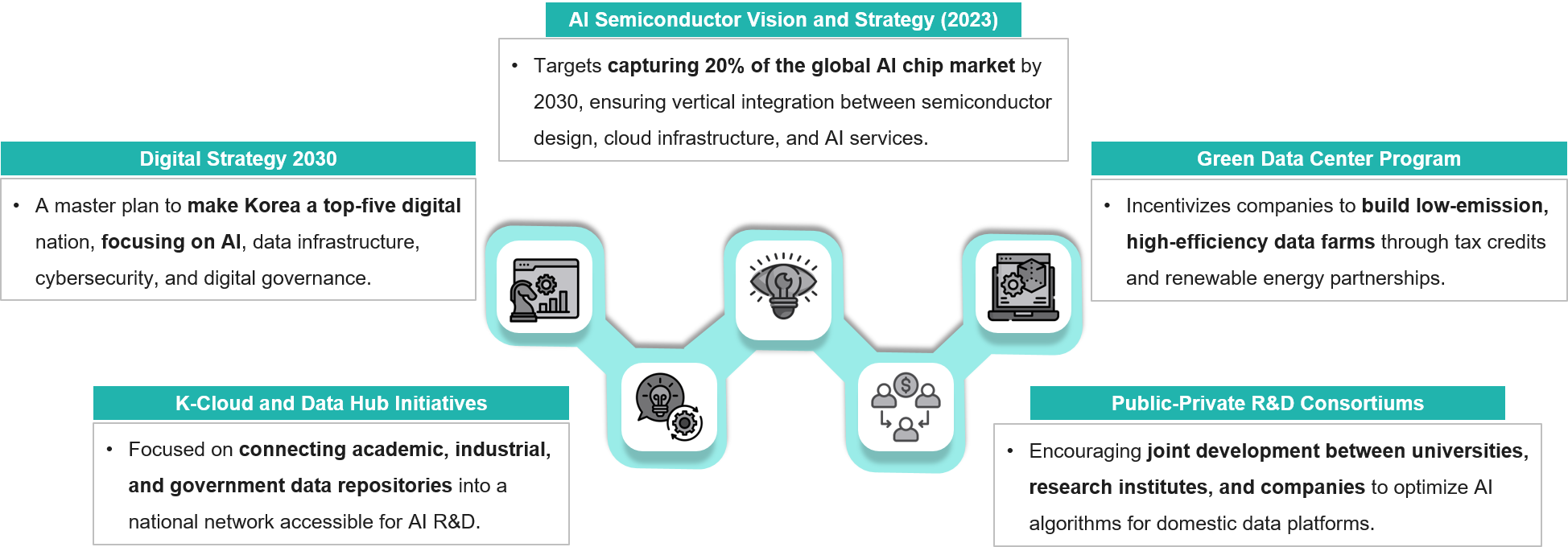
Key Policies & Initiatives
- Cloud Project: They announced this project in June 2023. The main goal of the project is to advance AI semiconductors (NPUs) and cloud services for data centers. The K-Cloud Project has a budget of approximately 826.2 billion KRW, to be used through 2030.
- AI Semiconductor National Project: This is a plan that will happen in stages. By 2025, apply NPUs; by 2026-28, integrate PIM (processing in memory); by 2030, target analog NVM-PIM architectures.
- Incentives for green data centers: It offers tax benefits and subsidies for data centers that use energy-efficient cooling. The government is also supporting data centers that use land and power in a way.
- Decentralization policy: This policy encourages people to build data centers outside of the Seoul metro area, like in Jeollanam-do and Ulsan. The goal of the decentralization policy is to help regions grow, reduce congestion, and take advantage of lower land and power costs.
All of these initiatives show that the Korean government is working hard to bring together industrial, environmental, and digital policies to achieve one common goal: making data the new infrastructure currency of the South Korean economy.
Strategic and National Gains: Building the Core of South Korea’s AI Future
The potential payoffs for South Korea are transformative, spanning economic, strategic, and societal dimensions.
- Strategic Gains: By securing control over its own data ecosystems, South Korea enhances its digital sovereignty and strengthens national resilience. The country can make its rules for how data is used, how private it is, and how artificial intelligence is used in a fair way. This means South Korea does not have to follow rules made by countries like the United States or China. This autonomy positions Korea as a neutral, trusted digital intermediary in an era of geopolitical tech rivalry.
- Economic and Industrial Benefits: Building farms for AI data farms brings a lot of economic spillovers. This creates demand for things like AI chips, cloud software, construction, and clean energy. The Korea Information Society Agency says that by 2030, the data center industry could add more than $40 billion to GDP. Moreover, AI-integrated infrastructure is expected to boost productivity in manufacturing, finance, and logistics sectors, where Korea already enjoys global competitiveness.
- Innovation and Employment Growth: The expansion of artificial intelligence data infrastructure creates a lot of jobs for skilled people in areas like engineering, data science, and training artificial intelligence models. This also helps anchor the startup ecosystem; companies working in intelligence analytics, cybersecurity, and data management now have a strong base in South Korea to build on.
- Global Influence and Technological Branding: South Korea’s success with “K-Tech” can be as popular as K-pop and K-culture. Having a strong artificial intelligence data industry makes the country look like a leader in innovation. This means South Korea cannot sell products to other countries, but can also share its ideas and rules for how artificial intelligence should be used.
In short, these strategic and national gains together reflect South Korea’s long-term plan to convert digital infrastructure into global influence, a transformation from being a manufacturing powerhouse to a data-driven innovation hub.
Global Perspective: How World Leaders See This
Global reactions to South Korea’s AI data ambitions are mixed but largely respectful.
Western IT firms view Korea as a key partner in developing Asia’s digital landscape, particularly in energy-efficient AI infrastructure. However, some hyperscalers view Seoul’s advocacy for “data sovereignty” as a covert strategy to shield domestic markets from outside influence.
United States
- Companies from the United States, like AWS, Microsoft, and NVIDIA, are working together in Korea. But Seoul’s focus on having its own computing resources shows that vendor relationships will change in the long term.
- For instance, NVIDIA has installed more than 260,000 GPUs in Korea, which shows that they are working well together.
China
- China sees Korea’s infrastructure development as a way to compete in the Asia-Pacific region, especially in AI and smart infrastructure exports.
- Korea could be a different place in the region where China can get cloud and data services.
Learn how China is reinventing high-density server cooling to power the next generation of regional AI infrastructure.
Japan & Asia-Pacific
- Japan is more willing to work with Korea, seeing it as a partner in semiconductors, AI infrastructure, and green data centers.
- A lot of countries in the Asia-Pacific might think that Korean infrastructure is a good alternative to dominate the U.S. and Chinese infrastructure.
To understand how Japan is restructuring its own tech footprint to build these regional networks, read about Japan’s shift from centralized computing to smart islands.
European Union: The EU expects compliance with data governance and AI ethics standards. Korea’s alignment with these frameworks boosts its global credibility.

In today’s changing global landscape, Stellarix can help companies assess the dynamics of international collaboration and competitive positioning. Our insights demonstrate how leading AI companies are responding to Korea’s rise by monitoring innovation across markets, global partnerships, and geopolitical data trends. It also identifies opportunities for technology licensing or strategic collaboration. This enables businesses to develop smart, globally adaptable AI strategies based on real-time insights.
Challenges: Infrastructure, Energy, and Global Competition
As South Korea races toward becoming a global AI infrastructure hub, it must overcome a number of obstacles. The scale, complexity, and pace of its ambition bring a new class of challenges, not just technological but structural, environmental, and human. The nation requires robust cybersecurity, sustainable energy systems, and trained personnel to maintain and enhance these intelligent infrastructures to build globally competitive AI data farms.
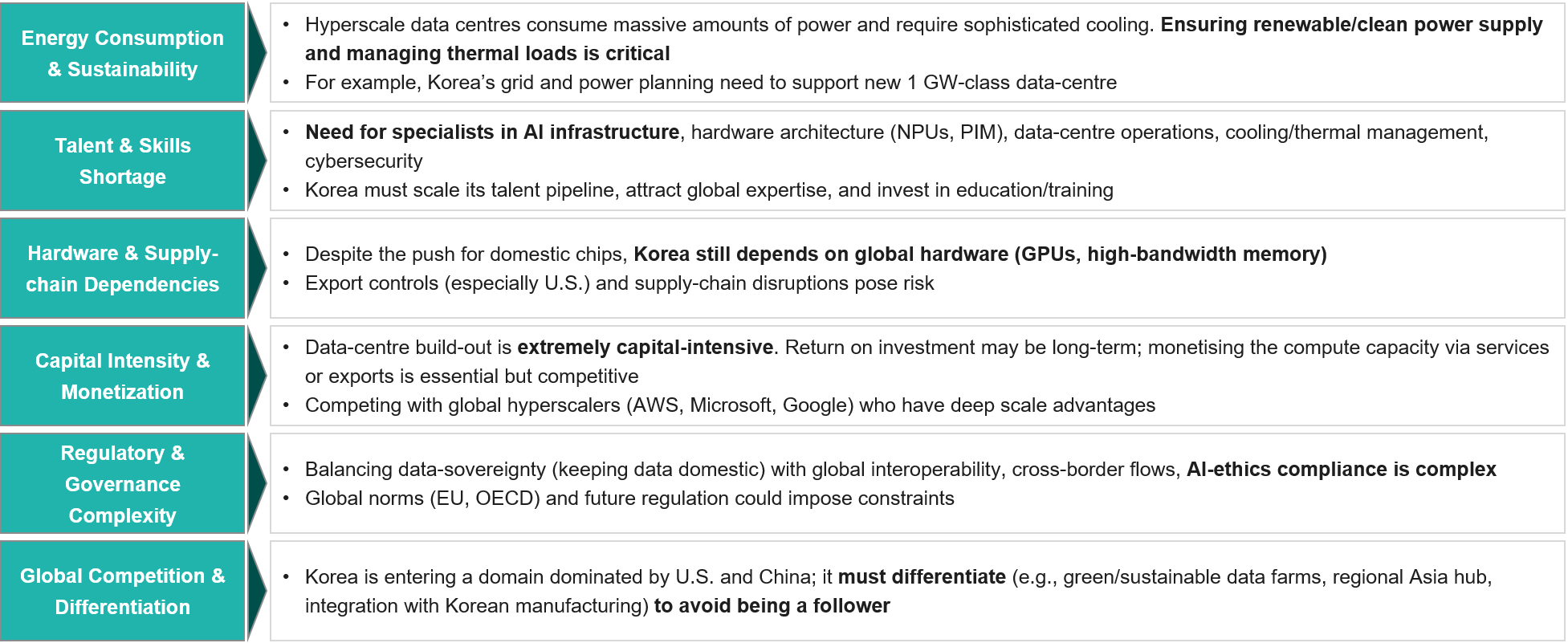
The lack of skill in South Korea must also be addressed, particularly in creating high-performance computers and AI systems. The nation must simultaneously protect its cybersecurity from ever-more-advanced threats. Resolving these problems will impact the country’s ability to transform its infrastructure into long-lasting innovation.
Future Outlook: Toward a Digitally Sovereign Korea
There are both opportunities and difficulties for South Korea’s AI data farms. The nation will redefine technical independence in the twenty-first century if it can strike a balance between growth and sustainability. Innovation will be driven by AI infrastructure, which will impact how industries operate, interact, and evolve.
- By the year 2030, Korea wants to be one of the top global Artificial Intelligence infrastructure hubs. This means Korea will have multiple gigawatt-scale data center campuses, domestic NPUs/PIM processors, and edge data center networks across regional Korea.
- Korea also wants to work with technologies like 6G internet connectivity, edge AI, self-driving cars, smart cities, and big collections of Internet of Things data. These things will be like the brain and nerves of Korea’s economy.
- Korea may become a regional AI-infrastructure export hub for Southeast Asia, the Middle East, and India.
- Korea wants to be a leader in green AI data farms. It can do this by cooling its big computers with renewable energy and finding ways to reuse the heat they produce.
- Collaboration with companies like NVIDIA, OpenAI, and AWS, as well as research centers from around the world, will help Korea shape how Artificial Intelligence is used and managed around the world.
Conclusion
South Korea’s evolution from semiconductor and electronics manufacturing to sovereign data and AI infrastructure signals its deliberate repositioning in the global tech market. The aim is to forge a scalable, integrated infrastructure ecosystem that becomes the foundation of its broader aspirations spanning mobility, advanced manufacturing, digital services, and AI/ML. However, as Gen AI, autonomous systems, and foundation models reshape its economics, the nation still needs to find ways to navigate intense competition, capital intensity, talent gaps, and energy constraints to get ahead in the global race. Success doesn’t hinge on scale alone but on interoperability, execution precision, and long-term sustainability. Stellarix is providing strategic support to data center operators, hyperscalers, and organizations looking to cut through technological, innovation, and business barriers. Our expertise is turning ambitions into an enduring competitive edge. As the AI data ecosystem of tomorrow is being built today, we are helping organizations position themselves with an upper hand for when the revolution arrives.
Let's Take the Conversation Forward
Reach out to Stellarix experts for tailored solutions to streamline your operations and achieve
measurable business excellence.