Beyond CRAC/CRAH to Immersion Cooling – How China is Reinventing High-Density Server Cooling

Executive Summary:
China’s data centers are shifting to advanced immersion and liquid cooling systems. These new systems promise lower water consumption, higher server density, and better energy efficiency. Pioneering efforts by market leaders like Alibaba are expanding China’s role in next-gen global cooling standards.
Chinese data centers are hitting a breaking point. The exploding AI workloads, growing density of GPU clusters, and unprecedented levels of computing power are making it hard for traditional air-cooling systems like CRAH and CRAC. What once worked for conventional server rooms is now becoming inefficient, energy-hungry, and increasingly unsustainable. In response, China is rapidly embracing a new generation of cooling technologies — from liquid cooling to full immersion systems — sparking a transformation that could redefine the future of high-density data centers.
Cooling has gone from being a basic service to an important focus area as China invests more in AI infrastructure and eco-friendly data centers. The switch from air cooling to liquid and immersion methods is part of a larger trend toward better efficiency, less water and energy use, and better heat management in densely populated areas. As things change, Stellarix helps businesses make decisions on cooling technologies, rules, and competitive strategies by giving them information about the market, reviews of technology, and ways to find partners. This method encourages smart decisions and ongoing growth in China’s booming data center industry.
The Market Landscape: Data Center Servers and Cooling in China
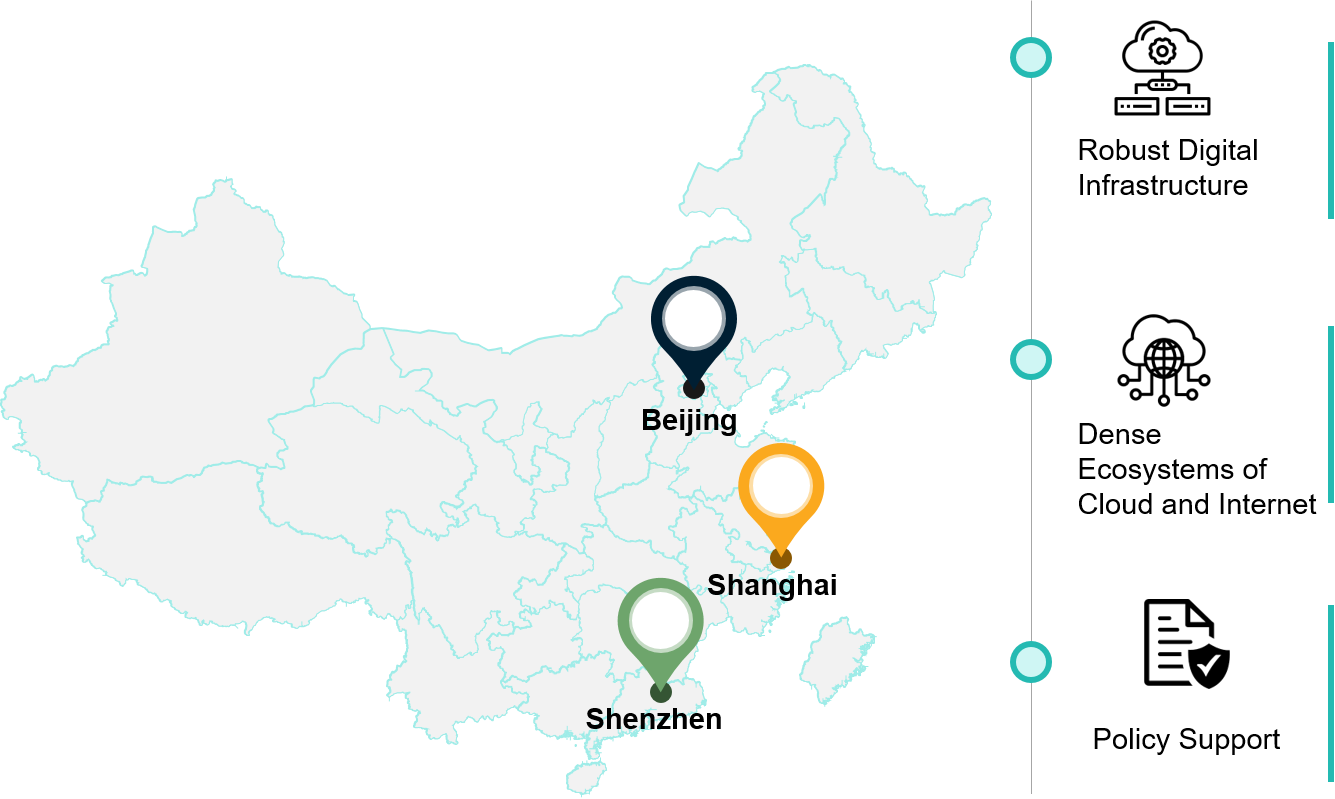
The market for data centers in China is growing rapidly due to the rise of cloud computing, AI, and high-performance computing workloads. China’s top data center hubs are a mix of strong digital infrastructure, strong cloud-provider ecosystems, and government-backed policy support. This shows how China is strategically spreading capacity and allowing long-term digital growth. As high-density servers, especially those with GPU acceleration, become more common, traditional CRAC and CRAH air-cooling systems are struggling to keep up. This is accelerating the adoption of more advanced liquid and immersion cooling systems to save energy, handle thermal loads, and meet national sustainability goals.
Growth Drivers
- The demand for cloud services in China is projected at 1.8 trillion yuan, with 600 million+ users, driving businesses to migrate online and increasing data center server requirements.
- China’s e-commerce market is projected to surpass 17 trillion yuan, fuelling demand for over 250,000 servers as major companies invest heavily in data center infrastructure to handle growing transactions and data.
- The Chinese government plans to invest over 1.5 trillion yuan in digital infrastructure, driving innovation, efficiency, and security, and supporting the creation of 350+ new data centers nationwide.
Cooling Market Momentum
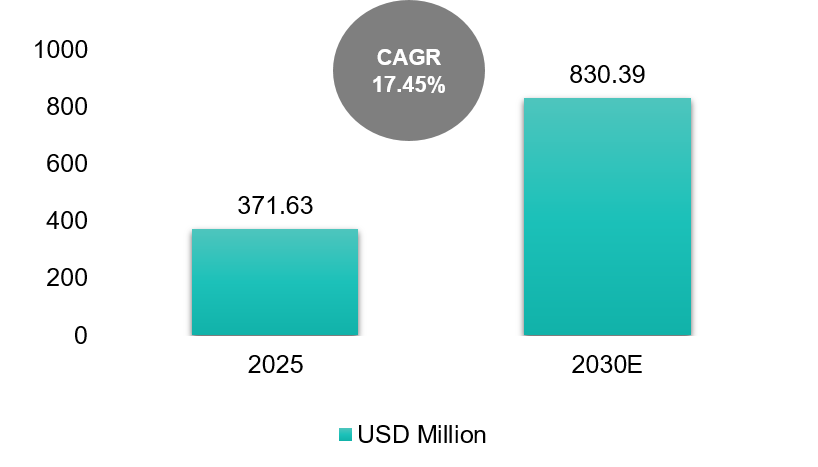
The China data center cooling market is expected to grow by 2030, reflecting a CAGR of 17.45%, driven by rising data center deployments and demand for efficient cooling solutions.
Driver Impact Analysis
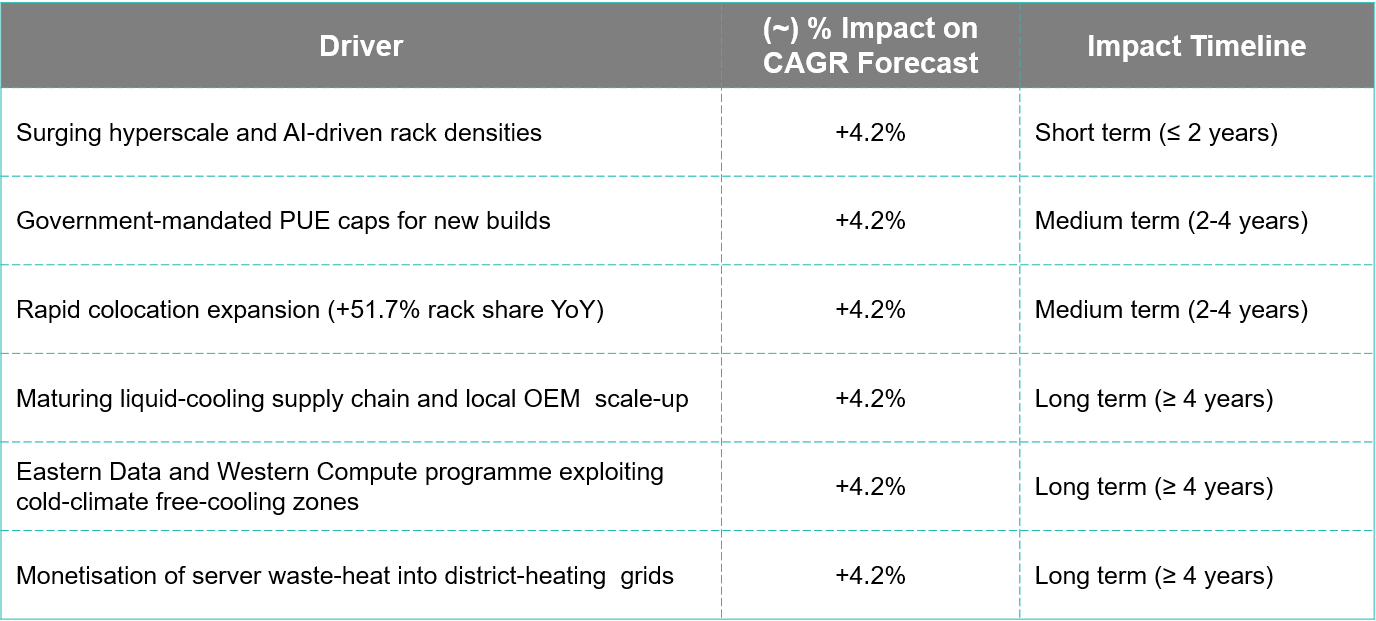
Several key factors are shaping China’s data center cooling market and influencing the CAGR over various time periods. In the short, medium, and long term, the market is expected to improve due to AI-driven rack densities, government PUE rules, colocation expansion, better cooling technologies, and efforts to use more sustainable energy.
The Air-cooled Era: CRAC and CRAH Systems
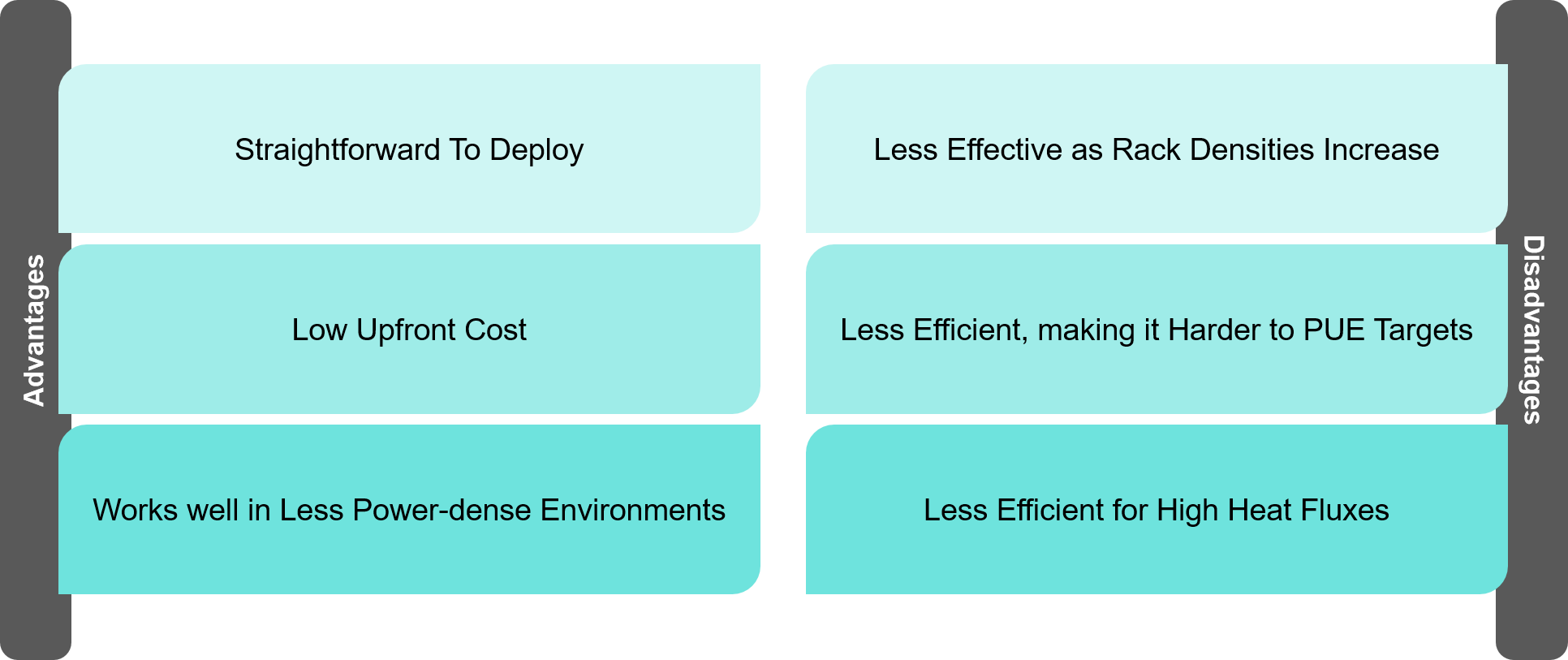
Traditional air cooling has been the most common way to control temperatures in data centers. This method uses cool air that moves through server racks to get rid of the heat that computers generate. Computer Room Air Conditioners (CRAC) or Computer Room Air Handlers (CRAH) take in warm air, cool it down, and then send it back out to the rest of the building.
Navigating the Shift to Liquid Cooling: Drivers behind China’s Transition
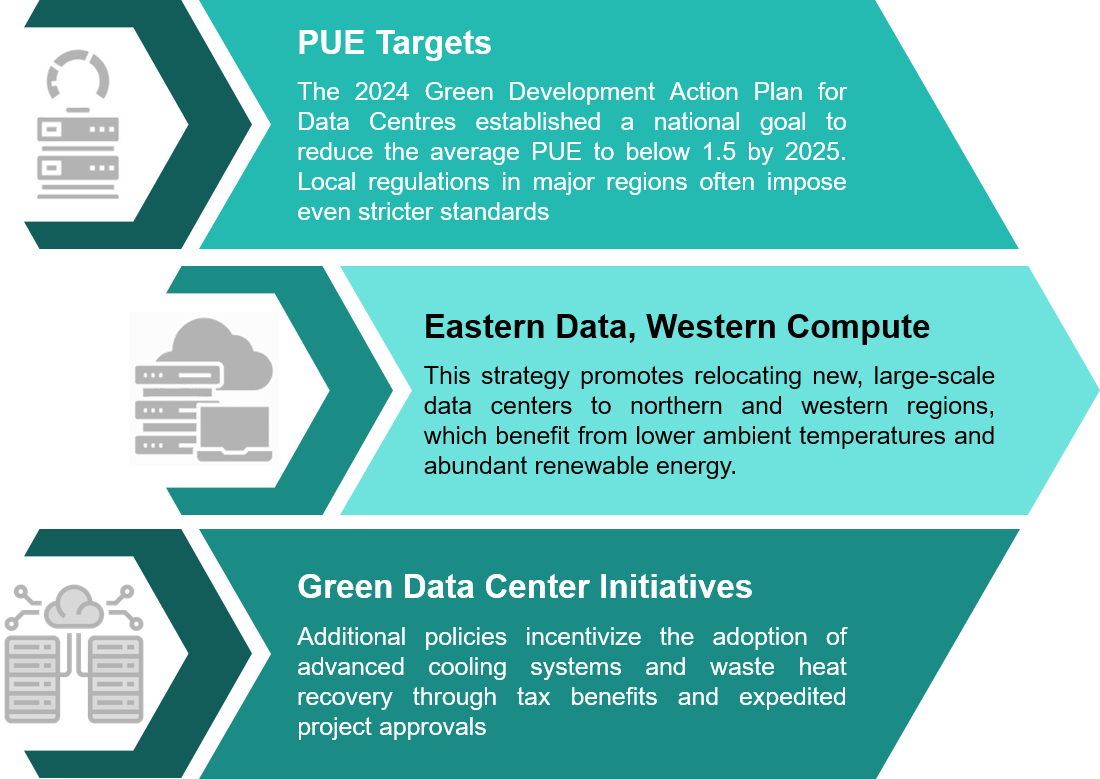
As data center workloads grow more intense, older air-cooling methods struggle to handle the additional heat. This problem led the industry to change how cooling is done, bringing it closer to where heat is produced. The utilization of containment methods and direct liquid cooling has been a big step forward because they remove heat more effectively and precisely than older methods. In China, direct-to-chip liquid cooling first became popular in supercomputing facilities like Sunway TaihuLight and other high-performance computing sites. It has now become the preferred choice for the country’s quickly growing AI workloads. Strong support from government policies has backed this shift since data center energy use is expected to rise by about 15% each year. This situation has led regulators to implement strict efficiency and sustainability requirements.
The Frontier – The Immersion Cooling Revolution
As demand for cloud services, especially for AI and crypto workloads, continues to grow, data centers are expanding quickly and consuming more energy. Nearly 1% of the world’s electricity is used by data centers, with around 40% of that used just for cooling. Immersion cooling is becoming a key solution. It goes beyond direct-to-chip liquid cooling by eliminating air entirely and submerging server components in thermally conductive, electrically insulating fluids for highly efficient heat removal.
Why China is Embracing the Immersion Bath?
The drivers for China’s push into immersion cooling are powerful and multifaceted:

Research Innovation
- Innovation: Next-Generation Data Center Cooling with Coal-to-Liquid Oil
- Brief: A specially formulated immersion-cooling fluid for data centers is mainly derived from a coal-to-liquid synthetic base oil. The fluid includes small amounts of low-viscosity hydrocarbons, pour-point depressants, antioxidants, defoaming agents, and metal passivators. This mixture provides excellent stability and viscosity at both high and very low temperatures, down to -40°C. This enables efficient heat transfer in immersion-cooled data center equipment.
- Assignee/ University: Fusi Lubricating Oil China CO. LTD., CN117050734A
- Challenges Address: When it’s cold, traditional cooling fluids can get too thick. When it’s hot, they can break down, make bubbles that can damage pumps, and corrode metals like copper and aluminum. PAO oils and other high-performance options are expensive, and fluorinated fluids are bad for the environment. Synthetic oil made from coal is a better option that solves these problems because it is cheaper, more stable, and safer.
- Output: The immersion cooling fluid that comes out is non-conductive, so it can safely contact other parts. It also has a low pour point, a high flash point, a low evaporation rate, and strong thermal properties. It transfers heat well, stays stable over time, and works reliably even in extreme conditions. It is also a cheaper option than traditional PAO and fluorinated fluids for large-scale immersion cooling deployments.
Key Player Ecosystem
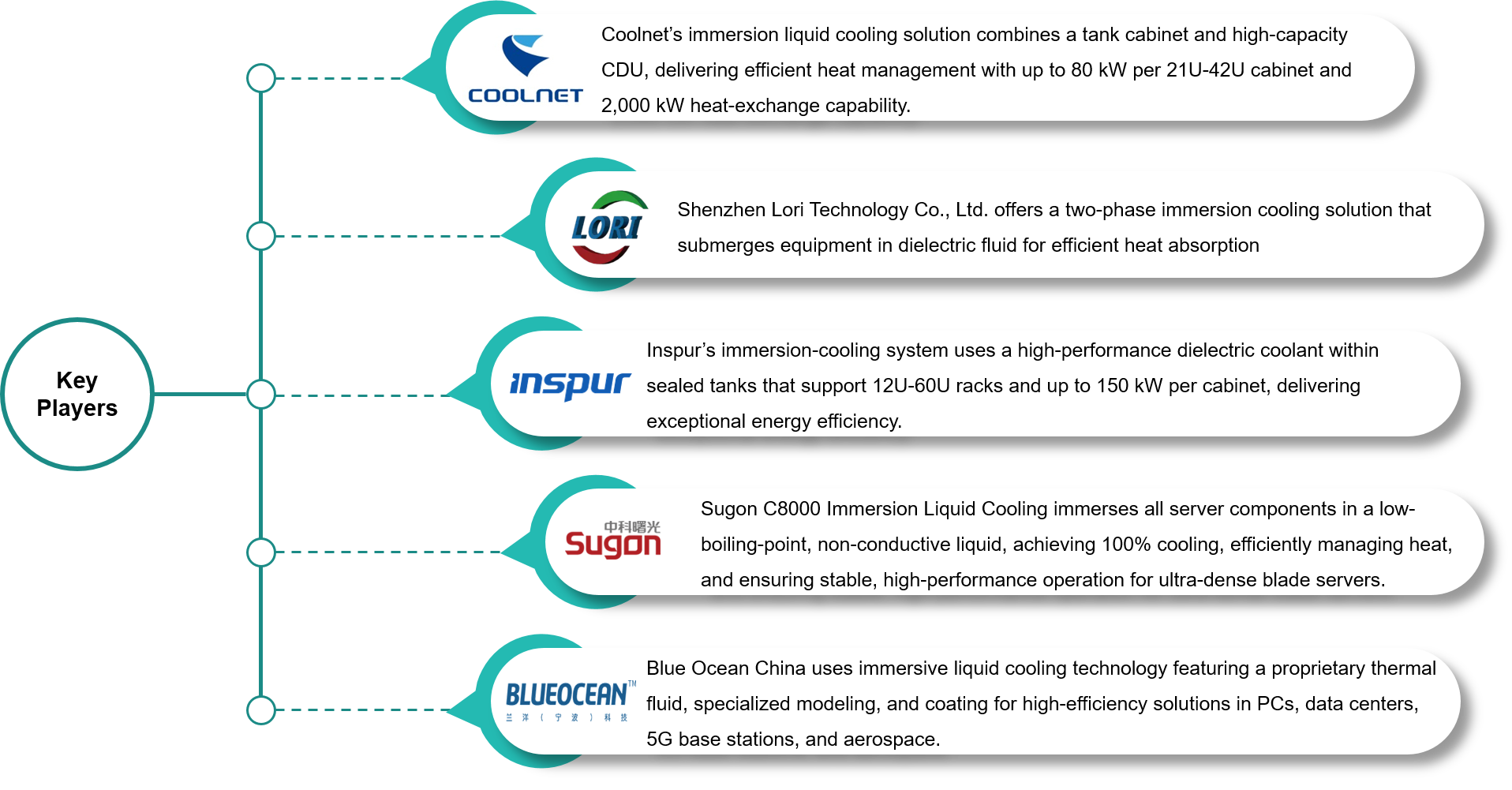
Below is an overview of the main Chinese companies offering immersion cooling technologies and solutions. Stellarix can use its focus on innovation in China to find and chart leading players, including Inspur and global experts like Güntner. It can also track emerging trends, such as AI-driven and fanless systems. By assessing technologies, reviewing suppliers, and backing joint innovation projects, Stellarix can provide detailed reports on technology use trends, energy savings, density improvements, and chances for strategic partnerships.
Chinese Innovation and Case Studies
- Inspur’s cold-plate and immersion-liquid systems are revolutionizing data center cooling. The cold-plate systems provide 15 kW–1.4 MW capacity with AI-driven controls achieving PUE ≤1.15. Immersion tanks can handle up to 150 kW per cabinet and accommodate racks ranging from 12U to 60U. This results in reduced PUE, improved energy efficiency, and increased power per rack.
- Since 2017, a leading e-commerce data center in Zhangjiakou, northern China, has successfully implemented immersion cooling, with Güntner (Germany) playing a pivotal role. The facility employs a “two-phase immersion liquid-cooling” system, in which servers operate in a liquid-filled chamber. Güntner’s V-shape VARIO Dry Coolers with hydroBLU™ deliver effective, high-performance cooling. They use very little water in normal conditions and switch to adiabatic cooling when more capacity is needed. This solution has achieved great results, cutting energy use by 95% and reducing cooling costs by 80%.
- A single-phase immersion liquid-cooling server cluster at Alibaba’s Winter Olympics Cloud Data Center is an example of sustainable innovation. Over 35% less energy is used when traditional air-cooling systems are removed, saving 200,000 tons of CO2 and 235 million kWh yearly for 100,000 servers. Fanless, sealed servers enhance density, are 50% more reliable, and are resistant to dust and vibrations. The cooling liquid has been stable for decades, and the floor area has been reduced by 75%.
Conclusion
China’s data center industry is leading a worldwide change in managing heat. The growing need for AI, cloud computing, 5G, and powerful computing tasks is driving this change. In places with many servers close together, traditional air cooling can no longer handle the heat. This is driving a shift toward better methods, such as submersion cooling and direct-chip-level liquid cooling. Government programs focused on cutting carbon emissions, protecting the environment, and saving energy strongly support this change. Data centers in Zhangjiakou are adopting new types of cooling liquids, alongside work by big companies like Alibaba. These advances show how China is helping to set global standards. By using less energy and fitting more servers into the same space, these improvements make China a leader in building powerful, eco-friendly data centers. Stellarix is helping data center companies navigate this shift towards direct-chip cooling and submersion by aligning energy density, efficiency, and regulatory leadership for the AI-driven era
Let's Take the Conversation Forward
Reach out to Stellarix experts for tailored solutions to streamline your operations and achieve
measurable business excellence.