The Rising Flavour Frenzy in Beverages

Flavor escapism is described as consumers’ desire for a new sensory experience that blends nostalgia, pleasure, adventure, and emotional stimulation. Essentially, it is a taste bud sensation that transports them to idyllic destinations without going there. This growing fanfare for new flavors has lately been a driving force in the beverage industry and is here to stay.
In this article, we explore emerging flavour categories, ingredients, and technology innovations driving them, their strategic implications, and how industry players could leverage the opportunities latent in these developments.
Globally Emerging Beverage Flavor Trends
There are noticeable differences in consumer behavior across generations. Gen Z tends to seek bold, adventurous flavors and combinations that are culturally inspired or creatively unconventional. In contrast, Millennials often prefer familiar flavors, especially those associated with health benefits, such as supporting digestion or boosting immunity. Emerging flavors like Yuzu Kosho, juniper, or sour cherry provide intense and unusual taste experiences. The global flavor market, valued at $19 billion in 2024, is expected to reach $24.96 billion by the end of this decade, growing at a CAGR of 5.03%. This robust growth is well reflected in the strongly growing consumer demand for healthy and novel sensory experiences. While this momentum is part of the bigger shift to sustainable consumption patterns, in this small space, there are a few drink flavours that stand out from the others:
Ready-to-Drink (RTD) Cocktails
RTDs are gaining strong traction due to their consistent quality, low variance, and convenience. In the U.S., they accounted for 17% of total consumers’ on-premise drink choices in 2024. Minimal ingredients, little prep time, and flavour variance are the USP of this category. The most enjoyed flavours include spritzes, margaritas, and Moscow Mules.
Nevertheless, longevity and flavor innovations are still gaps that demand a creative boost.
Nostalgic, Familiarity, and Reimagined Classics
There is a rise in innovations for comforting and nostalgic flavors that evoke memories and cultural touchstones. Familiar flavors offer emotional security and sensory grounding. Research indicates that 76% of consumers aged between 22 and 55 find nostalgic flavors in food and beverages reminiscent of childhood, offering a sense of comfort during uncertain times.
Beverages with spicy-sweet notes and reimagined classics have a vast global fan base. There is a growing craze for blending traditional flavour profiles with exotic twists. For instance, banana pudding martinis, berry-driven hydration, PB&J granola bar blends, and Central American and Southeast Asian flavours are being featured increasingly on menus worldwide.
Pickled, Fermented, and Umami Notes
There is growing experimentation with spices, savory, and umami-rich ingredients to lend more depth and complexity to beverages. Flavours at the top of the list are kimchi, miso, and umami, especially in the USA. More than 60% of consumers reported a growing preference for umami flavors in the last year.
Climate-Resilient Ingredients
International influences are reshaping the menus. From global to local flavors, consumers are eager to explore both the familiar and the foreign. Exposure to cuisines through travel, media, and migration has brought flavors like matcha, lychee, tamarind, etc., into the mainstream.
To address supply chain risks and embrace the “glocal” approach, new taste profiles emerging from drought-resistant crops include Asian moringa, African baobab, fonio, teff, sorghum, bambara groundnut, and breadfruit.
Functional and Wellness-Inspired Flavors
There is a growing inclination towards developing a taste for flavours related to wellness, such as those extracted from herbs, natural antioxidants, and plant-based ingredients. Most of these are teamed with claims of better functional benefits or enhanced nutritional value. Imaginative flavor concepts inspired by galactic or tropical motifs are rapidly gaining traction, especially among younger target groups. Ex: Gut-healthy fermented flavors, Hydration innovations, nootropics, etc.
Plant-Based and Natural Flavors
Plant-based specialty ingredients, botanical extracts, and essential oils are becoming integral to beverage ingredients, helping brands cater to the demand for natural, clean labels and sustainably produced products. Leading brands like The Coca-Cola Company, Nestlé, and Danone are already leading the way by expanding their product lines into this category.
Imaginative and Fantasy Flavors
The younger generation is more inclined towards playful and stunning flavors, such as “Unicorn” and “Rainbow” in the energy drinks and beverages category.
Industry Impact and Product Line Shifts
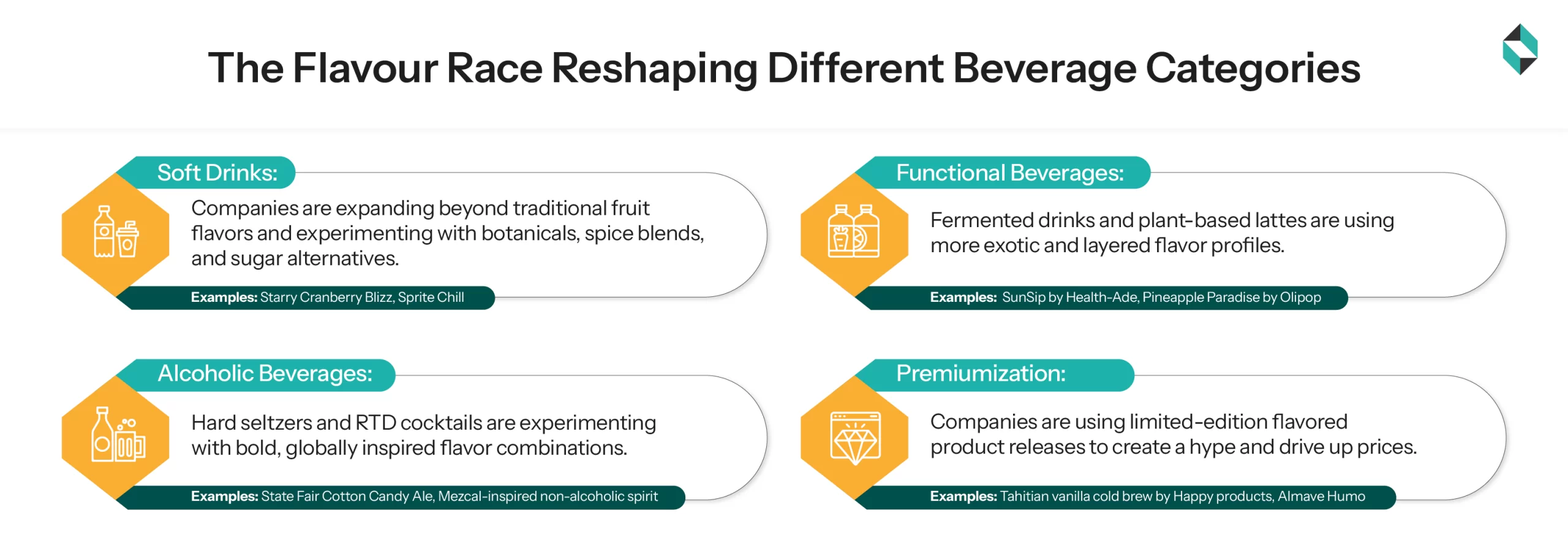
The beverage industry has seen an accelerated shift in flavor innovation, treating flavors as fast fashion. The companies have moved from annual launches to rapid, limited edition cycles, forcing R&D teams to work shorter timelines and supply chains to adapt quickly. Boundaries between beverage categories are also blurring as flavor migrates across different product lines. This is redefining consumer engagement. Functional beverages use flavor as the hook for health benefits, as that makes wellness more approachable.
Technological Advancements Driving Flavor Innovation in Beverages
Artificial Intelligence
Artificial intelligence (AI) can help tackle various aspects of sustainability in the food chain, including flavour innovation. It holds strong potential in enabling the creation of unique, personalised taste experiences and niche products. It is swiftly transforming the flavor development arena in both the food and beverage industries. AI systems can rapidly sift through vast datasets of sensory information and chemical compounds to propose novel flavors. Most of these platforms utilize machine learning to identify optimal ingredient pairings, generate new flavors, and accelerate the innovation process through faster iterations, precisely targeted experimentation, and reduced resource wastage in trials.
- Real-world Applications: Firmenich, one of the world’s first companies to create natural beef flavors using AI-ML algorithms, introduced one of the world’s first AI-created natural beef flavors in plant-based beverages. Similarly, Coca-Cola’s Y3000 Zero Sugar beverage is another notable example of the rising adoption of AI in flavor innovation.
Precision Fermentation
A total game changer, precision fermentation has opened doors in several categories of innovation, including flavor. They enable companies to create natural ingredients that are rare or premium in nature, proving very beneficial for flavor innovation. The integration of this biotechnological approach is aiding in addressing consumer demand for unadulterated, natural ingredients while meeting sustainability concerns and providing a promised competitive edge for early adopters.
- Real-world Applications: EvoDiaBio has been utilizing precision fermentation to create the aroma molecules of hops, enhancing the flavor of their non-alcoholic beer. Similarly, the EVERY company and Perfect Day are producing animal-free dairy and egg proteins using this process, which can be incorporated into beverages in the near future. Other notable players include Fonterra and DSM-Firmenich.
Microencapsulation Technologies
Microencapsulation technologies promise enhanced stability, controlled flavor release, improved efficiency, and sustainability. They have achieved unprecedented efficiency improvements, yielding a 93.43% encapsulation yield for flavor compounds. They enclose the sensitive or volatile flavor compounds and secure them from degradation that may result from oxidation, moisture, or heat. Not only can this technique mask unpleasant flavors, but it can also enhance overall taste. The most common methods include low-temperature, coacervation, and drying encapsulation, paving the way for diverse applications in both liquid and powdered formats. It empowers brands to deliver innovative, tailored, and consistent flavors, pushing the boundaries of beverage design.
- Real-world Applications: Sensient Technologies, Firmenich, International Flavors & Fragrances, and Givaudan have notably employed microencapsulation techniques for flavor innovation.
Advanced Extraction and Enhancement Techniques
A myriad of advanced extraction technological approaches, including supercritical fluid extraction, enzyme-assisted extraction, microwave-assisted extraction, ultrasound-assisted extraction, and pressurized liquid extraction, are also being adopted by beverage manufacturers to improve flavors.
- Real-world Applications: DSM-Firmenich, Kerry Group, Givaudan, Simrise, Dohler, Coca-Cola, and Pepsico have adopted these technologies for novel flavor extraction.
AI-Based Electronic Tongues
Electronic tongues powered by AI algorithms are helping manufacturers personalize products to meet specific consumer preferences. These models analyze chemical configuration while predicting consumer resonance, speeding up the formulation iteration process.
Gastrograph AI
Gastrograph AI is a predictive sensory analytics platform capable of mapping human taste preferences and developing precise flavours customized to individual perception. This approach has been valuable in addressing personalized nutrition requirements and taste impairments.
Nanotechnology Integration
The integration of nanotechnology is equipping e-tongues to examine textural elements, representing a significant advancement in beverages’ ability to synergize taste profiles and mouthfeel characteristics.
Evolving IP Landscape
The beverage industry has showcased active patent momentum across several innovation categories in this context:
- In the last two years, International Flavors & Fragrances (IFF) has filed the most patents and is currently leading the pack. As of June 2025, more than 50% of patents filed by this organization remain active
- Kerry Group has also been very active in this space with a specific focus on sugar-reduction tech, natural flavor systems, and “swicy” blends
- Givaudan has also been active with its AI-driven flavor pairing approach and sustainable sourcing techniques
- Other active players include Symrise, Firmenich, Tate & Lyle, and T.Hasegawa
Strategic Recommendations for Competitive Edge
Industry players looking to take a lead in intense market competition must prioritize:
- Technology Integration: Higher investments in AI-driven flavor development platforms, along with advanced analytical capabilities, are the need of the hour
- Regulatory Preparedness: Navigating evolving regulatory frameworks that emphasize clean-label and natural ingredient integration requires enhanced capabilities. Companies must work to build and improve their strength in this area.
- Innovation Agility: Rapid prototyping, iteration, and testing capabilities will be differentiating factors
- Sustainability Leadership: Implementation of biotechnological solutions to put ethical and environmental concerns to rest is a must.
The Startup Ecosystem
- Liquid Death: They are focusing on bold branding and receiving lots of traction for introducing new flavors in iced teas and sparkling waters. The company targets young consumers and has been a favorite for its unexpected flavor offerings.
- Remedy Organics: Their primary offerings include functional smoothies and plant-based juices. Their beverages include trendy healthy ingredients and sleek packaging targeting wellness-oriented consumers.
- Coolberg: They offer non-alcoholic craft beers with a wide range of flavors extending from strawberry to peach, cranberry, ginger, etc.
- Weller: They are known for their CBD-infused sparkling beverages, zero-sugar bold drink flavors like black cherry, watermelon, and tangerine.
Bottom Line
Flavor innovation is rapidly growing to become a market differentiator that will be the key to winning the new competitive battleground. While companies are gearing up to adopt regulatory compliance frameworks, technological convergence, and evolving consumer perceptions, their ability to turn these elements into operational excellence will decide their position in this race. A rapid innovation cycle can lead to flavor fatigue, which overwhelms the consumers, reduces the demand, and declines repeated purchases. Technology such as AI-assisted flavor development will play a vital role in identifying the niche combinations that resonate with people. Companies that can address the demand and use their ability to turn these elements into operational excellence will secure a strong market position in the sector.
Let's Take the Conversation Forward
Reach out to Stellarix experts for tailored solutions to streamline your operations and achieve
measurable business excellence.