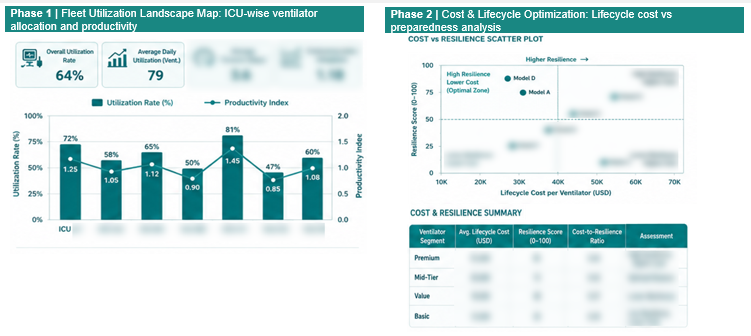

Client Background:
The client operated across hospital networks and made substantial investments in ventilators and critical care infrastructure, requiring effective asset deployment, maintenance, and reserve-capacity management.
Challenges:
- Limited centralized visibility into ventilator utilization, allocation, and lifecycle status across hospital sites.
- Uneven asset deployment and excess reserve inventory affecting fleet productivity.
- Rising maintenance costs, service-contract expenses, and spare-part dependency.
- Need to balance cost reduction with equipment reliability and surge preparedness.
Engagement Objective:
The engagement aimed to evaluate ventilator fleet performance, identify cost and deployment inefficiencies, and develop a scalable optimization roadmap that balanced operational efficiency with long-term ICU capacity resilience.
Approach:
The study combined secondary research, expert interviews, and operational benchmarking to assess fleet efficiency and critical care preparedness by:
- Benchmarking ventilator utilization, reserve inventory, and deployment patterns across hospital sites.
- Evaluating maintenance expenses, service-contract structures, and refurbishment versus replacement opportunities.
- Examining supplier dependency, spare-part availability, and equipment obsolescence risks.
- Modeling critical care demand scenarios to assess reserve capacity and infrastructure requirements.
Solutions Offered:
- Cross-site assessment of ventilator utilization, deployment efficiency, and reserve capacity.
- Lifecycle cost analysis covering maintenance, service contracts, and replacement decisions.
- Identification of underutilized assets and opportunities for redistribution across hospital networks.
- Assessment of supplier, spare-part, and equipment obsolescence risks.
- Scenario-based fleet optimization roadmap to support cost-efficient ICU preparedness.
Client Impact:
- Reduced excess ventilator inventory and improved fleet allocation by identifying underutilized assets and ICU deployment gaps.
- Improved visibility into ICU infrastructure utilization, fleet readiness, and lifecycle performance through cross-site benchmarking.
- Optimized maintenance, service-contract costs, and spare-part management by assessing lifecycle costs, supplier risks, and equipment reliability.
- Strengthened surge preparedness through scenario-based capacity planning, reducing expansion risks and improving critical care resilience.
Outcome Snapshot: