
Client Background:
The client is a global solution provider in the industrial automation domain
Challenges:
- Achieving low latency and minimal packet loss in real-time industrial process and motion control applications.
- Achieving low latency in 5G to minimize delay and finding digital modeling solutions to improve real-time industrial processes and motion control.
- Identifying technology solutions to improve latency and packet loss performance in industrial automation and other domains such as autonomous vehicles, surgical robots, and drones.
Engagement Objective:
The primary objective is to find solutions for low latency and minimal packet loss in real-time industrial process and motion control applications. The client also wanted to explore how to achieve low latency in 5G to minimize delay and to find digital modeling solutions to improve real-time industrial processes and motion control. Further, there is a need to identify technology solutions to improve latency and reduce packet loss in industrial automation as well as in other domains such as autonomous vehicles, surgical robots, drones, and others.
Approach:
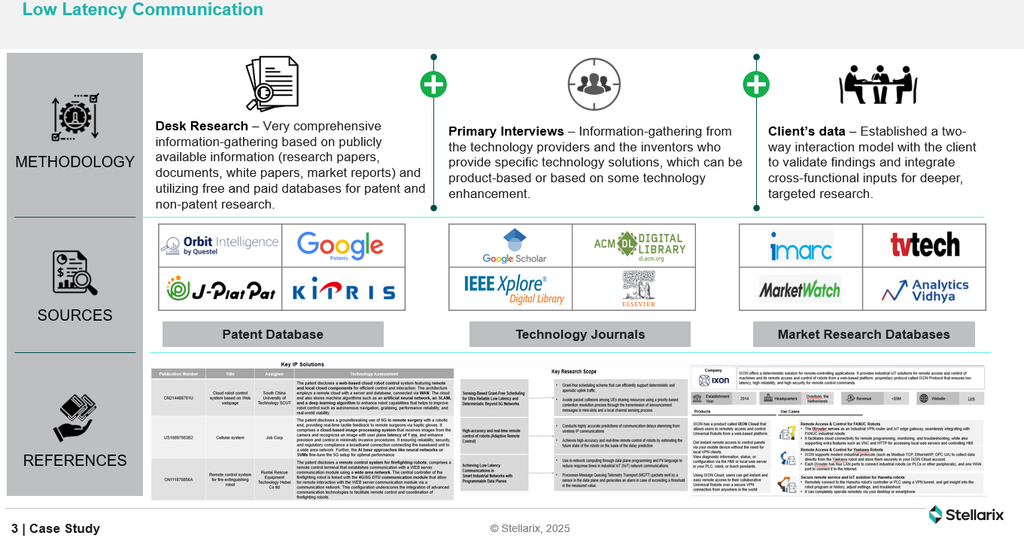
The Stellarix team conducted in-depth research to identify solutions to the client’s challenge:
- The study was conducted across databases covering patent and non-patent literature, secondary sources, and more to identify technology solutions for low latency and minimal packet loss over the WAN (e.g., 4G, 5G) in industrial automation as well as other application domains.
- The identified solutions were further analyzed in detail to identify the top solution that can be employed for real-time industrial process and motion control applications.
Solutions Offered:
- The study helped the client identify whitespace for low-latency, minimal-packet-loss real-time industrial process and motion control applications.
- The study benefited the client by providing business, bibliographic, and technological insights. In addition, a detailed overview of potential solutions to existing challenges helped the client define the right direction for the research and development team.
- The client also identified potential players and universities in the domain with whom they can further establish joint operations/acquisitions to develop solutions that achieve low latency and minimal packet loss in 5G networks, enhance the company’s presence in the industrial market, and gain an advantage over competitors.
Outcome Snapshot: