
Client Background:
The client is a global industrial component manufacturer.
Challenges:
- Mapping adjacent application areas beyond steering and braking where electric actuators are gaining traction.
- Tracking major sub-applications being developed by leading players.
- Understanding the trends, innovations, and business activities influencing current and future adoption.
Engagement Objective:
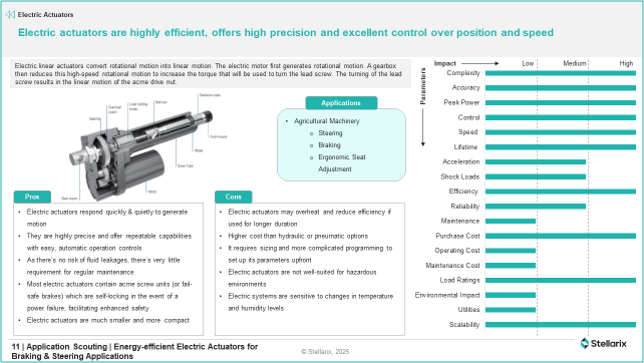
The objective of the study is to conduct an application scouting engagement focused on evaluating the use of energy-efficient electric actuators across critical automotive functions specifically steering, braking, and ergonomic seat. It includes:
Identification of adjacent application areas beyond steering and braking where energy-efficient electric actuators are gaining traction
- Major sub-applications being developed by leading players in this space
- Key industry trends, recent innovations, and business activities influencing current and future adoption
- Future scope for actuators in enhancing performance, efficiency, and vehicle system integration
Approach:
The team at Stellarix engaged in:
- Identifying high-potential sub-applications across steering, braking, and ergonomic seating.
- Exploring cross-application opportunities beyond automotive, such as aerospace and industrial robotics.
- Defining the technical specifications needed to replace hydraulic and pneumatic systems.
- Assessing key technology gaps and priority areas for R&D investment.
- Benchmarking existing actuator prototypes against leading competitors.
Solutions Offered:
- Detailed assessment of application areas for energy-efficient electric actuators.
- List of applications and sub-applications along with technical specification requirements.
- Mapping of sub-applications with functional use cases and emerging technology trends.
- Competitive intelligence and investment insights.
- Executive summary highlighting key sub-applications, technical specifications, and adoption potential.
Client Impact:
- Insight into advanced solutions such as TiMotion’s electric linear actuators, known for delivering precise, smooth, and quiet motion, enhancing vehicle control and operator comfort.
- Identification of industry best practices, including customized configurations, smart monitoring, and bus communication protocols that improve safety and user experience.
- Forward-looking perspective on future trends, such as integration with power electronics, smart control systems, and adaptive features for improved stability, versatility, and reliability in next-generation vehicle systems.
Outcome Snapshot: