

Client Background:
A global vision-care and ophthalmic products company engaged in the development and manufacturing of contact lenses and lens-care solutions focused on sustainable materials, packaging, and circularity.
Challenges:
The client was facing a strategic challenge in identifying sustainability opportunities across the contact lens value chain, as emerging materials, recycling solutions, and manufacturing innovations were fragmented and lacked clear insight into which approaches were technically feasible, commercially viable, and capable of delivering meaningful environmental benefits.
Engagement Objective:
The engagement worked to assess and identify sustainability opportunities across the contact lens value chain to evaluate recycling approaches, industry initiatives, patents, and emerging technologies. It spanned from materials to manufacturing, packaging, as well as end-of-life management. Our team needed to outline the approaches that were:
- Commercially viable
- Capable of delivering meaningful environmental benefits
- Provider of a structured evidence base for further evaluation of sustainable technologies and circular opportunities
Approach:
Our consistent technology assessment methodology included:
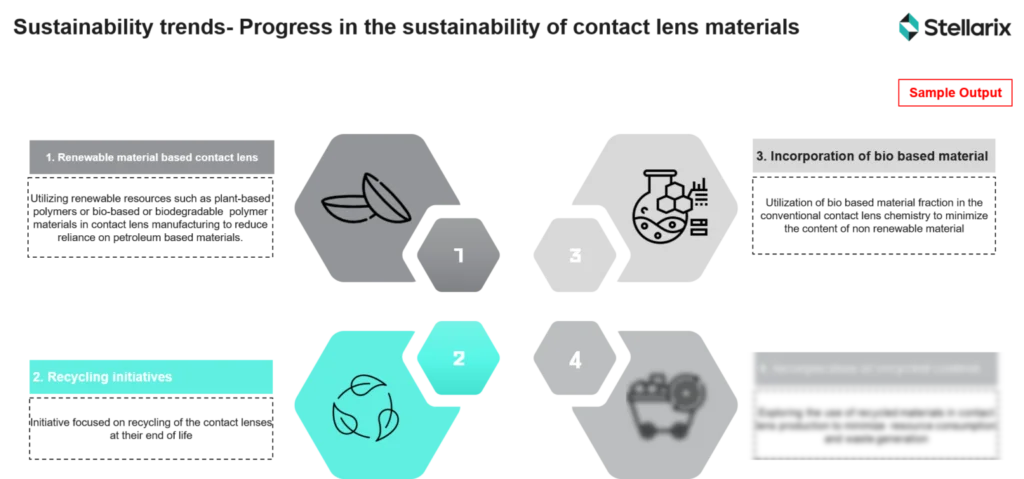
- Conventional Material Baseline: Mapped conventional contact lens materials and the relevant associated environmental complications to judge sustainability options against the defined set of problems.
- Value Chain Strategy Segmentation: Investigated emerging technologies, industry initiatives, and patent filings across every single category to evaluate adoption trends and innovation activity.
- Material Deep Dive: Built a detailed technology profile of a cellulose-based hydrogel contact lens, preparation methods, mechanical properties, biodegradability, and supporting publication evidence.
- Evidence Triangulation: Cross-referenced patent claims against industry announcements and published literature to examine if the stated performance and sustainability benefits were validated by verifiable evidence.
Solutions Offered:
The team at Stellarix :
- Mapped conventional contact lens materials and associated environmental challenges, including plastic pollution, resource consumption, and end-of-life disposal.
- Categorized sustainability strategies across the value chain and researched emerging technologies, patents, and industry initiatives to assess innovation and adoption trends.
- Developed a detailed technology profile of a cellulose-based hydrogel contact lens, capturing material composition, preparation methods, biodegradability, mechanical properties, and supporting patent and publication evidence.
- Final outputs included a structured discussion document presenting the sustainability landscape, emerging technology developments, and industry initiatives to support the identification of potential sustainability opportunities in contact lenses.
Client Impact:
- Sustainability Opportunity Landscape: Mapped key sustainability opportunities across contact lens materials, manufacturing, packaging, and end-of-life management to unlock actionable decarbonization and waste-reduction opportunities.
- Technology and Initiative Benchmarking: Assessed emerging material innovations, recycling approaches, patents, and industry initiatives to identify promising sustainability solutions
- Strategic Sustainability Enablement: Provided a structured evidence base to guide further evaluation of sustainable technologies and circularity opportunities across the contact lens value chain.
Outcome Snapshot: