

Client Background:
A diversified specialty chemicals company planning to assess future growth opportunities in textile chemistry amid evolving industry challenges and a rapidly changing innovation landscape.
Challenges:
- Higher Cost of Operations: Increasing operational costs across printing, dyeing, and finishing are narrowing investment capacities and compressing margins for next-gen chemistry.
- Energy and Carbon Footprint: High energy consumption during drying, curing, and steam-based finishing; requirement for lower-temperature curing technologies and need for bio-based ingredients and lower-carbon processing.
- End-of-Life & Recycling Challenges: Dyes and finishes are not designed for removal during recycling. Color contamination impacts mechanical recycling quality. Incompatible finishes affect fiber quality in closed-loop recycling. Less than 1% of textiles are recycled into new textiles today.
- Water & Wastewater Burden: Approximately 20% of global industrial water pollution originates from textile treatment and dyeing.
- Sustainable & Compliant Chemistry Transition: More than 70% of major apparel brands have announced PFAS phase-out commitments by 2030.
Engagement Objective:
The company lacks a consolidated understanding of emerging solution pathways and persistent technical gaps across functional dyes, pigments, and chemicals, limiting its ability to prioritize R&D investments and identify differentiated product opportunities.
Approach:
To build an analytical foundation through structured secondary research and a consistent TRL-based assessment foundation, our team at Stellarix:
- Assessed the major challenges associated with the transitional dyeing and printing processes along with their implications on the textile sector.
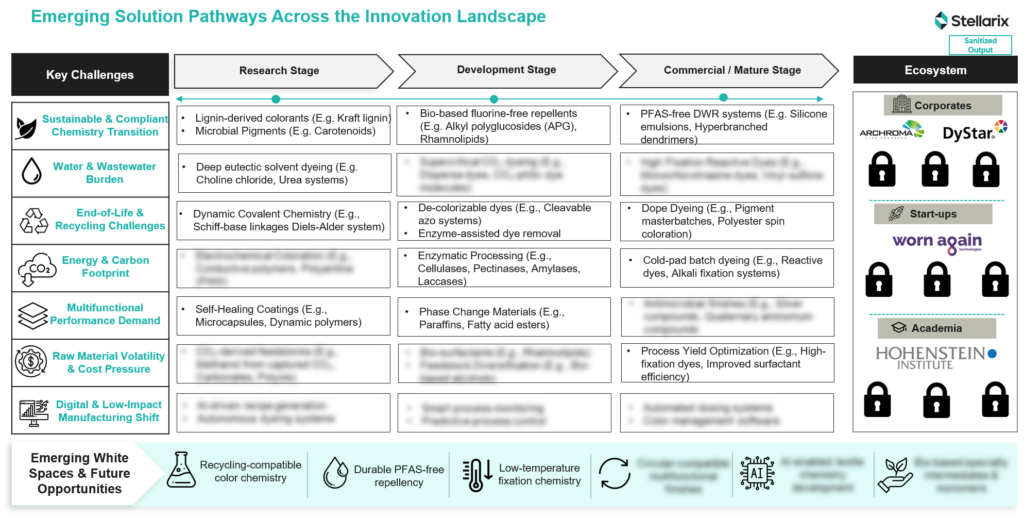
- Mapped innovations against various technology readiness levels for every identified challenge, generating a comparative view of market maturity instead of a list of technologies.
- Conducted in-depth dives into future opportunity areas, sustainability, and cost benefits, along with the players’ ecosystems involved in them.
- Structured a consolidated assessment linking challenges, gaps, opportunity areas, and TRL-mapped innovations to help the client prioritize R&D investments.
Solutions Offered:
The Stellarix team suggested:
R&D Portfolio Reallocation
Recommended redirecting investments toward unmet customer needs and major industry challenges where commercial potential and Technology Readiness Level (TRL) maturity are aligned.
White Space Bets
Identified specific innovation white spaces offering opportunities for strategic differentiation and market leadership.
Energy and Carbon Roadmap
Prioritized lower-temperature curing technologies and bio-based ingredient pathways to optimize energy consumption and reduce carbon footprints.
PFAS Transition Plan
Recommended a phased reformulation strategy across colorants and finishes to meet brand commitments to phase out PFAS by 2030.
Design-for-Recycling Direction
Recommended integrating recyclability criteria into product design specifications to address the textile-to-textile recycling rate of less than 1%.
Client Impact:
- Competitive Advantage: Identified differentiated solution pathways and innovation white spaces to strengthen the company’s positioning in evolving textile chemical markets.
- Faster Innovation and Commercialization: Identified external technologies and collaboration opportunities that can accelerate the development and market introduction of next-generation chemical solutions.
- Strategic R&D Prioritization: Direct innovation investments toward high-impact industry challenges, unmet customer needs, and commercially promising technologies.
Outcome Snapshot: