How Prepared is your Leadership Roadmap for the Next Decade of Physical AI?

As AI blurs the boundaries between software and hardware versions of it, they are becoming the new asset of competitive advantage for its early adopters. From autonomous manufacturing robots to AI-guided logistics systems and self-optimizing production lines, they are shaping the future of several operational environments. Yet, the path from pilots to commercialization remains astray with breakdowns and failed projects. It’s not about technological feasibility, but about organizational, commercial, and structural preparedness. Most leadership teams are trying to answer one simple question: “Can it be scaled?”
What Kind of Signals Need to be Scanned Prior to Strategizing?
Preparing for the era of Physical AI begins with informed readiness, not predictions. Therefore, identification of weak signals and acting upon them will pave the path to scaled deployment, giving them a 1.5-2 years’ leverage over their counterparts. Here is a small summary of weak signals identified under our observation and their strategic implications:
| Domain of the Signal | Observed Signal | Plausible Implication | Our Recommendation |
| Technology | Foundational models taking up robotics control in real-time | Proprietary automation stacks replaced by vendor | Audit lock-in risks in automation vendors’ contracts |
| Human Resource | Skill gap increases due to key mfg. economies | Physical AI augments the workforce instead of becoming another expense | Recreate the internal AI narrative this time around augmentation rather than displacement |
| Regulation | EU’s AI Act brings in risk tiers for autonomous industrial systems | Compliance turns into a market access requisite | Assign governance ownership to classify Physical AI risks |
| Competitive Landscale | Industry leaders rush to acquire Physical AI startups | Integrated platform players to consolidate market share in the next two years | Examine partner vs build vs acquire across core capabilities |
| Capital Markets | Investor focus shifting from AI adoption to AI-driven ROI | Unit economics of Physical AI turn into a key growth metric for top management | Define baseline KPIs for AI-based operational improvement |
What’s Stalling the Pilots from Moving Ahead?
The wide space between Physical AI and its upscaled commercialization is one of the most underestimated shifts in industrial strategy. Our observation of Physical AI initiatives across various industries reflects a consistent pattern of failure: pilots designed in controlled environments fail when executed at full operational scale.
There are three fundamental reasons that are common denominators of these failures:
- Data Inconsistencies: Labeling conventions, sensor configurations, and data governance standards vary across industries and facilities. This variance reduces the performance reliability of models beyond pilot phases.
- Fragmentation of Legacy Systems: Physical AI systems need to integrate with ERP, SCADA, MES, and OT networks. However, none of these systems weren’t designed for AI interoperability. Integration with them, thus, becomes costlier at every level.
- Heterogeneous Workforces and Their Relationships with Automation: Process engineers, frontline operators, and plant managers have varying relationships with automation. Deployment strategies overlooking this variance will result in resistance that cannot be overcome by data pipelines.
It isn’t the algorithm that’s resulting in high failure rates in Physical AI – it’s the assumption that what worked for one site will automatically translate to another. Scaling demands architecture, not just ambition. – Deepak Kumar Jain, Industrials, Hi-tech, and Mobility Leader, Stellarix
Balancing Standardization and Customization
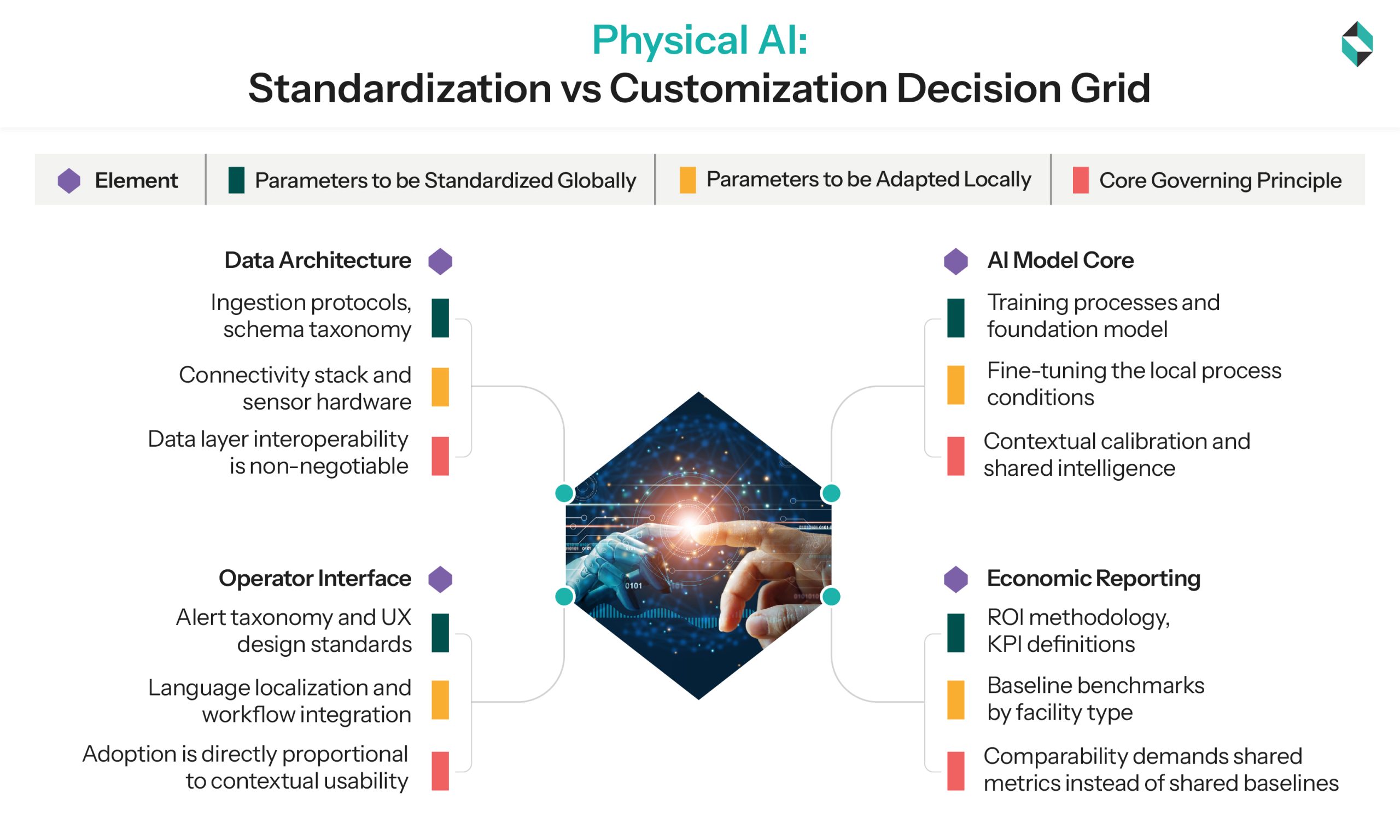
The scaling of Physical AI largely relies on balancing standardization with customization. It is a strategic challenge for adopters to decide which parts need to be standardized for utmost enterprise efficiency and which parts should be left to adaptation for operational effectiveness. Getting it wrong either way could be costly. Too much standardization could create frameworks that work perfectly in theory but may fail in context-specific conditions. On the other hand, over-customization would prevent economies of scale and create obstacles to governance. Here is a short preview of a starting framework that leadership teams should consider for adopting Physical AI architecture.
The Road to Long-term Growth: The Multi-phase Readiness Roadmap
Physical AI readiness is a capability trajectory that demands intermediate capabilities. However, organizations that overlook this part end up with overrun budgets, internal backlashes, and internal return to pilot phases. Therefore, a phased deployment strategy with explicit decision gates could ease the transition. Here is a short roadmap for 3-5 years that may help leadership teams see the horizon.
| Phase | Strategic Objective | Key Milestone | Decision |
| Phase 1 | Develop the prerequisites for scalable deployment | Data infrastructure audit, Physical AI governance charter, 1 or 2 pilots | Can pilot ROI be replicated? Can our data consistency be expanded? |
| Phase 2 | Single-site field trials | Full production deployment at one site, a real-world failure mode catalogue, and formalization of operator feedback loops | Has the system performed reliably across seasonal variation, shift patterns, and exceptional conditions? |
| Phase 3 | Expand to multi-site deployment while adhering to the governance charter | Data infrastructure audit, Physical AI governance charter 1 or 2 pilots | How are the unit economics faring as the company scales? |
| Phase 4 | Move from deploying AI to operating an AI-native enterprise | Data infrastructure audit, Physical AI governance charter 1 or 2 pilots | Is physical AI a competitive edge, or does it remain an internal efficiency program? |
Which Capabilities Should Leadership Teams Prioritize?
Technology readiness is only a small part of the risks associated with Physical AI deployment. The value-generating ability of these projects is determined by several other factors, including:
- Hybrid Workforce Models: Frameworks that team operational domain experts with AI engineers could extend the understanding across multiple teams, who alone may fail to create systems that work on the floor in real-time.
- Adaptive Learning Ecosystem: A learning environment where frontline teams become co-designers rather than final recipients certainly promises to increase the adoption rates and decrease surface failure that lab environments hardly reveal.
- Governance with Clear Accountability: A structure that takes accountability for incident response, performance monitoring, and risk classification builds institutional trust as the pace of deployment demands.
The Path Ahead
The economics of Physical AI isn’t linear. The most common mistake that most leadership teams make is underestimating costs and overestimating early returns. Market players must acknowledge that the initial deployments will bring high integration and new management costs. These costs will come down only as standardization and institutional knowledge improve. They only need to focus on getting the foundation work correct.
If narrowed down, there are three economic dynamics that need modeling: the integration cost curve, data flywheel effects, and talent leverage ratio. Boards must expect things to go unfavorably before they break even and enter the transformative phase.
The Bottomline
Physical AI adoption is a strategic reality that comes with an uneven curve. However, it promises a first-mover’s advantage for organizations that build readiness for now. They also need to acknowledge that the shift from pilot to full-scale commercialization has more to do with management and not technology. It needs foresight that decodes signals into strategic decisions and organizational infrastructure that outlasts multi-site deployment, and an economic model that genuinely reflects the nonlinearity of returns.
At Stellarix, we are working hand-in-hand with leadership teams on Physical AI readiness across the complete deployment lifecycle. If your company is navigating the transition from isolated pilots to enterprise-scale Physical AI, we could be your partners in the process.
Let's Take the Conversation Forward
Reach out to Stellarix experts for tailored solutions to streamline your operations and achieve
measurable business excellence.