Retailers De-Risking Holiday Season Shopping

With the holiday season just around the corner, retailers face distinct regional challenges: cautious US customers, ongoing inflation in Europe, and unpredictable supply chains in the APEC region. Retailers currently focus on offering attractive discounts and digital engagement. However, the business opportunity lies in building innovation capabilities and resilience amidst rapid digital transformation and changing customer expectations during the holiday shopping season.
As consumers plan to spend an average of $890.49 per person on food, gifts, and decor this holiday season, marking the second-highest expenses in the last two decades, retailers need to prepare thoroughly. Let’s explore how forward-thinking retailers can navigate risks during peak periods, maximize market opportunities, and meet customer expectations to sustain business growth in the coming years.
Why Retailers Need a Strategic De-risk Plan this Holiday Season?
US consumers are projected to scale back on discretionary expenses while expecting enticing sale events from retailers. On the other side, European retailers strive to balance sustainability reporting expenditure with inflation. Further, APEC markets encounter increasing import tariffs and fragmented logistics. The global scenario denotes volatility across the entire retail segment.
Being predictive and strategic is the way forward while deploying common tactics like flash sales, discounts, and omnichannel pivots. A thoughtfully crafted de-risk plan not only forecasts disruptions but also diversifies dependencies and utilizes data to reallocate capital. Here, AI-equipped agility and inventory management based on buyer behavior prediction are emerging trends among retailers during the holiday season.
Furthermore, macroeconomic factors suggest that price sensitivity and supply chain disruptions are key customer trends, underscoring the need for a practical strategic playbook to mitigate risk aversion among retailers.
Strategies for Maintaining Holiday Resilience for Retail Business Players
1. Re-engineer Value, Not Just Pricing
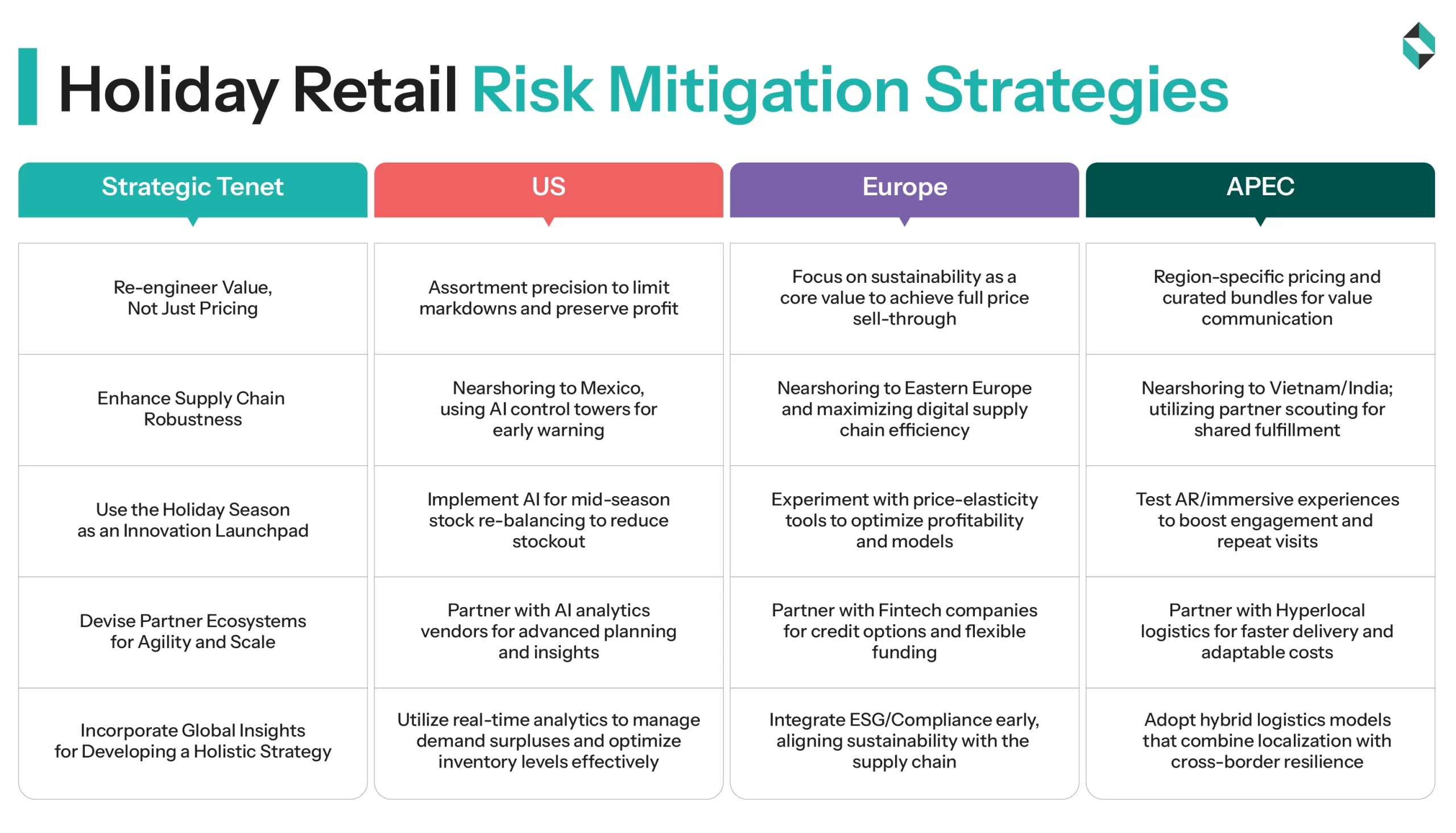
Leading Asian retailers, as well as US retailers such as Alibaba Group, Flipkart, HUL, Walmart, and Amazon, are opting for assortment precision through curated bundles, hero SKUs, and region-specific pricing strategies.
Instead of implementing broad markdowns, leading U.S. and Asian retailers are shifting to assortment precision, focusing on hero SKUs, curated bundles, and region-specific pricing strategies. For example, Under Armour concentrates solely on its top-performing products and limits its assortment, thereby reducing markdowns. Furthermore, in Europe, the Green Friday framework emphasizes sustainability as a core value rather than a cost, enabling full-price sell-through rather than discounting that cuts into margins.
Retailers can focus on aligning customer elasticity data with pricing to preserve margins and strengthen brand credibility in an inflation-sensitive environment.
2. Enhance Supply Chain Robustness via Predictive Resilience
On a broader scale, US companies are shifting operations to Mexico, while APEC-based brands are nearshoring to Vietnam and India. Additionally, European retailers are moving their operations to Eastern Europe to reduce supply chain risks. It is noted that AI-driven control towers provide early warnings of rising costs or supplier delays. For example, companies with mature digital supply chains achieve inventory savings of approximately 15-30% and a 20-40% decrease in order fulfillment times.
Mid-size retailers can choose partner scouting to improve supply chain resilience through predictive analytics and scale affordably. Partner scouting enables shared fulfillment centers where technology alliances or regional freight collaborations support proactive continuity planning.
3. Use the Holiday Season as an Innovation Launchpad
Retailers can use Q4 to experiment and innovate, outperforming peers in the following year’s readiness metrics. For example, Kosmo, a European grocery company, experimented with price-elasticity tools that increased its profits. Later, Sephora in Southeast Asia tested AR-based gifting experiences, which significantly boosted repeat visits. Additionally, US retail chains such as Levi’s and Walmart, along with many other companies, use AI to automate mid-season stock rebalancing to reduce the risk of stockouts.
AI-driven forecasting tools, such as the “AttnBoost” framework, demonstrate the value of adaptive models in changing conditions. Retail businesses can capitalize on the holiday shopping season by conducting micro-experiments to stay ahead and incorporate adaptability into their operations.
4. Devise Partner Ecosystems for Agility and Scale
Ecosystem adaptability may outweigh the advantages of internal optimization during holiday cycles in 2025. Therefore, retailers are partnering with hyperlocal logistics startups in the APEC region and forming alliances with AI analytics vendors in the US and with fintech companies in Europe to secure funding and alternative credit options.
In short, partner scouting is a strategic way for retailers to increase flexibility without significant capital expenditures. Smart collaborations reduce delivery times and enable more adaptable costs across different channels. Managing these benefits is essential for retailers in today’s rapidly evolving digital landscape.
5. Incorporate Global Insights for Developing a Holistic Strategy
- In the US market, retailers should focus on real-time analytics to manage demand surpluses, as retailers using predictive inventory tools report fewer instances of inventory shortages.
- In the APEC region, hybrid logistics models that combine localization with cross-border resilience are a practical approach.
- European retailers need to incorporate compliance and ESG considerations early in the holiday season and align their sustainability efforts with supply chain plans to handle mid-season disruptions with utmost efficacy.
Overall, a global, cohesive framework that incorporates regional insights helps build a robust, data-driven holiday strategy that intelligently allocates resources and assesses risks across diverse markets.
Final Words
To mitigate the risks of the holiday shopping season, retailers cannot rely solely on digital flash campaigns; they must adopt a unified strategy rooted in innovation and resilience. Retailers focusing on precise assortment, predictive supply chain control, utilizing the holiday season for innovation experiments, and building agile partner networks are likely to succeed. The future of holiday retail shopping will be shaped by blending agility, innovation, and the ever-changing preferences and expectations of customers.
Amidst economic uncertainties, supply chain risks, and changing customer demands, the stakes remain high for retailers during the holiday season.
At Stellarix, we help retail companies minimize risk factors and maximize benefits from market opportunities through partner scouting, strategic scenario planning, and omnichannel optimization. Our retail consultants help navigate holiday volatility with strategic frameworks that harness the benefits of peak demand and turn them into a competitive advantage for future growth.
Let's Take the Conversation Forward
Reach out to Stellarix experts for tailored solutions to streamline your operations and achieve
measurable business excellence.