How AI is Revolutionizing Fragrance Creativity and Compliance?

Artificial intelligence, IFRA compliance, and digitalization are emerging as pivotal partners in the future of the fragrance industry. AI, however, is at the heart of this change, augmenting the entire product cycle, right from molecular design to regulatory compliance. Beyond accelerating R&D, AI is also laying the foundation for ethically sound, sustainable, and personalized products that are well-aligned with changing consumer preferences. This article delves into the latest breakthroughs, use cases, and industry developments that are shaping the future of perfumery.
Latest AI Breakthroughs Driving the Fragrance Science Forward
Generative Diffusion Network for Scent Creation
A game-changer, this AI model was developed by the Institute of Science, Tokyo. It can automate the new fragrance creation process based on scent descriptions by users. The model utilizes the mass spectrometry profiles of essential oils and their corresponding odor descriptors to create novel blends of essential oils. It is enabling perfume makers to move beyond the trial-and-error phase and achieve scalable and faster fragrance production.
Cheminformatics Method for Automatic Scent Creation
Deep neural networks (DNNs) trained with comprehensive sets of odor descriptors and essential oils can predict and produce new scent compositions. These are also accompanied by human evaluations that confirm the alignment of AI-generated scents with intended profiles.
Consumer-Driven Personalized Designs
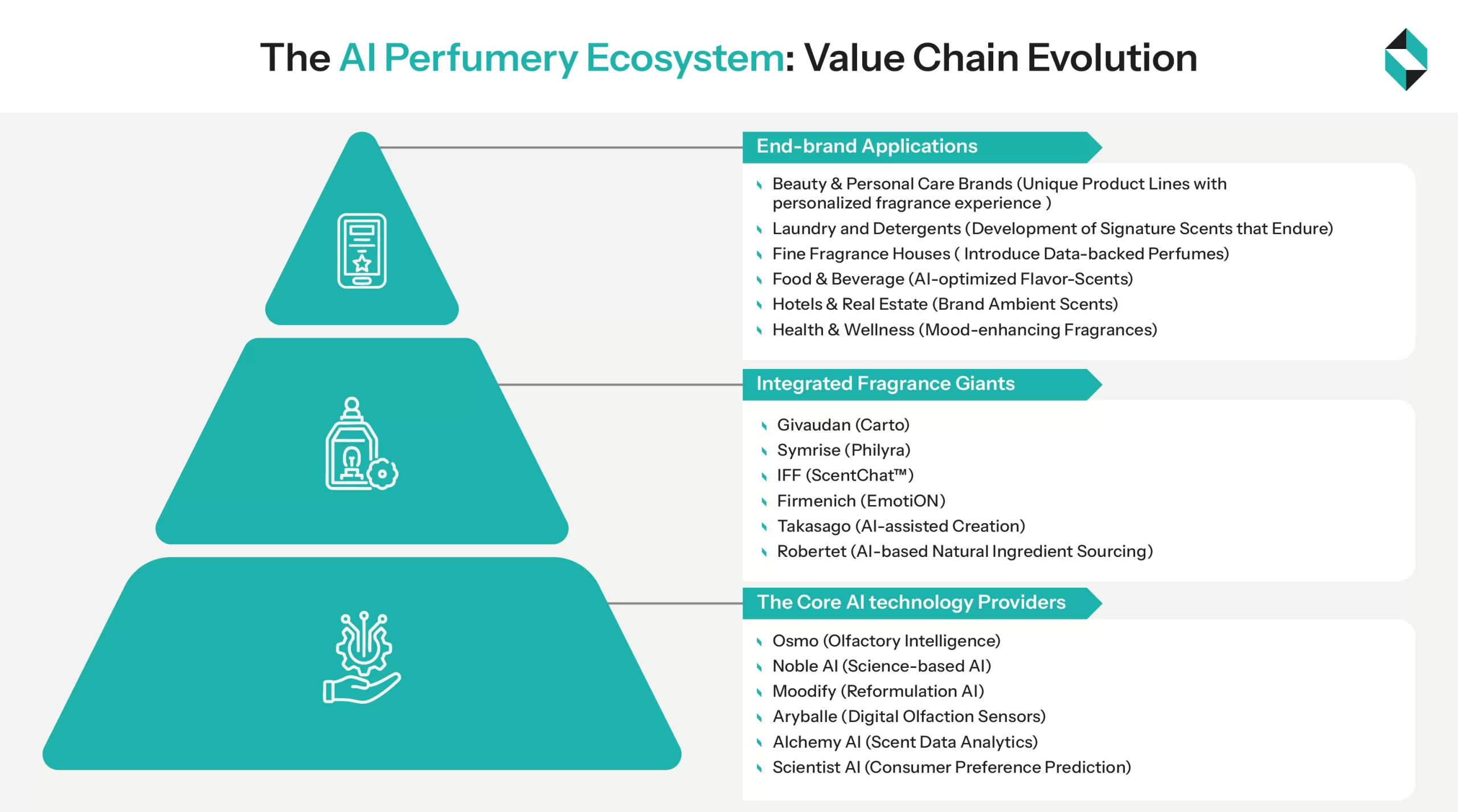
AI is paving the way for hyper-personalized fragrance designs. Several new AI platforms, such as The Fragrance Shop’s “EveryHUman” and Osmo’s “Generation”, analyse consumer preferences, emotional states, and skin chemistry to create customized scents. These digital scent technologies also utilize graph neural networks (GNNs) to design new fragrances based on direct user feedback, signaling a shift toward co-created, data-driven perfumery.
Elevating Human Creativity
Parallel to other industries where AI is accelerating product design and development cycles, it is increasingly viewed as an authentic co-creator for human perfumers rather than replacing them. The recent innovations from Givaudan and Symrise are helping artists experiment with new combinations, introduce desired innovation levels, and visualize scent spaces by blending computational power with human intuition.
Digital Olfaction and Fragrance
AI-based systems, such as electronic noses, are mapping molecular structures to sensory reactions and generating data-driven benchmarks for fragrance intensity, character, and quality consistently. Niche brands like Aryballe are using these to benchmark their competitors and achieve batch-to-batch consistency worldwide. Overall, digital olfaction is addressing the longest-standing challenges faced by the industry.
Are There Any Drawbacks?
Though AI is fuelling fragrance creation, its abilities are juxtaposed with some inherent limitations. The boundaries that need to be acknowledged and addressed are:
- No Genuine Olfactory Perception: The trained AI models only process data without any real sense of olfaction. Their lack of perception, emotions, and dopamine release from scent inhaling reduces their efficacy in processing scents
- Overfitting Risks: Most models use only past data, which only reiterates previous blends. This subdues the chances of novelty and any chances of revolutionizing fragrances.
- Lack of Nuance: Data models do not understand contextual, emotional, and cultural subtleties of scent, which remains a human domain.
AI and Regulatory Ecosystem: Facilitating Safety and IFRA Compliance
Automating Ingredient Screening and Monitoring Regulatory Developments
Artificial intelligence is now an integral part of ensuring compliance with the evolving IFRA (International Fragrance Association) standards. Along with instantly cross-referencing new formulations against the latest IFRA standards, AI screening also flags restricted substances and suggests compliant alternatives. Currently, platforms like NobleAI’s VIP and Chemcopilot are orchestrating toxicology assessments, ingredient substitutions, and carbon emissions calculations within a single workflow, simultaneously providing sustainability and compliance metrics.
For more context, check out the article IFRA Ingredients Restrictions & Sustainability Aspects
Swift Reformulation and Proactive Compliance
AI-based platforms, such as Osmo’s Generation OI tool and Moodify’s Reformulation services, are aiding in the rapid identification of IFRA-compliant substitutes and even investing in molecules that cater to safety and olfactory requirements. These platforms monitor regulatory updates continuously to help manufacturers ensure compliant, innovative products.
Predictive Allergenicity and Toxicology
ML models equipped with deep learning algorithms and Quantitative Structure-Activity Relationship (QSAR) are helping to predict the allergenic and toxicological potential of fragrance molecules based on their chemical structure. Termed as new alternative methodologies (NAM), these approaches are mitigating animal testing requirements, thereby speeding up safety assessments.
More Transparency and Consumer Safety
AI tools are automating allergen labeling and detection to ensure precise disclosure and decrease regulatory risks, especially in regions with strict regulations like the EU. Advanced AI can also detect counterfeit products by analyzing scent profiles, promising both brand integrity and safety.
Key Industry Developments
Several sophisticated platforms are currently helping industry players with both compliance and creative processes. The table below summarizes the most influential platforms that are driving innovation in the perfume industry:
| AI Platform/Company | Core Function | Primary Application |
|---|---|---|
| Osmo’s Generation | Offers olfactory intelligence (OI) for creating fragrance | Supports fragrance creation and scaling through ingredient and market data analysis |
| Carto by Givaudan | AI-supported formulation and visualization | Offers real-time visualization of fragrance combinations; speeds up innovation with fewer errors |
| Philyra by IBM & Symrise | Scent generation through data analysis | Generates commercially viable and novel fragrances by analysing thousands of market data and existing formulas |
| ScentChat™ by IFF | Real-time consumer co-creation | Uses NLP on messaging apps to turn consumer feedback into data for perfumers |
| EmotiON by Firmenich | Provides emotion-based fragrance design | Predicts emotional responses stimulated by various scent profiles using AI, aiding in establishing a link between fragrance, wellness, and mood |
| EcoScent Compass by DSM-Firmenich | Sustainability evaluation and analysis | Assess the carbon footprint of fragrance ingredients, aiding in the creation of sustainable products |
| Moodify’s reformulation service | Reformulation and regulatory compliance | Helping brands update their existing scent profile to create IFRA-certified fragrances and address supply chain disruptions |
Also, read our case study on AI Formulating Fragrance and Perfumery
When Should Brands Deploy AI in Fragrance Creation?
Here is a short, strategic guide that could help companies decide when to use AI for fragrance innovation.
Pros:
- Ideation: Generates new molecular combinations or new scent profiles devoid of human bias
- Compliance: Automatically monitors evolving IFRA standards and regulations
- Initial-stage Testing: Analyses potential consumer response to hundreds or thousands of virtual prototypes before actual production
Cons:
- End Product: Data and AI models lack the nuanced art of refining or balancing the sensory judgment for the final formulation
- Heritage Scent Replication: It cannot capture the intangible core and soul of the classic perfume, which only depends on human tradition and expertise
The Startup Ecosystem
- Osmo: Established in 2022, Osmo focuses on AI-powered fragrance molecule discovery, rapid scent creation, digital olfaction, and compliance.
- EveryHuman: Their algorithm perfumery platform focuses on hyper-personalized, AI-generated fragrances.
- NOS Emotiontech: Since its inception in 2020, it has been creating AI-driven, tailored fragrances derived from biometric and emotional data.
- INUA AI: Operating since 2022, they are personalizing scent and creating digital perfumes through machine learning methodologies.
- Moodify: Since 2017, they have developed an AI-based fragrance design software that was adopted by P&G in 2023.
Key Innovation Opportunities
Identifying key innovation areas and prioritizing investments based on their impact and implementation feasibility could help leadership teams prioritize resource allocation. So, here is a prioritization matrix where we mapped the impact of major AI innovations against their implementation feasibility.
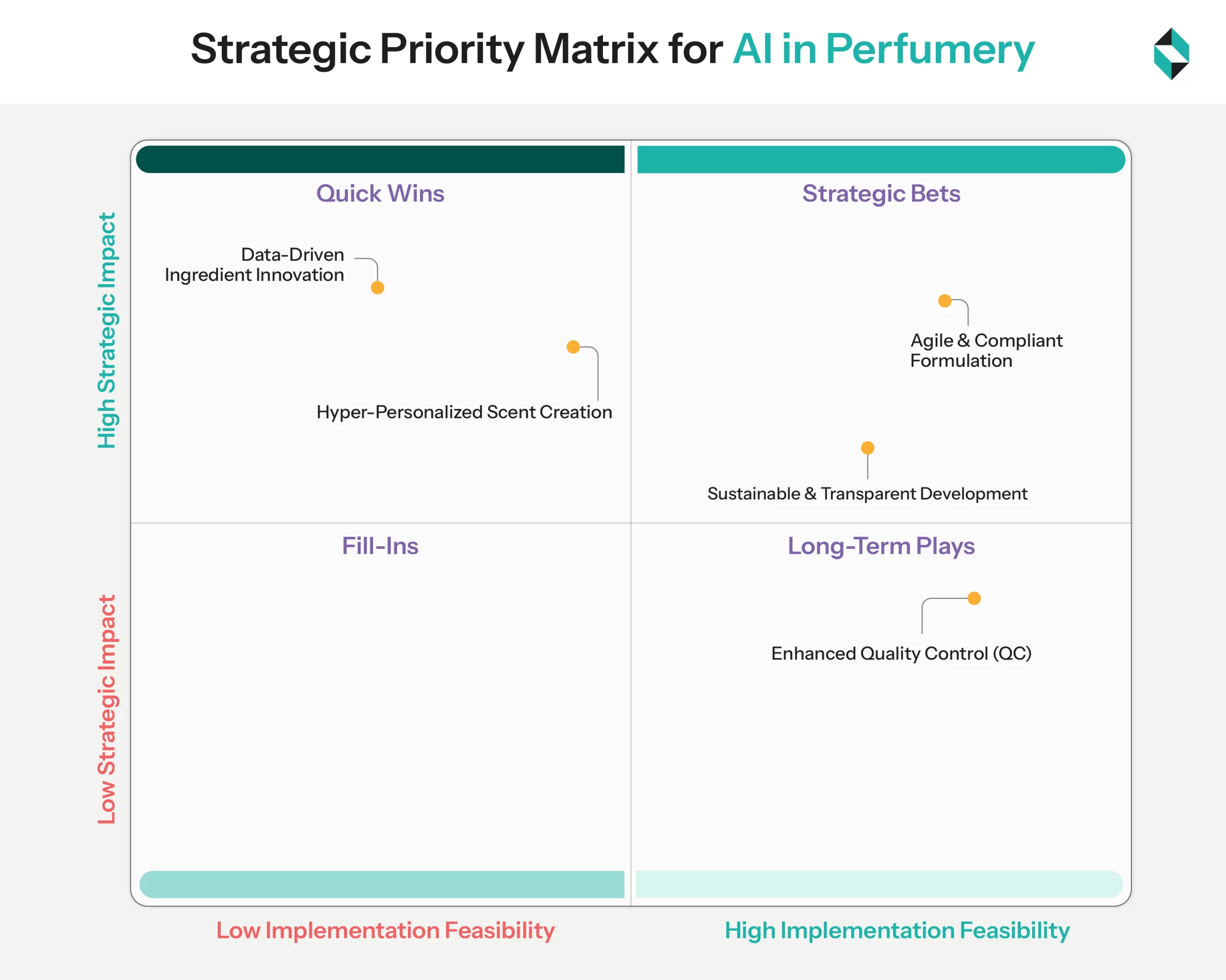
Here is a short guide to its analysis:
Quadrant 1: High Impact & High Implementation Feasibility
The strategic bet segment encompasses innovations that promise long-term market leadership opportunities.
Quadrant 2: High Impact & Low Implementation Feasibility
The high-impact and low Implementation feasibility segment represents quick wins, which means the innovations under this segment promise significant returns with moderate, manageable risk and quicker implementation cycles.
Quadrant 3: Lower Impact & Low Implementation Feasibility
The fill-ins segment represents developments that can be implemented as part of operational upgrades; they come at a cost and are less likely to be revenue drivers.
Quadrant 4: Low Impact & High Implementation Feasibility
In the long-term play segment, the developments are hard to monetize and full of challenges. They can better be integrated as embedded value add-ons that may yield results in the long term.
Teachings from Cross-industry Creative AI Applications
- Music: They are using AI for creating compositional elements; however, emotions are integrated by humans. Similarly, in fragrance creation, AI could be the “co-composer” while the perfumer remains the director
- Fashion: AI models are used to zero in on sustainable properties in materials before actual production. The fragrance industry could take the same concept to predict scent profiles and the sustainability metric of new molecules
- Visual Design: They use AI for visuals while artists refine concepts. Fragrance companies could do the same, just limit AI for ideation, but not the final formulation
Final Words
Beyond revolutionizing product design and development, AI is contributing to the democratization of creative processes. It supports rigorous adherence to evolving IFRA standards throughout the creation of innovative, personalized, and safe perfumes. Over time, as human-machine collaboration deepens, it will accelerate integrated iteration cycles, create compliance-first formulations, and enhance human-AI collaboration. However, its real value will be realized through clear guidelines and strategic governance on AI applications.
As an innovation and strategy partner, we are helping CPG companies and fragrance brands address strategic questions like:
- How to structure organizations to foster a human-AI blend in their creative processes?
- How to integrate lightweight governance frameworks for responsible AI deployment?
- Where to place strategic bets for a competitive advantage?
For more insights and tailored industry experts’ guidance, talk to our CPG consultants.
Let's Take the Conversation Forward
Reach out to Stellarix experts for tailored solutions to streamline your operations and achieve
measurable business excellence.