Market Landscape: Who’s Winning the Race in Agentic AI and Why?

The Agentic AI Surge: How the Landscape Is Transforming
For business leaders, the buzz around AI is swiftly shifting from Generative AI to Agentic AI. It is not merely a latest tech trend but also an operational necessity. It is forecasted that the market value of Agentic AI will exceed $47 billion, with a CAGR of over 44 percent. This rapid growth highlights the potential of agentic AI to influence industrial operations through autonomous decision-making and actions.
From finance to pharma, manufacturing, medtech, telecom, and other high-tech industries, agentic AI is delivering measurable results by managing multistep workflows with limited human intervention.
Amid intensifying competition among tech giants like OpenAI, Google, and Microsoft, emerging startups are also vying to capture the market share. In this context, the blog analyses which tech giants and innovative start-ups are ahead in the agentic AI race and what it implies for business leaders assessing their AI roadmaps.
Comparative Assessment: OpenAI, Google, Microsoft, and Emerging Startups in the Agentic AI Era
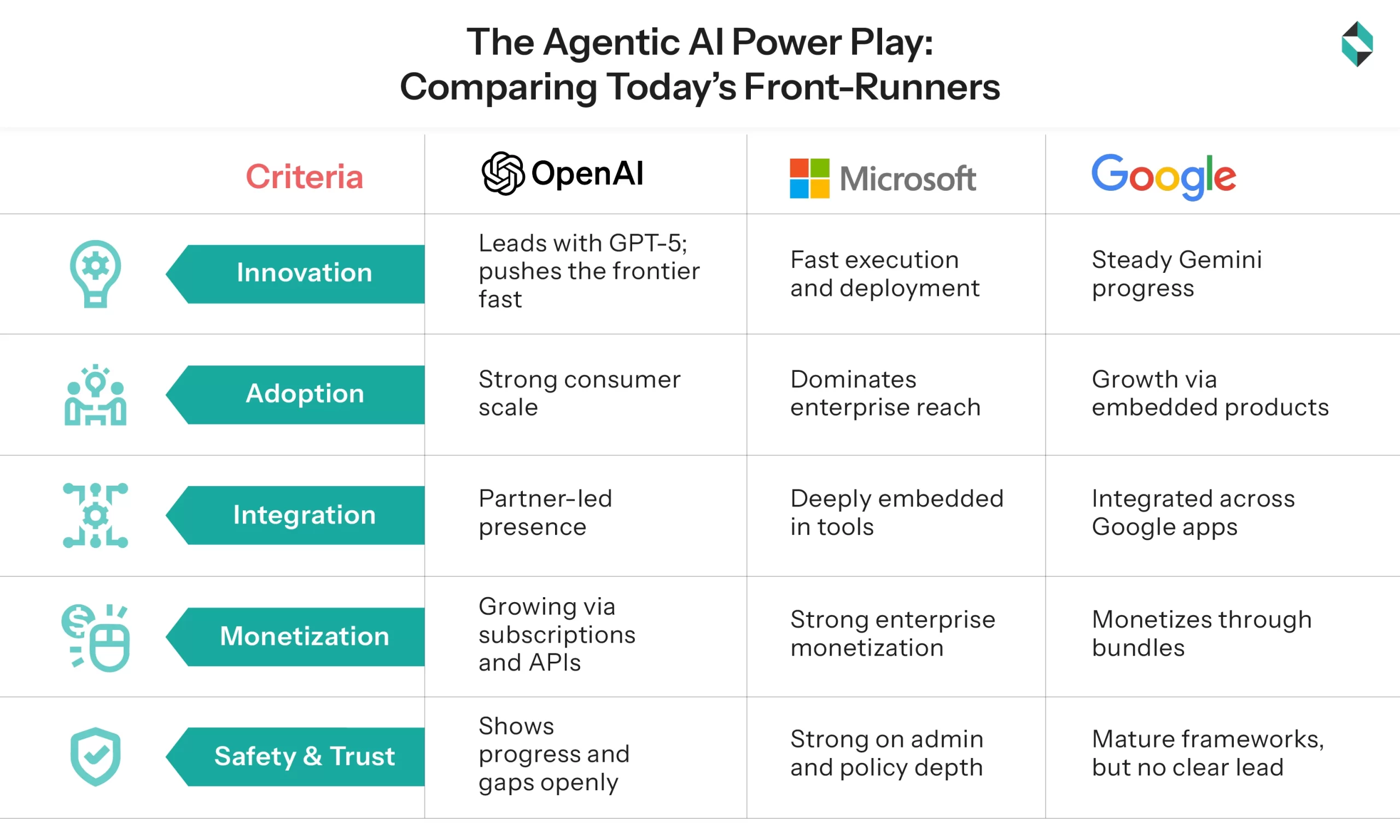
From customer support to engineering and design teams, deploying AI agents for tasks such as automating workflows and testing products is becoming increasingly common. This shift is being driven by emerging trends in Agentic AI, including composable agents, model interoperability, and persistent agents. A brief overview of the top players and their comparative analysis is as follows:
OpenAI
- Main Features: Codex engine of GPT-5, the assistant application programming interface (API), the OpenAI operator platform, and persistent memory.
- Strategic Focus: Robust developer-first framework with tools available for building custom agents through enterprise tiers and ChatGPT teams.
- Competitive Edge: OpenAI is currently leading in multi-model reasoning and model capability, specifically with tool usage and deep planning features.
Microsoft
- Main Products: Copilot Studio, Autogen Studio, and seamless integration with Azure and Microsoft 365.
- Strategic Focus: Orchestrating enterprise operations and governing agents, with significant investment in secure workflows and compliance.
- Competitive Edge: Enables data interoperability and promotes cross-platform agent communication while harnessing benefits from a large distribution network and established trust within enterprises.
- Core Offerings: Gemini 2.5, Agent Development Kit (ADK), and Vertex AI Agent Builder.
- Strategic Focus: Emphasizing multimodal reasoning and scalable deployment via Google Cloud, while leading in secure agent execution and AI research.
- Competitive Edge: Ethical AI leadership, adaptable tools, and robust infrastructure for agent orchestration.
Notable Startups
Some prominent players, their offerings, and USPs are as follows:
Cognition AI
- Offering: Devin, the world’s first AI software engineer, autonomously manages end-to-end software engineering tasks. It includes multi-agent orchestration and an integrated developer environment.
- USPs: Allows engineers to focus on advanced problems due to autonomous task management. Exhibits strong long-term reasoning, planning, and superior benchmark performance.
Reka AI
- Offering: Reka Research examines the web and private documents to address complex questions.
- USPs: True multimodality with models developed from scratch to process distinct data types natively. Offers fast, transparent, and highly effective agentic reasoning, which is also cost-efficient.
Orby.AI
- Offerings: Proprietary Large Action Model (ActIO) to independently monitor, learn, and automate complex enterprise workflows across different interfaces.
- USPs: Compared to traditional Robotic Process Automation (RPA), Orby’s generative and self-healing automations adapt seamlessly to evolving environments. This intelligent, autonomous learning minimizes the need for manual maintenance.
SuperOps
- Offering: An agentic AI marketplace designed for Managed Service Providers (MSPs), integrated within a single Professional Services Automation/ Remote Monitoring and Management (PSA/RMM) platform.
- USPs: Immediate access to specialized, purpose-built agents to accelerate AI adoption for MSPs. Provide proactive, autonomous problem-solving abilities, transmuting reactive IT support into outcome-focused workflow.
A Comparative Analysis of Top Agentic AI Features: Pros and Cons
Interoperability vs Lock-In
Open standards, such as Model Context Protocol (MCP) and Agent-to-Agent (A2A), are emerging in the market, but industry giants like OpenAI and Microsoft still rely heavily on their own ecosystems. Microsoft’s integration typically performs best within its own ecosystem, whereas Google actively promotes greater openness.
Reliability vs Autonomy
Greater autonomy in AI agents presents increased risks. Persistent agents can pose significant challenges for enterprises, especially in highly regulated industries, as they continue to struggle with human override and auditability. This risk factor is common to every player in the Agentic AI space.
Accuracy vs Speed
Long contexts and complex reasoning often cause latency. GPT-5 strikes a balance between deep reasoning and speed, whereas other competitors typically prioritize speed. On-device agents provide faster responses at a lower cost.
Security & Governance
Agentic systems require strict access controls. Microsoft excels in compliance and policy tools, followed by Google. Moreover, startups are trying to keep up, but they often lack enterprise-grade governance.
User Experience
Deployment ease, monitoring, and testing vary across all platforms. Microsoft Copilot Studio is user-friendly even for teams without technical expertise, while Google offers reasonable flexibility. OpenAI’s Assistants API is effective but tends to be developer-focused.
What are the Real-Life Applications of Agentic AI: Industry Use Cases and Impact
Pharma & Life Sciences
- Use Case: Literature review agents, regulatory document generators, and trial recruitment bots, all with integrated validation trails.
- Impact: Quick drug discovery accompanied by better compliance and streamlined clinical operations
- Example: AI agents are accelerating pre-clinical research by evaluating databases, designing simulations, and drafting study protocols. GPT-5’s benchmarks demonstrate strong performance in medical NLP, radiology, and oncology, particularly in terms of accuracy.
High-Tech / Engineering / Manufacturing
- Use Case: Develop validation agents, code QA bots, agentic CAD systems, chip verification & design, and simulation agents for research and development.
- Impact: Higher accuracy, faster iterations, and less manual work
- Example: Automotive companies utilize agentic AI to validate and create multiple test scenarios for hardware systems.
Finance / Supply Chain / Energy
- Use Case: Procurement automation, policy compliance checkers, multi-agent risk frameworks, and forecasting agents.
- Impact: Data-driven real-time decision-making, enhanced transparency, and automated documentation
- Example: Logistics firms utilize agent squads to forecast demand, manage inventory, and streamline documentation.
Aside from that, in the IT sector, Ciroos, a growing start-up, is deploying multi-agent systems to reduce manual work and triage incidents. Additionally, SuperOps in IT operations is reducing effort with autonomous agents, while Microsoft AutoGen is used for incident management and multi-agent workflows.
Overall, organizational success depends more on the readiness of internal processes and less on AI model adoption, but the main question is whether your organization and R&D processes are prepared for effective Agentic AI adoption and growth.
Bottom Line
It is apparent that agentic AI is not optional for business leaders; the question has fundamentally shifted from whether to adopt it to where and how to integrate it effectively into the business. It is especially important for industries such as healthcare, life sciences, and high-tech, which demand extensive documentation, strict adherence to regulatory frameworks, and have inherently complex operational requirements. OpenAI leads in broad reasoning and raw model competency, while Microsoft excels in enterprise integration and trust. Subsequently, Google brings strength relating to secure deployment and infrastructure. Further, start-ups are accelerating innovations in verticals.
The winners won’t be the ones who create the most powerful agents, but those who deploy them wisely, balancing their capabilities with usability, integration, and trust. In this competition, meticulous execution becomes the crucial factor that sets them apart.
Navigating the Agentic AI frontier effectively is challenging for organizations facing misaligned implementations and governance gaps that hinder achieving the desired ROI. Stellarix is helping organizations address this gap through market, business, and R&D-specific strategic solutions, customized AI roadmaps for seamless integration, and enhanced operational efficiency. We assist companies in developing an interoperable agent ecosystem that boosts operational resilience while providing a clear market advantage. We are catalyzing the transformation of Agentic AI deployment from a technical project into a driver of competitive leadership, supporting long-term growth.
Let's Take the Conversation Forward
Reach out to Stellarix experts for tailored solutions to streamline your operations and achieve
measurable business excellence.