Smart Grid: Architecture, Developments and Use Cases

A smart grid is a digitized, intelligent energy network that can efficiently perform energy transfer between the source and the consumer. It combines information, telecommunications, and power technologies to provide a two-way communication channel between the service provider and customers, allowing electricity and data to be exchanged.
The architecture of a smart grid system consists of various components, including energy storage, smart meters, smart substations, distributed generation, phasor measure units, and integrated communications. Recent developments in this system include grid tools for smart charging of electric vehicles, electricity theft detection in power grids with a convolutional neural network (CNN) and Random Forests (RF), etc.
The upcoming article will explore what smart grids are, the smart grid system, the architecture of smart grids, recent innovation areas, major players in the smart grid domain, and their recent activities towards advancing smart grid technology.
What are Smart Grids?
A smart grid is a digitized, intelligent energy network that can efficiently transfer energy between sources and consumers. It combines information, telecommunications, and power technologies to provide a two-way communication channel between the service provider and customers, enabling the exchange of electricity and data. The architecture of an intelligent grid system comprises various components, including energy storage, smart meters, smart substations, distributed energy generation, phasor measurement units, and integrated communications. Recent developments in this system include on-grid smart chargers for electric vehicles, AI-based electricity theft detection in power grids, innovative power converter topologies, and others.
Smart Grid Systems
A grid is a network of power cables that distributes electricity to consumers. As the adoption of automation increases, organizations require smart grid technology to manage the power distribution network and its components. The image below summarizes a few differences between conventional and smart grids:
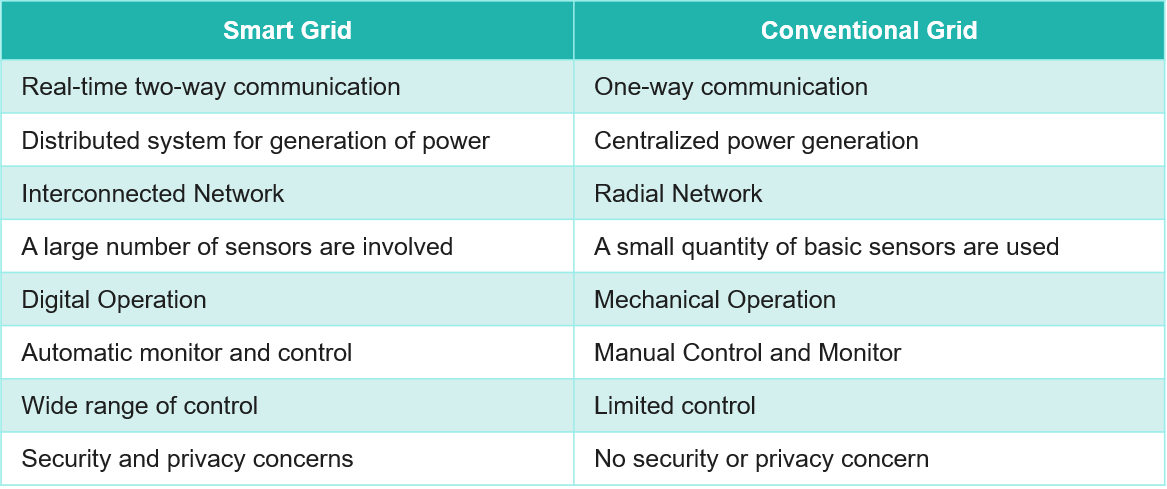
A smart grid is an intelligent network with an automated control and monitoring system that integrates the actions of all stakeholders, including generators, consumers, and those who do both, to provide an efficient distribution of electricity and a grid that is sustainable, economically viable, fault-free, and secure from cyber-attacks. Some benefits of incorporating a smart grid into an electrical power distribution system are:
- Easier integration and operation of generators of various sizes and technologies
- It enables customers to participate in the system’s optimization
- Users can make informed decisions regarding
- Improves system reliability, quality, and supply security
- Improves existing communication systems and boosts network flexibility by integrating additional intelligence (e.g., temperature control of transformers, real-time thermal monitoring of cables) into network equipment
- Helpful in reducing the carbon footprint of an electricity distribution network and end-users
Smart Grid Market
According to Stellarix’s research, in 2022, the smart grid technology market was valued at nearly $50 billion. This market is expected to experience significant growth, with a projected compound annual growth rate (CAGR) of 17.4% over the next six years. By 2028, the market is anticipated to reach approximately $130 billion. This growth is driven by increasing demand for efficient energy management solutions, technological advancements, and supportive government policies promoting smart grid infrastructure.
Smart Grid: Architecture
A smart grid system has a highly distributed and hierarchical network architecture. It utilizes intelligent sensing devices to collect information regarding each grid component to make an informed decision regarding its operation. The main components of a smart grid include:

1. Energy Storage: It is an integral part of smart grids. Additionally, suitable scaling and optimized operation of energy storage devices can lead to effective management of peak power demand, increased renewable energy penetration, improved power quality, and other benefits. Typical energy storage systems for smart grids include:
- Electrical energy storage, i.e., electrostatic energy storage, including capacitors, super-capacitors, and magnetic/current energy storage.
- Flywheels, compressed air, and hydro-pump energy storage are examples of mechanical energy storage.
- Electrochemical conventional batteries, fuel cells, solar fuels, metal-air batteries, and thermochemical reversible processes are examples of chemical energy storage.
- Thermal (sensible, latent, and thermochemical) energy storage.
2. Smart Meter: It utilizes a two-way secure communication network to transmit precise energy usage data to the service provider automatically. Additionally, a smart meter with a built-in display screen shows the real-time energy consumption and cost.
3. Smart Substation: Smart substations support advanced functions, including real-time automatic control of power grids, intelligent regulation, online analysis, and decision-making to interact with adjacent substations and facilitate power dispatching. Additionally, smart substations are responsible for collecting, measuring, controlling, protecting, computing, and monitoring information.
4. Distributed Generation: Distributed generation refers to the use of small-scale energy-generating techniques at the consumer level, along with traditional energy generation techniques. It can lower prices, improve dependability, reduce emissions, and extend generation options. Energy production occurs near demand, which reduces transmission line development costs and transmission losses, resulting in increased efficiency.
5. Phasor Measurement Units: Phasor measurement units (PMUs) or synchro phasors are devices that measure voltages and currents at predetermined places in the utility grid and synchronize with the global positioning system (GPS) radio clock. This technique offers a revolutionary method for managing power flow through the utility grid, while also enhancing security and improving transmission congestion management in overload situations.
6. Sensing and Measurement: Advanced sensing and measurement technologies collect and manipulate data to improve the management of the power system. They analyze and monitor equipment health, prevent energy theft, and provide strategy support. They are also used to generate energy bill estimates and analyze grid stability, among other applications.
7. Smart Appliance: Smart appliances leverage cutting-edge computer and communication technology to complete tasks quickly, efficiently, and effectively. Refrigerators, washing machines, toasters, dishwashers, and electric vehicles all tap into smart-grid generation sources. After implementing smart-grid technology, users indicate when and how much electricity they require, thereby minimizing peak demand issues.
8. Security: The smart grid system has key security objectives. One objective is to proactively identify anomalies. This helps decrease the attack surface of the smart grid. Another goal is to avoid unintended consequences. The security coverage extends to critical aspects of the smart grid. These aspects include managing user data confidentiality, addressing basic grid faults, and mitigating cyber-attacks.
9. Reliability: A smart grid identifies any fault and allows the system to self-heal. As grids grow in size and complexity, assessing their reliability will become increasingly challenging. Smart Grids are well-suited to address these concerns due to their ability to monitor and retain all data as well as estimate service reliability.
Smart Grid Technologies: Recent Developments
Recent developments in smart grid technology have established a period of innovation and transformation in the energy sector. Here are some recent developments in smart grid:
- AI-Powered Grid Intelligence: Artificial intelligence is transforming grid operations by enabling predictive maintenance, fault detection, outage prevention, load forecasting, allowing utility companies to effectively anticipate demand-supply, equipment failures, maintenance needs, etc., and helping companies optimize operations and reduce operational expenditure.
- Distributed Energy Resources Management System: DERMS supports the companies in managing and optimizing the operation of distributed energy resources, including solar panels, energy storage, wind farms, and others that are crucial elements in the modern grid.
- High-Voltage Direct Current (HVDC) Integration: One of the significant advantages of HVDC is the efficient long-distance power transmission. It supports bidirectional power transfer among the renewable power sources, energy storage systems, electric vehicles, and other grid elements that consume DC power. This will help minimize the energy losses during the conversion of power from AC to DC and vice versa.
- Virtual Power Plants: VPPs are the digital platforms that aggregate, manage, and coordinate thousands of decentralized assets using real-time communication and artificial intelligence to balance the supply and demand in the grid and improve the overall grid reliability and capacity to integrate more resources.
- Power-to-X Integration: P2X systems convert excess power from the grid into hydrogen, synthetic fuels, or heat for storage and later use. This conversion can be performed by various electrochemical processes, such as electrolysis, methanation, ammonia synthesis, and methanol synthesis, among other pathways, which enable efficient energy conservation.
Smart Grid Use Cases
Extensive investments in the development of smart grids are anticipated in the Middle East and North Africa regions. They create renewable energy and enhance the efficiency of the electrical sector. Additionally, key players in the market include Honeywell International Inc., Hitachi Energy Ltd., Siemens AG, Landis+Gyr, General Electric Company, and many more.
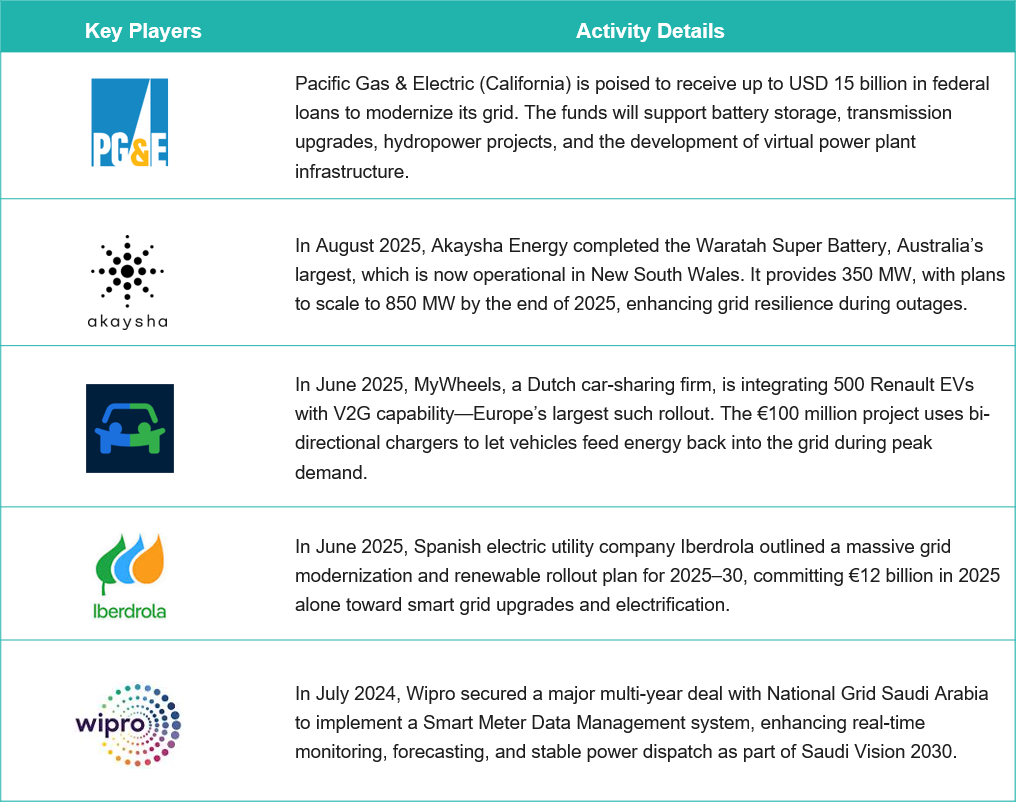
The following are a few of the use cases implemented by different companies:

Recent Activity
Across the innovative grid sector, companies are driving large-scale investments and collaborations related to grid-scale storage, large-scale renewable integration, EV-to-grid rollouts, and smart metering, aiming to enhance energy efficiency, meet regulatory goals, and deliver advanced capabilities such as real-time monitoring and flexible power management.
Conclusion
The concept of the smart grid is constantly growing to efficiently meet energy consumption needs. It also minimizes carbon emissions by incorporating renewable energy sources. Moreover, improving the reliability, efficiency, and quality of power distribution has the potential to transform the traditional grid and consumer behavior in terms of energy usage.
Although smart meters are useful for operating smart grids in an energy-efficient and profitable manner. Several concerns exist regarding the data collected by smart meters in real time. Obtaining statistics on hourly electricity usage may contain unnecessary information at times. Furthermore, this data collection occasionally infringes on the privacy of users. Also, to improve the privacy of the end-user, there is a need to increase the incorporation of AI-based algorithms and data obfuscation techniques in a more secure smart grid.
Let's Take the Conversation Forward
Reach out to Stellarix experts for tailored solutions to streamline your operations and achieve
measurable business excellence.