Next-Gen Heat Exchangers: How Additive Manufacturing and Nanocoatings are Revolutionizing Heat Transfer
Key Takeaways:
- Additive manufacturing and nanocoatings are transforming the paradigm of heat transfer in the AI-factories era by replacing traditional, bulky, and inefficient heat exchangers
- Nano-coated AM heat exchangers are moving from the lab to the pilot phase
- Nanocoatings transform heat exchangers from passive barriers into active thermal interfaces, enabling quick heat extraction and higher efficiency
- The path from laboratory nanocoatings to industrial-scale heat exchangers involves numerous IP challenges, integration obstacles, and regulatory barriers
The Thermal Wall: Why Incremental Innovation is no Longer an Option
For decades, thermal management was solved as a commodity problem. As we enter into the era of AI-factories, the traditional approach has hit the Thermal Wall. Traditional designs of heat exchangers are not just bulky; they are becoming a liability for the customers. They are too heavy and inefficient when we consider AI-factories / liquid cooling server racks as the use case.
The Convergence: Geometry & Science
The future of heat transfer is re-imagined by two synergetic technologies:
- Additive Manufacturing: We are moving beyond “printing parts” to “printing physics” to extend the boundaries of science. It enables complex geometries that eliminate the need for braised joints and reduce leakage risks, therefore reimagining the complex design of components, e.g., heat exchangers.
- Nanocoatings: Nanocoatings define the surface physics and improve the heat transfer characteristics of the components. Coatings like graphene, CNT, and ceramic nanocoatings help boost the heat transfer coefficients. These coating solutions are very valuable in critical applications such as EV power electronics, aerospace, data centers, and others.
The Current Landscape: Research and Industry Trends
As per the recent analysis, we are seeing nano-coated AM heat exchangers moving from research to the pilot phase. In addition, academic work is advancing in surface engineering, and corporate entities are exploring these innovations in areas where efficiency, reliability, and compact design are critical.
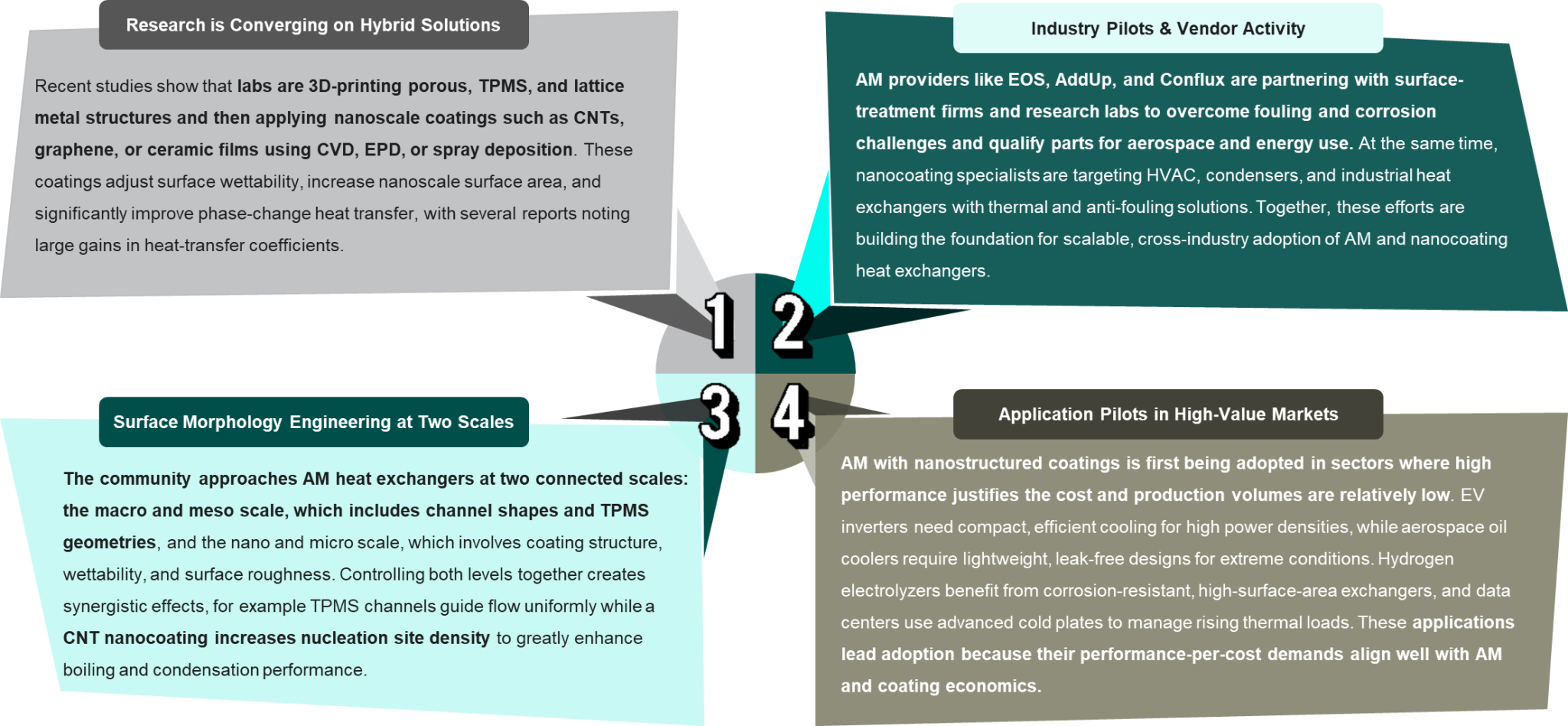
Stellarix is actively supporting organizations with market intelligence, technology intelligence, and opportunity analysis by tracking global developments and identifying suitable opportunities for investments or collaborations. It enables clients to identify collaboration opportunities, benchmark leading research initiatives, and evaluate technology readiness levels (TRLs) to guide strategic investments.
Nanocoatings: Moving from Passive Barriers to Active Thermal Interfaces
Traditional coatings are defensive, whereas Nanocoatings are functional and actively manipulate fluid at the molecular level. For a strategist, this represents an opportunity to shift the lens from material science to system engineering.
The four pillars of molecular heat control:
1. Enhanced Thermal Pathways (Source): Nanomaterials such as graphene sheets and carbon nanotube (CNT) forests offer extremely high in-plane thermal conductivity. When applied as conformal coatings on AM heat exchanger walls, they reduce thermal contact resistance, boost effective conductivity, enable faster heat extraction from hotspots, and provide more uniform temperature distribution across the heat exchanger.
2. Phase-Change Amplification (Source):
- Superhydrophilic, micro/nano-roughened surfaces increase nucleation site density, which delays critical heat flux (CHF) collapse.
- Surfaces engineered with controlled hydrophobic patches promote dropwise condensation, which offers heat transfer coefficients an order of magnitude higher than traditional condensation.
- When phase change amplification is further combined with additively manufactured microchannels, the surface effects enhance significantly, unlocking the efficiency levels that cannot be achieved by conventional heat exchangers.
3. Anti-Fouling and Anti-Corrosion Protection (Source): Efficiency of heat exchangers is often limited by biofouling, scaling, and corrosion, especially when used with seawater, brines, or any other dirty industrial fluids. Nano coatings provide multiple defensive strategies:
- Ceramic-based coatings act as chemically inert barriers against corrosion.
- Biocidal nanofilms prevent microbial growth and biofilm formation.
- Graphene and other 2D nanolayers are nearly impermeable to ions and water, shielding the substrate from corrosive attack.
By reducing fouling and corrosion, nanocoatings extend operational lifespans, maintain efficiency, and cut costly downtime.
4. Nanoscale Surface-Area Multiplication (Source): Nanostructured coatings add an entirely new dimension of effective surface area at the microscopic scale.
- CNT forests and high-aspect-ratio nanostructures increase the contact area between the solid and fluid.
These features induce localized turbulence and micro-mixing near the wall, disrupting thermal boundary layers. As a result, convective heat transfer is boosted far beyond what is achievable through macro-geometry design alone.
The transformation path from laboratory nanocoatings to industrial-scale heat exchangers is filled with IP minefields and integration hurdles. Stellarix bridges this gap by providing R&D leaders with cross-industry technology intelligence, identifying the exact partners and process chains needed to move from concept to commercialization.
Process Chains for Combining Additive Manufacturing and Nanocoatings in Heat Exchangers
The integration of AM with nanocoatings is a carefully engineered process that maximizes the performance, durability, and manufacturability of the solution. Below are a few case examples to highlight the advancements in each step:

- Printing the Metallic Core: Additive manufacturing provides the complex metallic architecture, the heart of next-generation heat exchangers. Industry leaders like Conflux Technology and HiETA Technologies have proved that achieving ultra-thin walls around 150 µm is possible. Therefore, if R&D teams are not designing heat exchangers for these limits, then they are over-engineering weight and under-engineering the density.
- Post-processing and Surface Readiness: Nanocoatings require atomic-level smoothness in the surface. Whereas the products that come out from AM are rough with Ra values between 5–20 µm, which can compromise nanocoatings’ adhesion. Pioneers like Purdue and Fraunhofer are defining the “Surface Finishing” protocols that make Nano coatings viable in commercial production.
- Nano coating Application: Depending on performance requirements, several nanoscale coating approaches are applied:
- CVD/ALD Nano Coatings: These provide best-in-class performance and are actively being researched/developed by MIT, Rice University, Leibniz Institute for New Materials, and many more
- Liquid-Applied Nanocomposites:
- Nano Surface Solutions (Switzerland) markets proprietary hydrophobic Nano coatings against scaling and fouling.
- HydroVentiv (France) applies liquid nanocomposite films to reduce biofouling in water-based exchangers.
Although these integrated approaches remain experimental, they offer the promise of eliminating multiple downstream process steps and achieving coatings with unprecedented adhesion and conformity.
Key Innovators Driving AM & Nanocoatings in Next-Gen Heat Exchangers
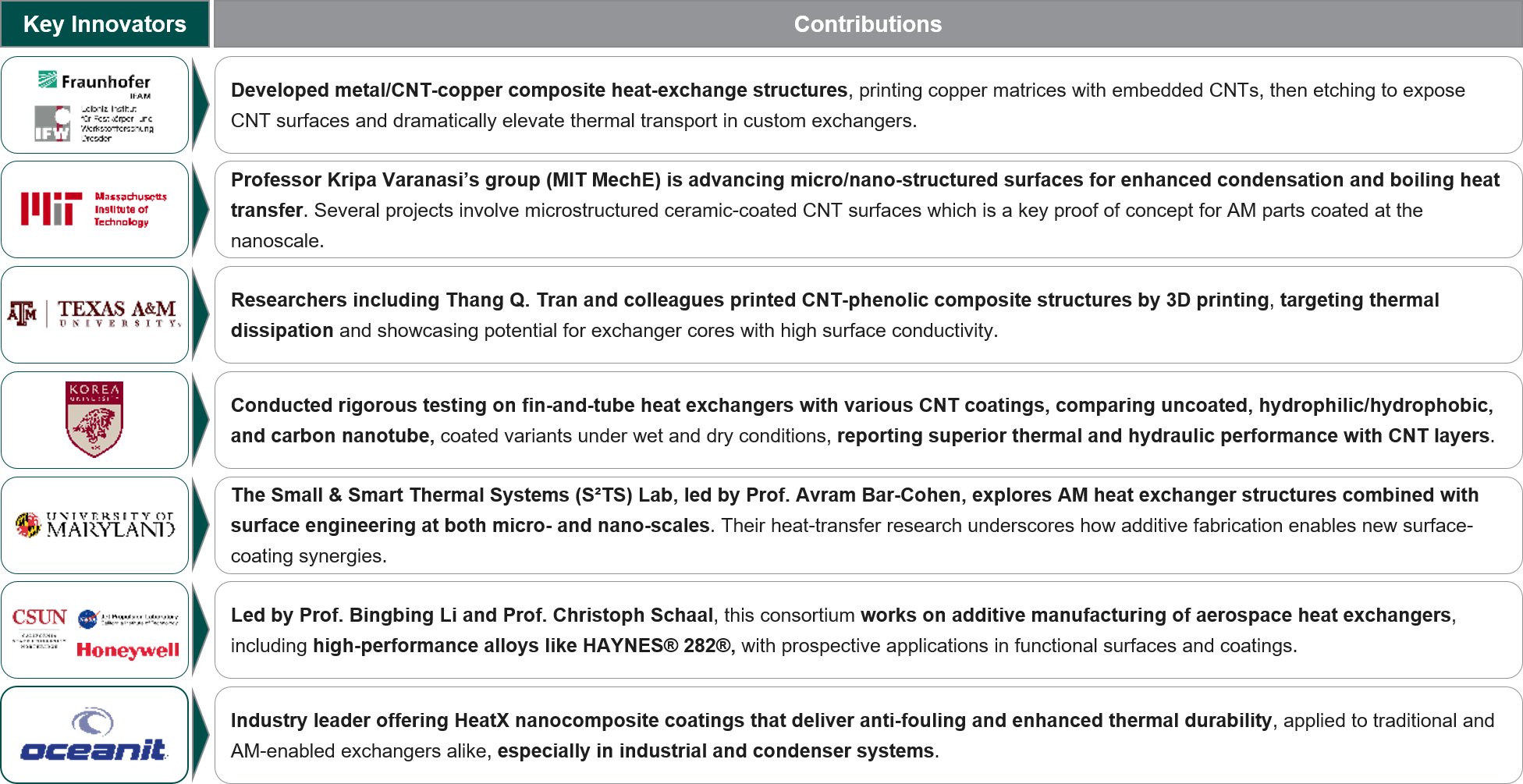
During our recent literature analysis, we observed that there is continuous research by universities, research institutions, and corporations for advancement in nanoscale surface science across the globe. Industry players are commercializing coatings and complex AM geometries. A few examples are provided below:
The Market Validation
The transition from lab to industry is not theoretical; the examples below demonstrate how cross-sector partnerships are solving the most “unsolvable” thermal bottleneck:
1. Conflux Technology & GKN Additive: Australian AM innovator Conflux Technology partnered with GKN Additive to bring 3D-printed, topology-optimized heat exchangers to Europe. The collaboration between these 2 companies is primarily aimed at bringing metal 3D printing capabilities to applications in automotive, electronics, energy, and aerospace industries. (Source)
2. HiETA Technologies & Renishaw: UK-based HiETA Technologies, in collaboration with Renishaw, pushed the envelope on thin-walled AM heat exchanger production. They validated leak-free Inconel walls as thin as 150 microns using Renishaw’s AM250 system. The outcome was components that were 30% lighter and more compact, with validated thermal and fluid-flow performance. Through optimized machinery and software, the collaboration also cut build time from 17 days to only 80 hours. (Source)
3. NASA JPL / Fabrisonic (Ultrasonic AM): NASA’s Jet Propulsion Laboratory, working with Fabrisonic, used Ultrasonic Additive Manufacturing (UAM) to fabricate heat exchangers with channel widths from 0.02 inches up to over 1 inch. They have presented their commercialization potential by scaling it up to 4-foot length for advanced thermal management applications. (Source)
Stellarix supports their partners with patent landscape evaluations, opportunity assessment, and partnership analysis to uncover opportunities across additive manufacturing and nanocoating ecosystems. Stellarix helps identify leading academic, industrial, and R&D collaborators while evaluating technology synergies, co-development potential, and market scalability.
The Entry Barriers
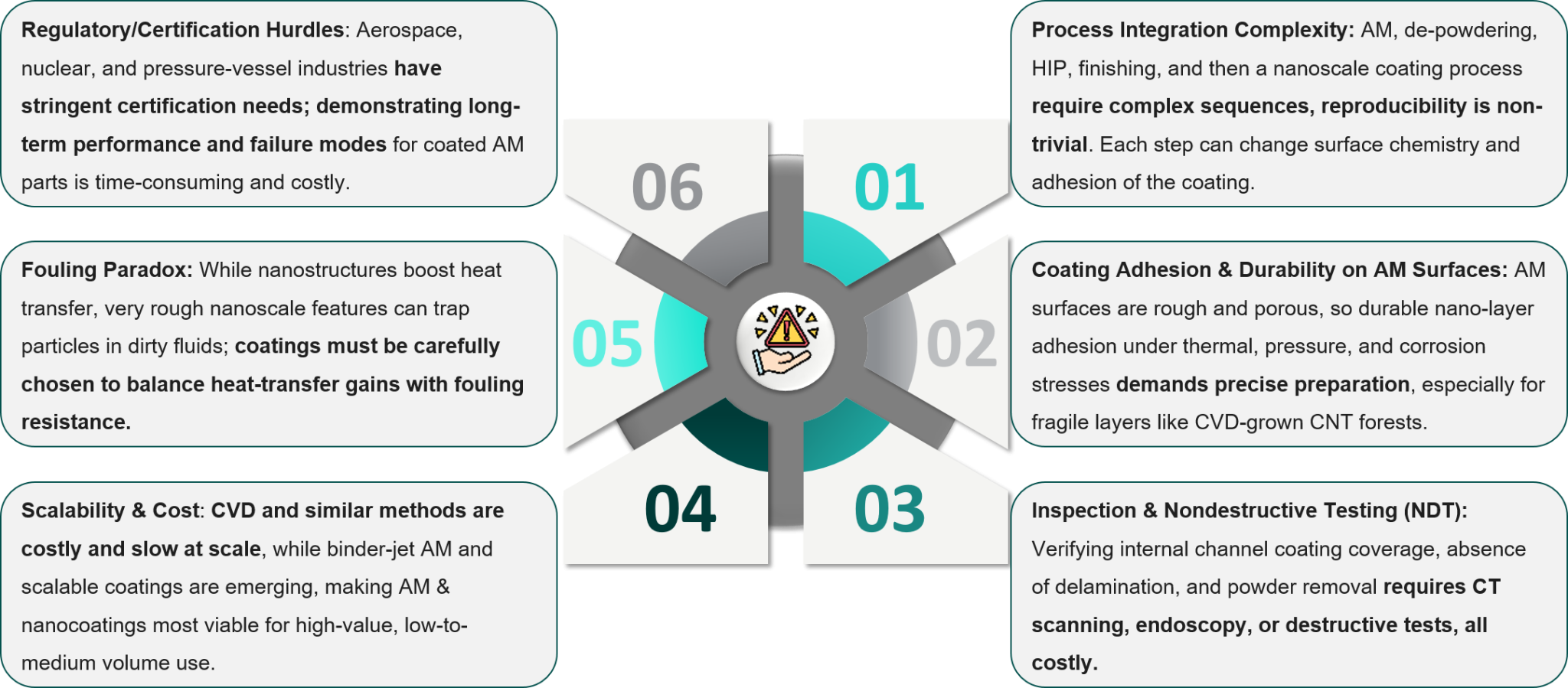
While next-generation AM & nanocoated heat exchangers promise unprecedented performance, their path to mainstream adoption is far from straightforward. Technical, economic, and regulatory barriers continue to shape how, and how fast, these innovations can scale from lab to industry.
The Future of Thermal Strategy
As we are approaching the end of this decade, the ability to manage extreme heat fluxes will define the winners in AI, Datacenters, Aerospace, and Electrification.
In the next 8-10 years, Generative Designs will start making complex biomimetic designs with self-diagnosis and optimization in real time. Emerging ESG mandates and efficiency standards will push the industry players towards AM and nanocoatings for regulatory compliance. We have already started witnessing the industry convergence where liquid-cooling breakthroughs for AI data centers are directly informing the next generation of ultra-fast EV charging.
However, in your journey from research pilot to a scalable solution, Stellarix can act as your strategic intelligence layer to de-risk this roadmap. By mapping the global IP landscape, vetting the TRL (Technology Readiness Level) of emerging startups, and scouting niche manufacturing partners, we help you turn “Lab Physics” into a proprietary competitive advantage.
Let's Take the Conversation Forward
Reach out to Stellarix experts for tailored solutions to streamline your operations and achieve
measurable business excellence.