Breaking Barriers: The Rise of Needle-Free Drug Delivery Solutions

For over a century, needles have been synonymous with drug delivery. From routine vaccinations to the management of chronic disorders such as diabetes, injections have remained a medical backbone. But this long-standing standard comes at a price—pain, fear, risk of contamination, and reduced patient compliance. Today, in a world increasingly shaped by patient-centered care and technological innovation, a new frontier is emerging: needle-free drug delivery.
With recent developments in engineering, biotechnology, and materials science, needle-free solutions are not just possible—they’re becoming viable, scalable, and in some cases, superior to traditional injections. This article discovers the evolving landscape of needle-free drug delivery, examining the technologies driving it forward, the clinical and commercial opportunities they unlock, and the barriers that must be overcome before they become the global norm.
Problem with Needles
With rising healthcare costs and global demand for home-based and painless delivery systems, the conventional needle-based delivery system is increasingly being seen as outdated and limiting. Several key challenges highlight the urgent need for safer, scalable alternatives:
- Needle Phobia: Children, as well as some adults, report anxiety or fear associated with needles. This fear, known as trypanophobia, often leads to skipped vaccinations or avoidance of essential treatments, particularly in chronic conditions that require regular injections.
- Risk of Injury and Infection: Accidental needle-stick injuries among healthcare workers are a serious concern, with the potential to transmit life-threatening infections like HIV or hepatitis B/C. These risks are even greater in low-resource environments where proper safety measures may be hard to enforce consistently.
- Disposal and Environmental Burden: Every used needle must be disposed of carefully to avoid contaminating communities or the environment. Unfortunately, improper disposal is still a widespread problem globally, posing both ecological and public health threats.
- Barriers to Access: Injections often require trained professionals and clinical infrastructure, making access difficult for people in rural, remote, or underserved areas.
These limitations have catalyzed demand for alternatives that are safe, self-administered, and easy to deploy at scale.
Explore the future of needle-free delivery — download the full insights now.
Needle-Free Technologies on the Rise
Needle-free systems aim to deliver the same therapeutic effects as injections, without the drawbacks. Current technologies include:
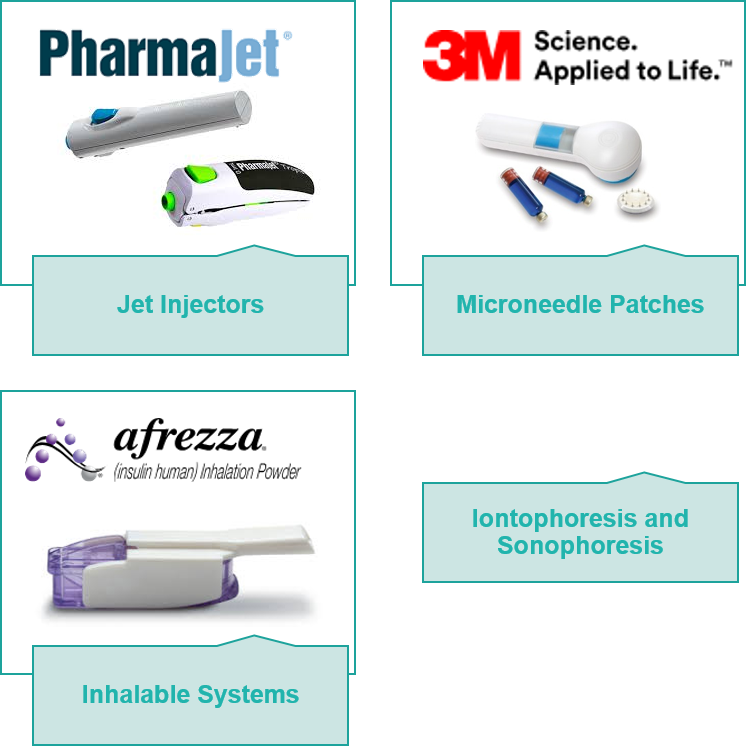
Jet Injectors: These injectors use a high-pressure stream of liquid to penetrate the skin and deliver medication intradermally, subcutaneously, or intramuscularly. Spring-loaded or gas-powered, these devices enable fast, pain-minimized delivery without breaking the skin with a needle. PharmaJet’s Stratis and Tropis devices are WHO-prequalified and used globally for vaccine delivery, including during polio eradication efforts.
Microneedle Patches: These are tiny projections, often thinner than a human hair, that pierce only the outermost layer of skin. Microneedle patches can be solid (coated with the drug), dissolvable (made from biodegradable polymers), or hollow (for fluid transport). 3M’s Hollow Microstructured Transdermal System is being developed for vaccines and biologics.
Inhalable Systems: Pulmonary drug delivery allows drugs to be absorbed via the alveolar membrane in the lungs, offering rapid systemic uptake. Ideal for both local respiratory treatments and systemic therapies like insulin or vaccines. Afrezza®, an inhaled insulin product by MannKind, delivers rapid-acting insulin via a dry powder inhaler.
Iontophoresis and Sonophoresis: These techniques use electrical currents or ultrasonic waves to increase the permeability of the skin, facilitating the transdermal delivery of larger molecules that would not normally cross the skin barrier.
Clinical Applications and Emerging Use
Needle-free technologies aren’t just a concept; they’re already reshaping patient care across multiple areas:
- Vaccines: In large-scale immunization drives, especially during pandemics, needle-free delivery simplifies logistics, eases patient flow, and lessens the strain on healthcare workers. It also helps overcome vaccine hesitancy linked to needle phobia.
- Diabetes Care: For individuals managing diabetes day-to-day, alternatives to traditional insulin injections, like microneedle patches or inhalable insulin, offer a more comfortable, discreet, and patient-friendly experience, leading to better adherence and outcomes.
- Hormone Therapies: Transdermal patches for hormones such as testosterone or contraceptives have already become mainstream. Now, newer microneedle systems are making these therapies even easier and more convenient to use, without sacrificing efficacy.
- Pain and Migraine Management: When it comes to treating migraines or acute pain, speed matters. Needle-free methods can deliver medication quickly and easily, giving patients faster relief without the hassle of injections.
- Pediatrics and Geriatrics: Children and older adults often struggle the most with needles. Non-invasive delivery systems not only reduce discomfort but also improve medication adherence and ease the burden on caregivers and healthcare staff.
Competitive Players
The needle-free drug delivery field is bustling with innovation, from traditional jet injectors to microneedles. The key players (PharmaJet, Antares, Crossject, 3M, etc.) dominate through robust tech and partnerships, while emerging players (IntegriMedical, ApiJect, Portal) bring tech-specific promise.
| Company | Country | Technology Focus | Key Products / Platforms | Notable Strengths/Differentiators |
|---|---|---|---|---|
| PharmaJet/PenJet | USA | Jet Injector (Spring-powered) | Tropis® | Stratis® | PenJet® | WHO-backed; used in global immunization programs |
| Bioject Medical Tech | USA | Jet Injector (CO₂-based) | Biojector® 2000 | Supported by Serum Institute, emerging markets |
| NuGen Medical Devices | Canada | Jet Injector (Insulin-focused) | InsuJet™ | CE-marked; diabetes care |
| IntegriMedical | India | Jet Injector (Low-cost prototype) | N-FIS | Peptide drug delivery for diabetes and obesity |
| Zealand Pharma | Denmark | Microneedle & Transdermal Patch | ZP Patch | Peptide drug delivery for diabetes, obesity |
| Micron Biomedical | USA | Dissolvable Microneedle Patch | Vaccine delivery patches | Paediatrics, pain-free administration; global health focus |
| Vaxxas | Australia | High-Density Microneedle Array | HD-MAP™ | Thermostable vaccine patch; robust delivery tech |
| MannKind Corporation | USA | Inhalable / Pulmonary | Afrezza® (inhalable insulin) | Needle-free via lungs; ultra-rapid acting insulin |
| ApiJect Systems | USA | Prefilled Disposable Injectors | ApiJect BFS system | Blow-Fill-Seal; scalable for mass vaccination |
Challenges to Widespread Adoption
Despite the promise, needle-free technologies face significant barriers:
- Formulation Constraints: Many large-molecule drugs (e.g., monoclonal antibodies) are not yet compatible with needle-free methods due to stability or volume requirements.
- Device Complexity and Cost: Precision manufacturing and advanced materials can drive up production costs, affecting scalability and affordability.
- Regulatory Hurdles: Combination products (device + drug) often face complex approval pathways and require evidence of equivalence or superiority to injections.
- Patient and Provider Education: Adoption depends on trust and familiarity. Both clinicians and patients may need retraining to use and accept new delivery modalities.
Conclusion
Needle-free drug delivery is not just a technological trend—it’s a paradigm shift. It addresses long-standing challenges in medication adherence, patient comfort, and healthcare delivery logistics. While the road to universal adoption involves overcoming technical, regulatory, and behavioral hurdles, the momentum is undeniable. By breaking away from the needle, the healthcare industry is embracing a future that is less painful, more efficient, and ultimately, more human-centered.
Let's Take the Conversation Forward
Reach out to Stellarix experts for tailored solutions to streamline your operations and achieve
measurable business excellence.