Liquid Cooling: The New Backbone of High-Density Data Centers
Global demand for computing power is rapidly accelerating, driven by digital transformation and explosive growth in artificial intelligence. In response to AI expansion, the emergence of edge computing, and advancements in high-performance computing, data centers are expected to require more than USD 6 trillion by 2030 for expanding data center capacity, with an additional USD 5 trillion investment to fulfill demand for AI alone. With the latest estimates, the current global data center capacity is expected to double in the next 5 years, from ~103 GW in 2025 to ~200 GW in 2030. Generative AI is acting as a key driver for this shift, as forecasted to represent the 50% of all the data center capacity by 2030, when compared with 25% in 2025.
This rapid expansion of data center capacity is also driving the shift towards high-density data centers that enable better use of space, improve operational efficiency, and support faster data processing. Traditionally, data centers were operated at rack densities of 5–10 kW, relying on traditional air cooling systems. In today’s scenario, they are being replaced by AI-and GPU-intensive systems that are currently operating at 30–50 kW density per rack, and are anticipated to exceed 80-120 kW per rack in next-generation AI platforms in Hyperscale and research environments. As power density demand accelerates, new efficient and sustainable approaches to thermal management become essential.
Global Liquid Cooling Market Outlook
At present, the global data center market is experiencing rapid growth and is expected to increase from USD 380–400 billion in 2025 to around USD 620-650 billion by 2030, with an annual compound growth rate of approximately 11%. It is anticipated that the majority of new capacity additions will be dominated by hyperscalers and edge data centers. North America will remain in a dominant position by installed capacities; however, the Asia-Pacific region will be the fastest-growing market since the region is expanding its digital services, cloud computing, and data localization initiatives.
Due to a surge in power density demand, there would be a huge impact on the data center liquid cooling market size since next-generation data centers have to rely on liquid cooling technology to manage heat generation at high rack density. In 2025, the data center liquid cooling market was valued at approximately USD 5.5 billion, and is forecasted to reach ~USD 18.7 billion by 2031, growing at a CAGR exceeding 20%. Higher growth rate is attributed to the adoption of direct-to-chip cooling in hyperscale and retrofitting legacy infrastructure, while immersion cooling is gaining momentum in ultra-high-density AI and HPC environments.
Limitations of Air Cooling in High-Density Environments
With rising power density demand, thermal management becomes the critical challenge in data center operation because traditional air cooling systems could support the cooling of a data center with rack density up to 25kW, and become inefficient in managing AI and HPC workloads. Air cooling technologies face challenges in dissipating high thermal loads due to their physical limitations in airflow, heat transfer capacity, increased energy consumption, and poor power usage effectiveness (PUE). Further, the use of the air-cooling method in high-density racks creates localized hot spots that may increase the risk of equipment failure.
In addition, there is a significant sustainability pressure on data center operators driven by higher energy consumption for air cooling (~40% of total energy consumed by a data center), increased water usage, and reduced energy efficiency (energy waste) at high operating costs.
As a result of these challenges, air cooling methods seem no longer a practical option for next-generation data center cooling. To address these challenges, the industry has shifted its focus toward advanced cooling solutions, particularly liquid cooling, that support higher power densities while improving energy efficiency, reliability, and sustainability.
The Growing Need for Liquid Cooling in Modern Data Centers
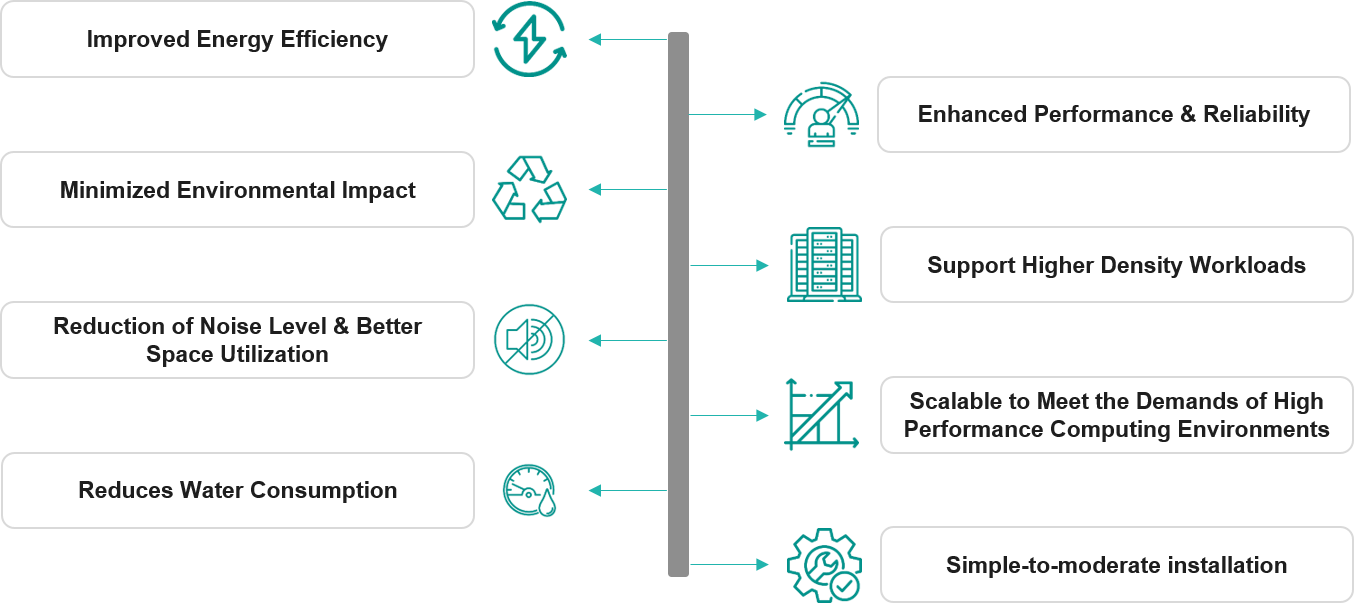
Liquid cooling emerged as a disruptive innovation in data center cooling, offering significantly higher heat removal efficiency than conventional air-based cooling. This performance is primarily observed because of two major reasons, which include the superior heat transfer capacity of liquids and the ability to remove heat directly from the source, such as CPUs, GPUs, power electronics, etc. The excellent thermal management capabilities make liquid cooling the best option for heat management of higher-density workloads, which can be achieved while keeping energy consumption low and improving overall system performance and reliability. The use of liquid cooling enables data centers’ operations at reduced noise levels due to reduced fan usage, allows better space utilization, and helps to comply with sustainability goals, resulting in improved energy efficiency and reduced water usage.
Types of Thermal Management Systems in Data Centers and Liquid Cooling
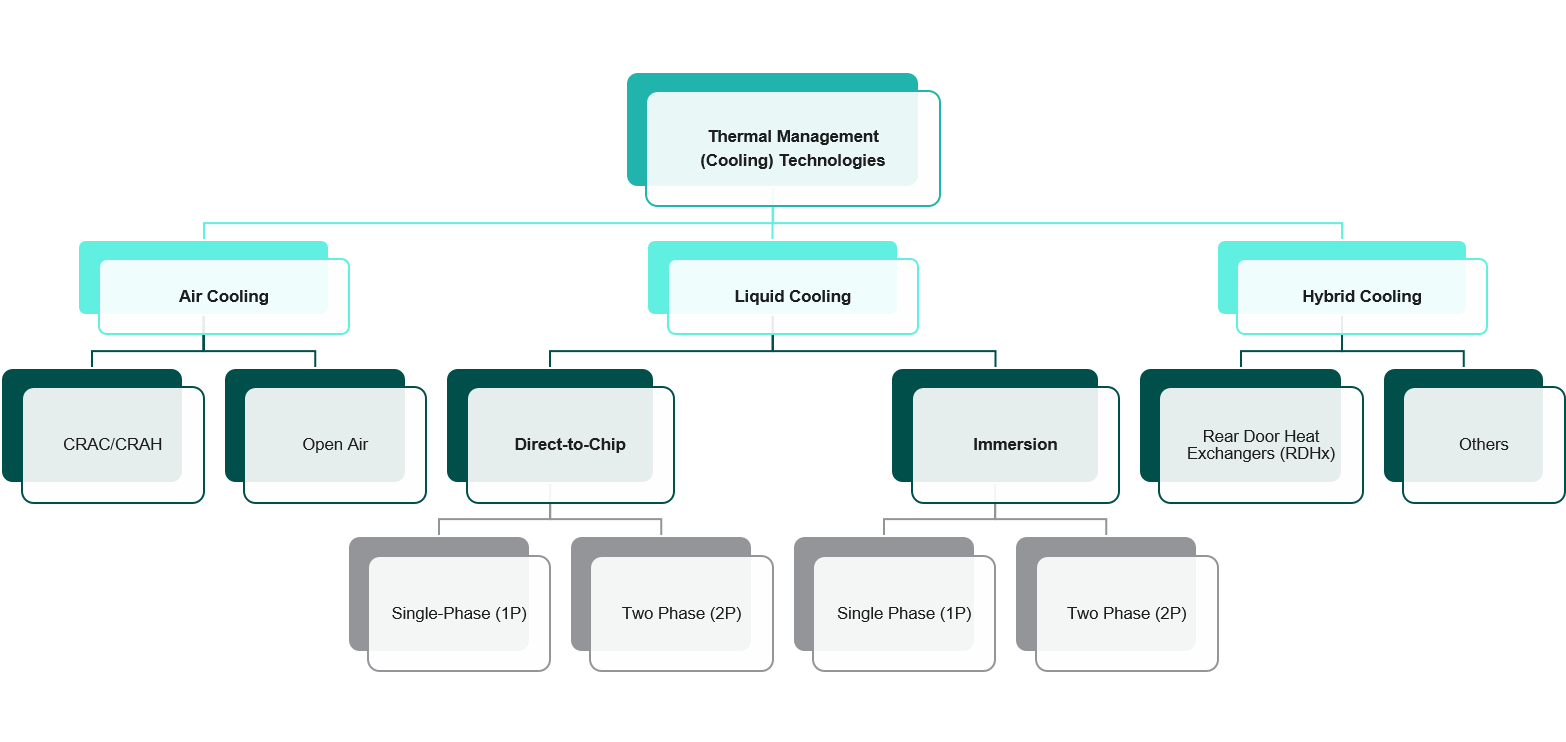
Liquid cooling can be achieved through different mechanisms with unique advantages associated with each technology. Its mechanism of working involves the circulation of a thermally conductive dielectric coolant liquid through IT components such as CPUs, GPUs, and memory modules to absorb generated heat. The heated coolant is then transferred to heat exchangers or a cooling unit, where heat is dissipated. Based on the design approach, there are three main types of liquid cooling methods: Direct-to-Chip Cooling, Immersive Liquid Cooling, and Rear Door Heat Exchangers (RDHx).
Direct-to-Chip (DTC) Liquid Cooling
Direct-to-chip liquid cooling, also known as cold plate cooling, involves the removal of heat directly from the surface of high heat-flux components such as CPUs, GPUs, etc., by circulating dielectric cooling fluid. In the method, heat is transferred from the chip to the liquid and rejected outside the rack via a cooling distribution unit (CDU).
Direct-to-chip cooling is classified into two segments based on the cooling mechanism:
- Single-phase DTC: Liquid coolant absorbs heat via cold plates and remains in liquid form throughout the loop. The heat is rejected through a heat exchanger.
- Two-phase DTC: A low-pressure dielectric fluid boils at the chip surface and converts into a vapor state, carrying heat away before condensing outside the rack.
Key advantages offered by the DTC method include high precision with minimal risk, high thermal resistance that enables efficient cooling, seamless integration in existing server designs (legacy infrastructure), and low servicing & maintenance costs.
An important thing to notice is that the Direct-to-Chip liquid cooling system removes 70-75% of rack heat through liquid; however, it has an inherent limitation that supplementary air cooling is still required to remove 25-30% of residual heat from other components, such as memory, drives, and auxiliary components.
Immersion Liquid Cooling
This method involves the complete immersion of the entire IT equipment (server) inside a bath of nonconductive dielectric liquid that directly absorbs heat from electronic components. The heated liquid naturally rises and is removed from the system and replaced by cooler liquid. Immersive liquid cooling is also segmented into two types based on the cooling mechanism.
- Single-phase Immersion: Entire servers are fully immersed in a dielectric liquid that remains in a liquid phase. Heat is removed via fluid circulation and external heat exchangers. Key advantages offered include low fluid loss, non-toxicity, low cost, and lower maintenance.
- Two-phase Immersion: Servers are immersed in a dielectric fluid that boils at a low temperature and vaporizes by absorbing generated heat. The vapor condensed back in a condenser coil, delivering superior thermal performance and lower PUE by eliminating intermediate heat exchangers.
Immersive liquid cooling is simpler in design and offers better space efficiency, total cost of ownership, improved PUE, and higher flexibility. Unlike direct-to-chip cooling, it operates without the need for supplementary air-cooling systems.
Rear Door Heat Exchangers (RDHx)
Rear door heat exchangers (RDHx) are a technology wherein a cooling device is placed on the rear side of the server rack to remove heat from exhaust air before it enters the data center room. It helps in reducing the thermal load on the room’s HVAC system. This system mostly works based on a liquid-to-air heat exchanger mechanism.
RDHx technology is typically considered the bridge technology between traditional air cooling and advanced liquid cooling, and can be effectively retrofitted in the existing air-cooled facilities.
Comparative Mapping: Liquid Cooling Technologies Vs Air Cooling
Though liquid cooling technologies have emerged as viable and scalable alternatives for data centers, there is no one-size-fits-all approach because each data center faces distinct thermal challenges that demand different cooling strategies. For instance, in today’s scenario, the data centre ecosystem is still dominated by traditional workloads (legacy infrastructure); however, AI-based data centers are rapidly increasing their share and are expected to represent a substantial portion within a few years. When deploying liquid cooling, operators must wisely choose between retrofitting existing facilities, hybrid cooling, and liquid cooling in alignment with workload requirements and facility type. The table below provides a detailed comparative summary of liquid cooling technologies relative to traditional air-cooling.
| Parameters | Air Cooling | Direct-to-Chip Cooling | Immersive Liquid Cooling | Rear Door Heat Exchangers (RDHx) |
| Power Density Support | Up to 30 kW per rack | ~30-100 kW per rack | ~50-250 kW per rack | ~20-60 kW per rack (bridge solution) |
| Power Usage Effectiveness (PUE) | ~1.4–1.8 | ~1.15-1.30 | ~1.05 – 1.15 | 1.25 – 1.45 |
| Cooling Efficiency | Low heat transfer capacity creates hot spots at higher power density | High due to localized liquid conduction | Highest because the entire hardware is in a fluid | Moderate, improves air cooling by extracting waste heat |
| Energy Efficiency | – | ~10 – 20% reduction in energy consumption | ~30-40% or up to 60% reduction in energy consumption | ~5-15% reduction in energy consumption |
| Thermal Hotspots | Frequent at high density, which may result in equipment failure | Minimal due to direct heat extraction from the source | Very low due to complete immersion | Improved over air-based cooling alone |
| Operating Noise | High due to fans & chillers | Low | Very low | Moderate |
| Retrofitting Suitability | – | Good for retrofitting | Very limited retrofit suitability | Excellent for retrofitting with legacy infrastructure |
| Upfront Capital Cost (CAPEX) | Lowest | Medium-High | Highest | Low-Medium |
| Operation Expenditure (OPEX) | High operational cost for high power density | Lower than air cooling | Lowest long-term OPEX | Moderate reduction vs air cooling |
| Water Usage | High | Low | Very Low | Moderate |
| Best Use Cases | Legacy Infrastructure (low-mid power density | High-density AI/HPC clusters | Extreme density HPC/AI/cloud at Hyperscale | Retrofit legacy infrastructure & hybrids |
Table 1: Comparative Mapping of Different Liquid Cooling Technologies Against Air-cooling
Players’ Ecosystem in Liquid Cooling Technologies
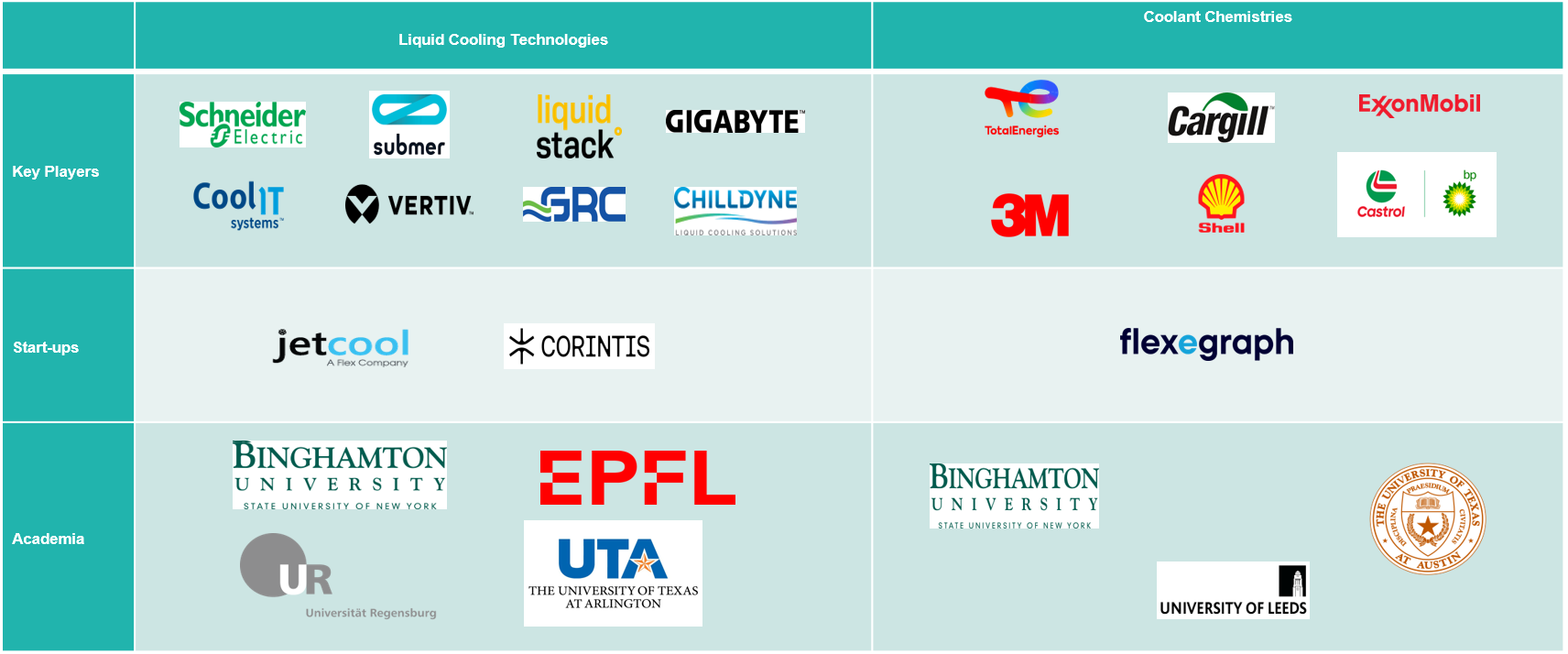
Liquid cooling technologies have evolved from the nascent stage to a core enabler for next-generation data centers. As data centers’ power density demands are increasing with rising demands for AI and high-performance computing workloads, cooling infrastructure has transitioned from room-level to rack-level control, and nowadays, is exploring component heat removal, enabling excellent thermal management with reduced hot spots at much higher rack densities.
On the other hand, with the evolution of liquid cooling technologies, coolant chemistries are also becoming of paramount importance. Well-explored coolant fluids are being adopted in current liquid cooling systems, such as water/water-glycol mixtures, mineral oils, and fluorinated dielectric fluids; however, these fluids are becoming inefficient to support the high rack density data centers’ requirements. As a result, cooling fluids with higher heat removal capacity, lower environmental impact, better material compatibility, and long-term reliability are gaining traction in the industry, since they address both sustainability goals and long-term operational durability.
Commercial Deployment of Liquid Cooling Technologies
As of 2025, air-based cooling technology still dominates the data center cooling market by ~65-80%, Specific to liquid cooling, Direct-to-Chip liquid cooling has emerged as the most widely adopted solution, representing around 40-45% of the commercial market in the liquid cooling segment. This dominance is attributed to its ability to integrate with existing facilities and support high power densities without major facility redesign. In contrast, immersion cooling is gaining traction in hyperscale and extreme-density environments. Mainstream players in direct-to-chip technology are CoolIT Systems, ZutaCore, Vertiv, Asetek, etc., whereas Green Revolution Cooling (GRC), Submer Technologies, LiquidStack Holding B.V., etc., are leading from the immersion cooling front.
On the coolant side, water & water-glycol mixtures are widely used in direct-to-chip and rear-door-heat exchanger systems due to their excellent heat capacity, low cost, and ease of handling, while Immersion cooling systems rely on mineral oils and fluorinated dielectric fluids.
Emerging Innovation & Start-Up Activities
Innovations in liquid cooling are primarily focusing on streamlining and addressing the existing first-generation systems. Activities are concentrated around advanced immersion cooling (both single-phase & two-phase), novel microfluidic/ micro-convective direct-to-chip cooling, hybrid cooling systems, and integration of AI/ML-driven thermal optimization. At the same time, bio-based, low-GWP, and environmentally safer dielectric fluids are gaining traction due to regulatory pressure.
JetCool Technologies: Developed micro-convective cooling technology that uses arrays of small fluid jets to target hot spot regions precisely, enabling cooling performance at the chip or device level to support thermal loads above 1,000 W per component.
Corintis: a Swiss-based start-up developing advanced microfluidic cold-plate technologies that target heat removal directly from chip-level hotspots.
Early-Stage Research and Future Innovations
Academic players are exploring novel cooling concepts with long-term disruptive potential to shape the future roadmap of data center thermal management. Key technological areas in focus include next-gen immersion and adaptive cooling, closed-loop thermal capture & heat reuse, nano-enhanced dielectric fluids, supercritical fluids, etc.
Key Challenges Ahead of Liquid Cooling Technologies
Although liquid cooling technology offers superior benefits such as energy efficiency and superior ability to cool higher-density data centers, there are several challenges that need to be addressed to enable its faster and widespread adoption.
Material-Coolant Compatibility & Corrosion: In liquid-cooled data centers, cooling fluids are in continuous contact with metals and other materials. If cooling fluids are incompatible, their exposure to metals and other materials may result in galvanic corrosion and chemical degradation of piping, fittings, cold plates, and heat exchangers. Thereby, incompatibility of cooling fluids jeopardizes thermal performance and reliability.
Elastomer/Seal Degradation and Leaching: Flexible materials such as gaskets, O-rings, hoses, and seals are highly sensitive to coolant chemistries. Prolonged exposure to dielectric fluids or glycol leads to swelling, cracking, particle leaching, etc., which compromises sealing integrity and increases leakage risk.
Coolant Aging and Chemical Breakdown: Some coolants are susceptible to oxidation, and thermal degradation may generate acidic or particulate by-products that may affect heat transfer efficiency or maintenance cost.
Coolant Selection & Formulation Trade-Offs: While selecting coolants, balancing thermal performance, material compatibility, cost, safety, and environmental impact becomes paramount in importance.
Sustainability Consideration: Sustainability remains a critical challenge for liquid cooling adoption in data centers as current liquid cooling systems rely on the use of fluorinated dielectric fluids, hydrocarbons, specialty polymers, etc., that have high global warming potential and limited recyclability.
Component-Level Compatibility in Immersion Systems: In immersion cooling, all components are submerged in a fluid medium, wherein there is a chance of chemical degradation of plastics, coatings, and electronic materials such as PCB coatings, connectors, thermal interface materials, etc.
Other Operational Challenges: High upfront capital investment, integration and retrofit complexity, maintenance expertise, lack of standardization, etc.
Conclusion
The rapid growth of AI, HPC, and high-density computing has pushed data center operators to think beyond the limits of traditional air-cooling. As demands for high rack densities are rising, liquid cooling technology is no longer an optional requirement but has become a strategic necessity for next-generation data centers.
The rapid adoption of direct-to-chip cooling is scaling for its seamless integration into legacy infrastructure and better thermal performance. On the other hand, while immersion cooling is being chosen for initial stage deployment, there are still gaps related to operational efficiency, material compatibility, and long-term reliability that need to be bridged.
Considering the importance of liquid cooling technology, investments are increasingly directed toward advancing the liquid cooling infrastructure, upgrading coolant chemistries, and enabling the seamless integration with existing and future data centers.
Going forward, for successful adoption of liquid cooling, data center operators, equipment manufacturers, and ecosystem partners must align with workload requirements, facility type, and long-term sustainability goals, while balancing the trade-off between thermal performance, material compatibility, cost, safety, and environmental impact.
At Stellarix, we support businesses across the liquid cooling value chain with strong capabilities around coolant chemistries, materials compatibility, and sustainability considerations. Our services span from identifying alternative and compatible materials, comparative mapping, benchmarking performance, mapping active ecosystems, and finding the best partners suitable for business collaborations and co-development.
Let's Take the Conversation Forward
Reach out to Stellarix experts for tailored solutions to streamline your operations and achieve
measurable business excellence.