Bridging Innovation and Scalable Impact in Surgical Robotics

The Inflection Point: From Hardware Sales to Value Ecosystems
Surgical robotics has reached a crucial milestone. Once considered luxury prestige technologies, robotic platforms are now being seen as essential hospital infrastructure by hospitals worldwide. As the market is expected to grow, it will be business model innovation, not technological advances, that determines which companies dominate future growth.
The traditional capital-intensive model, which relied on multi-million dollar sales of hardware through contracts and proprietary instruments, has been replaced by a service-oriented approach. Although this strategy was successful in healthcare in earlier years, it is increasingly misaligned with modern healthcare economics. Hospitals face rising cost pressures, payers demand outcomes-based accountability, and new entrants target established players with flexible, software-driven solutions.
Business Model Innovation Requirements and Emerging Surgical Robotics
Surgical robotics has revolutionized minimally invasive surgery by providing greater precision, dexterity, and visualization. The original business model, which focused on selling expensive robots, was quite successful in establishing a niche in the market. However, there are several limitations associated with this CapEx-intensive approach.
- High Initial Cost: The notable financial barrier at the outset will make it unavailable to most of the hospitals and health care systems, especially those with tight budgets.
- Utilization Issues: Achieving the maximum in relation to the expended investment in relation to high utilization rates can be challenging, because of the issues of surgeon training, case mix, and scheduling restrictions.
- Poor Scalability: The capital-intensive scheme impedes expansion and market penetration in new markets, particularly in developing nations.
The existing business models in the surgical robotics market are quite restrictive; as the market evolves, there will be a need to shift toward more flexible and value-oriented models.
Emerging Business Model Trends
Surgical robotics is shifting from a traditional capital-focused approach to more flexible, data-driven models and outcomes. The models outlined below are becoming more popular, each providing a unique value proposition and related risks.
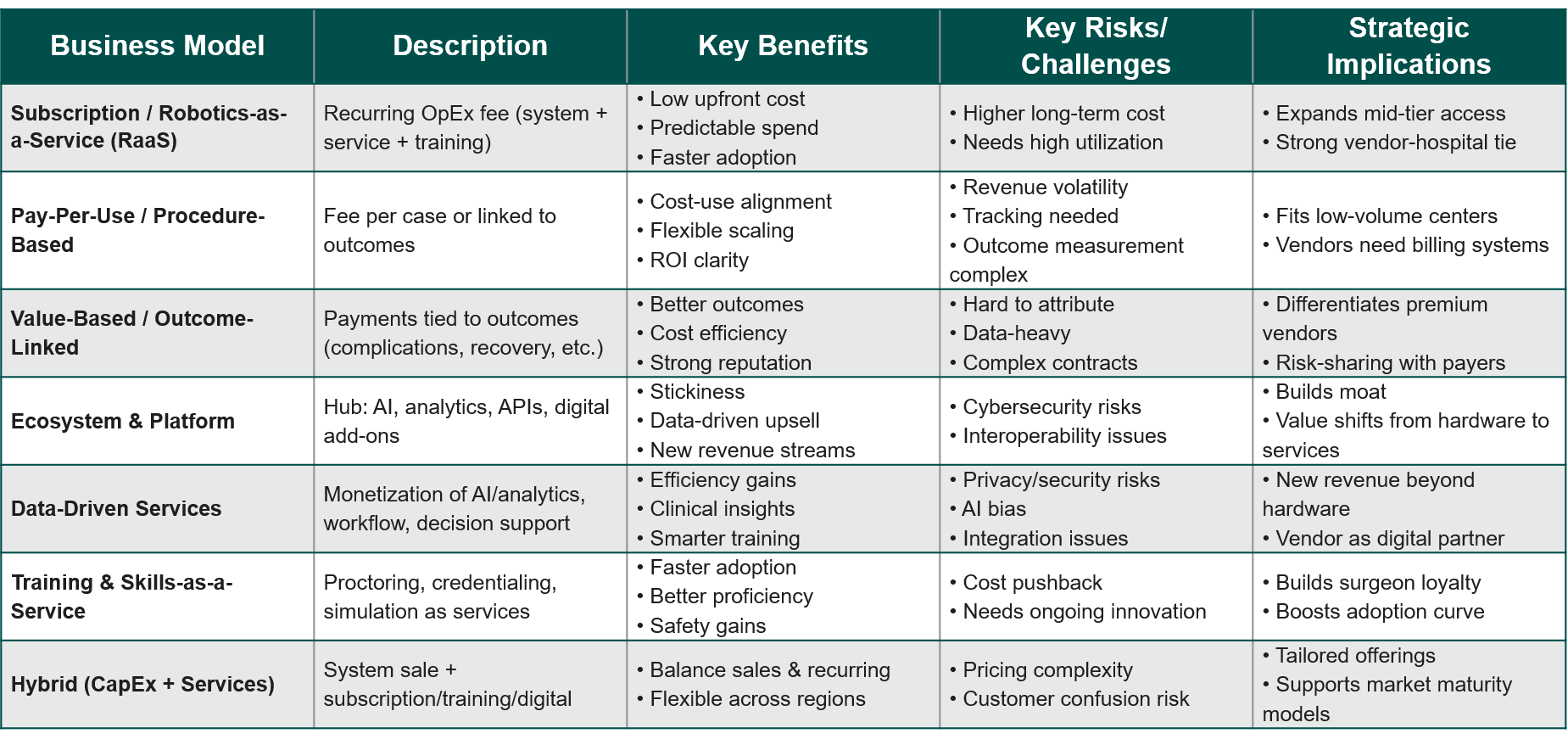
Table 1: Emerging Business Model Trends
Download the full article to map stakeholder-specific outcomes of these models and strategic pathways for a competitive advantage in this ecosystem.
Let's Take the Conversation Forward
Reach out to Stellarix experts for tailored solutions to streamline your operations and achieve
measurable business excellence.