DNA Origami Explained: Trends, Use Cases & Market Outlook

Recently, ‘scaffolded DNA origami’ (DO) has emerged as one of the most promising assembly techniques with many applications. Its core is a long DNA molecule scaffolding through simplified DNA structures for advanced applications. Structures from DNA origami are lightweight, small, and modified for controlled applications. It provides various construction possibilities, gives nanoscale precision, creates dynamic nanostructures, and accurately tunes metabolic and non-metabolic interactions. Recent technological progress paves the way for future applications such as molecular diagnosis, drug delivery, therapeutic applications, fluorescence imaging, superconductive materials, advanced renewable materials, and nanorobots.
DNA Origami and Its Areas of Application
Origami (ori means “folding“& kami means “paper“) is a term associated with Japanese culture and the art of paper folding. Like origami, it is related to the folding of DNA.
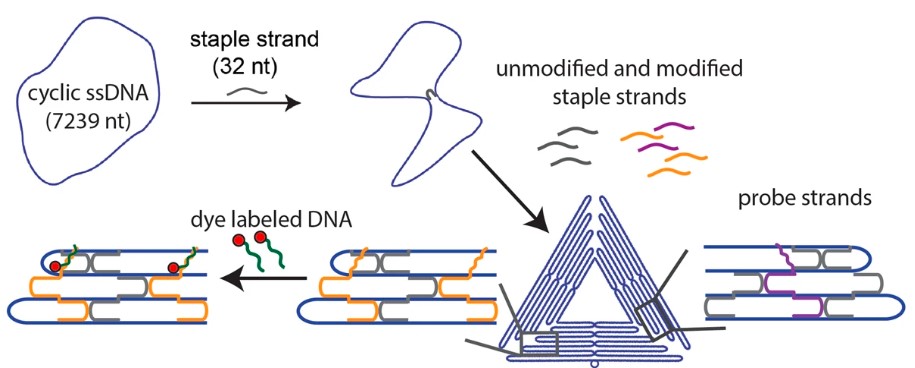
The technology involves designing and building multi-dimensional nanoscale DNA with predetermined characteristics.
Figure 1 shows the conversion of cyclic ssDNA into DNA Origami, wherein long single-stranded DNA is folded into the desired shape by many short DNAs, termed “staple.” Stable strands are further connected on the various sides, depending on the origami structure, using a different process.
It has applications in several therapeutic and non-therapeutic domains, including –
- Delivery: Drugs, proteins, enzymes, antibodies, and nucleic acids
- Therapy: Gene therapy, chemotherapy, immunotherapy, and phototherapy
- Sensing: Bio-sensing (nucleic acid sensing and protein sensing), fluorescence sensing, and chemical Sensing
- Regulation of Reactions – Enzymatic reaction, protein substrate reaction, gene reaction, and metabolic pathway cascade reaction
- Studies of biomolecules, light, energy, and microscopy
- Diagnosis and Detection – Tumours and Viruses
- Nanotechnology– Nanofabrication, nano-photonics, nano-electronics, and nano-robots
Designing and Constructing DNA Origami
DNA origami is a design tool on the nanoscale with wide applications in therapeutics, diagnostics, sensing, biomolecular research, and nanotechnology. DNA origami enables site-specific delivery of drugs, genes, and immunotherapy; site-specific biosensing and detection of tumors and viruses; regulation of biochemical processes; and development of complex nano-devices. Development of a DNA origami shape requires conceptualization of the shape of interest, a box, smiley face, or mini robot, and precise digital designing of DNA strands folding into the shape.
Design Phase
- Computer models map the route of a “scaffold” DNA strand
- Short “staple” strands are programmed to bind at specific points, forcing the scaffold to bend and fold along those lines
- The design ensures that every fold is intentional and every connection is exactly placed
Once the design is ready, the focus shifts to turning it into a real, physical object.
Assembly Phase
- Stage and scaffold are merged in solution (Nuclease-free water, Tris buffer, Mg2+)
- Heating unwinds the strands, and slow cooling allows staples to find their respective locations on the scaffold
- This self-assembly secures the scaffold within the desired 2D or 3D structure
Innovative DNA Origami Designs
Recently, DNA origami has progressed from mere shapes to develop smart, functional nanostructures that can perform real-world problem-solving. The design involves combining precision folding with interaction, which transforms DNA from being just a mass of biological molecules to being akin to a miniature machine.
- Locked DNA Boxes – Very small 3D boxes that remain closed until they recognize a special molecule, used so far for localized drug release within the box.
- Molecular Robots – “Walkers” constructed out of DNA, which can move down a track, grab molecules, and unload their cargoes in special locations.
- Shape-Shifting Structures – Fold/unfold upon stimulus from light, pH, or temperature change, and are like nanoscale switches.
- Virus Traps – Empty DNA carriers that are capable of trapping viruses like Zika or SARS-CoV-2 that are not infectious to cells.
- Artificial Enzyme Platform – DNA structure that keeps enzyme molecules in optimal orientation, significantly enhancing their capability to accelerate chemical reactions.
Recent DNA Origami Technology Trends
Globally, many research organizations are working on improving origami techniques and expanding their applications in the therapeutic and diagnostic areas, especially in drug delivery and fluorescence technology. Some of the new innovative DNA origami technology trends are –
- DNA Nanorobot Therapy – DNA nanorobots constructed from DNA origami were designed to specifically target cancer cells. The nanorobots contain cancer-killing ligands that are kept hidden during circulation but are revealed only within acidic tumor microenvironments. The studies conducted on mice showed that this strategy decreased cancer growth by 70%, and this was a targeted cancer therapy that was less harmful to tissues.
- Virus-Trapping Nanocapsule – Icosahedral Nano capsule precludes infection because it is constituted of triangular DNA origami that engulf viruses such as hepatitis, adeno-associated viruses, and coronaviruses.
- Antigen Spacing Control – Programmable geometry self-assembled DNA origami can control the inter-antigen distance. This is done to place antigens spatially at an equal distance for antibodies to interact with them, leaving it for further control of the process of affinity maturation for vaccine design and therapy.
- Single-Molecule Diagnostic Chip – A DNA origami, gold nanoparticles, and fluorescence marker molecule diagnostic chip that can detect a single molecule and diagnose drug-resistant disease. By using a miniature, portable optical tool, this process can identify a single molecule. DNA Origami helps to immobilize the gold nanoparticles. After capturing the target, if fluorescent dye is left there, detectable long-wavelength fluorescence radiation is enhanced several times.
- Digital Nucleic Acid Memory (dNAM) Technology – DNA-origami-based technology that can store and retrieve image information. This opens up prospects for DNA-origami-based data storage media of the future.
A Look at the Prospects of DNA Origami
Researchers are working on creating a universal scaffolding technique for various next-gen applications. Each year, the number of unique origami structures with novel applications grows exponentially.
The possible next-generation applications of DNA origami in the near future are endless, and a few of them are –
- Advanced Drug Delivery — It offers a highly sophisticated therapeutic delivery system because of its tiny size, high designability, programmability, and multiple load-carrying features.
- Precision Therapy — It presents antigens, target-specific medication delivery, and infectious organism trapping. One can effectively control ailments by utilizing the programmable control and regulation of metabolic reactions offered by DNA origami. This might lead to the revolutionary precision treatment of cancer, infectious diseases, and other genetic disorders.
- Ultra-level Diagnosis – The fluorescent technology, biosensor, and single-molecule bio-sensing approach of DNA origami detect the biomarker in low-concentration samples, improve the bio-sensing device’s performance, and decrease the diagnostic cost and time.
- Nanopore Sequencing – Nanopore origami, using fluorescence and encapsulation, provides a better platform for DNA sequencing to improve the quality and speed of diagnosing fast-spreading pandemic diseases.
- Sustainable Data Storage – DNA is a plentiful natural resource. DNA’s modest size and ATGC bases allow it to store much information. Scientists successfully stored and retrieved the data in DNA origami structures. It offers a variety of long-term data storage platform development options.
- Self-Assembled Electronic Components –They find applications in 2D/3D arrays, nanoelectronic circuits, small transistors, and serve as the building blocks of computers. In the future, self-assembled compact electronic components could be possible.
Market Trends & Major Competitors
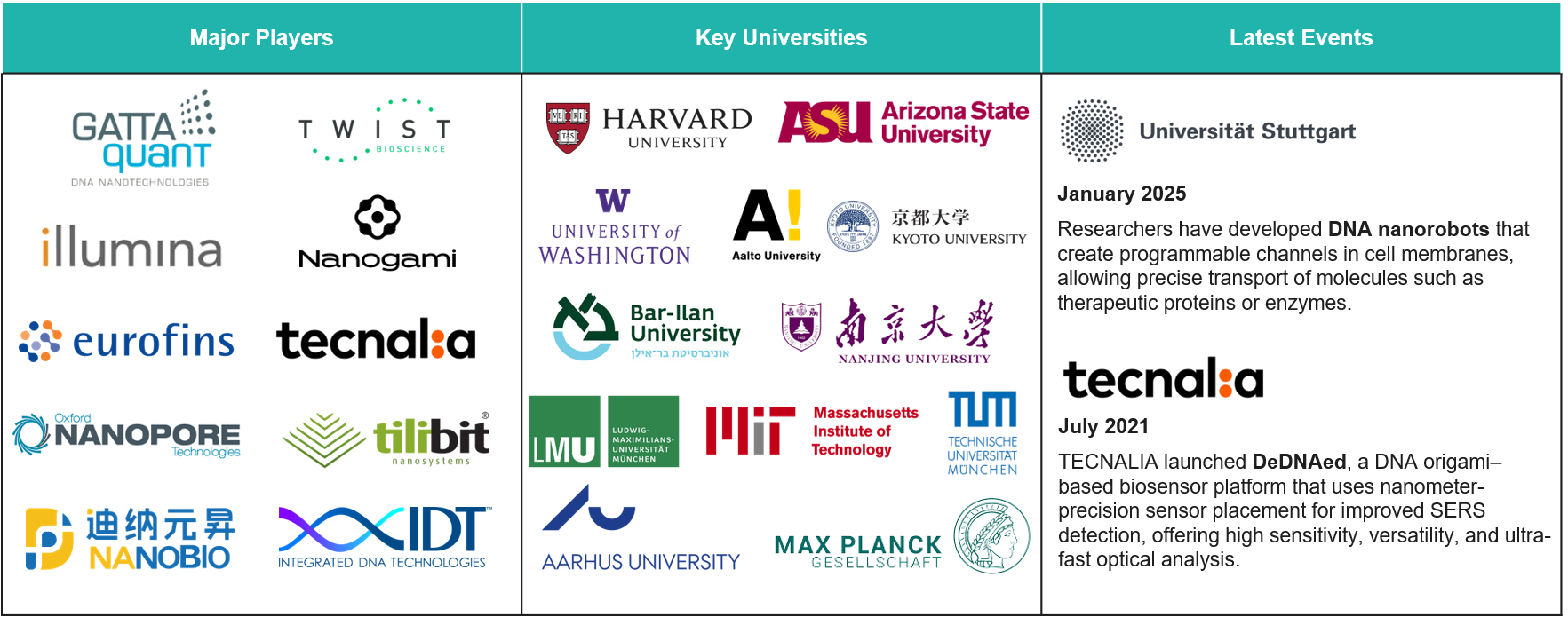
The DNA origami market is at an interesting point in time, with innovative scientists and dynamic biotechnology companies developing DNA origami based on their molecular blueprints into functional nanostructures. Growth has been driven by demand for specifically programmed nanoscale devices across a wide range of applications, from drug delivery to biosensors and diagnostics. The DNA origami market is undergoing a clearly defined transition toward commercially scalable outputs specifically for drugs and therapeutics, molecular diagnostics, nanophotonics, and bio-computing. The intrinsic functional nature of DNA origami can be thought of as a transformative technology likely to have varying degrees of implications in the future across a wide breadth of uses.
Conclusion
DNA origami nanostructures are adaptable nanostructures with many biological uses due to their size, the availability of sophisticated chemical and enzymatic techniques to alter their nucleotides and functions, and their biocompatibility. DO-based nanostructures have been employed as platforms for spatially controlled enzyme cascades, investigation of dynamic molecular events, triggered cargo release, immune stimulation, and molecular chips for label-free RNA detection. However, the lack of adequate ssDNA scaffolds is the main obstacle to developing DO structures.
Designing complex structures with DO requires manual adjustment due to additional constraints, including DNA geometry and sense/antisense pairing. Utilizing complete genomes as scaffolds, such as the commonly used M13, restricts their designs to discrete dimensions. Alternative methods for building structures at the nanoscale include the recently established “molecular canvas” concept and single-stranded “DNA bricks.”
However, recent innovations have represented promising biotechnological applications. These include automated routing algorithms, analysis of effective folding pathways, and the creation of finite-size wireframe nanostructures with great complexity and programmability, which result in improved technology. Recent development emphasizes its potential for encapsulating igens/probes for therapy, detection, or biosensors. Its lithography can pattern micrometer-scale structures and become a promising tool for developing solid-state devices with precise and programmable surface interactions.
Want to explore DNA origami’s potential in your product or research? Contact our experts today.
Let's Take the Conversation Forward
Reach out to Stellarix experts for tailored solutions to streamline your operations and achieve
measurable business excellence.