Why Marine Vessels and Mining Vehicles Are Becoming Proving Grounds for Next-gen Decarbonization Tech?
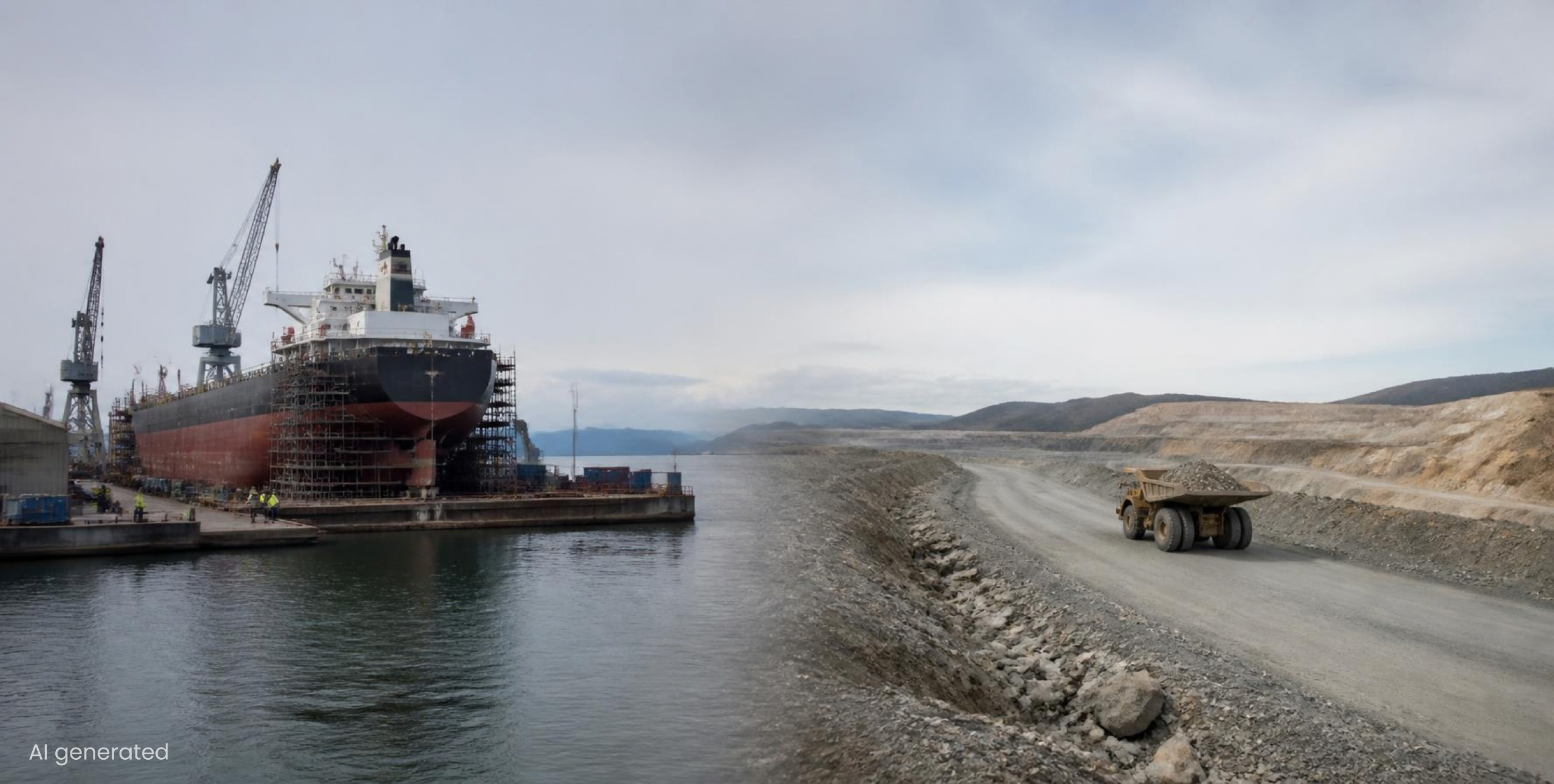
The two most conservative heavy industries are quietly evolving as testbeds for next-gen sustainable hardware. Every structural change in ships gets them classed and re-classed, while mining sites run haul routes on tolerances measured in seconds and minutes of downtime. Therefore, it seems a bit surprising that such operators are leaning so much towards unproven hydrogen, battery, and dynamic charging technologies.
“For heavy industries like mining and marine vessels, retrofit is the new R&D ground.”
The reason they are experimenting on revenue-generating vessels and trucks is that it is the simplest way to turn regulatory and capital burdens into a strategic advantage. This blog delves into why mining hauls and marine vessels are becoming proving grounds for decarbonization technologies and the impact of this shift on capital allocation practices in these industries.
Why Retrofit Programs are the New Testbeds
Both regulatory and capital disciplines are forming the foundation of this development. Several new policies, like the International Maritime Organization’s Net-Zero Framework, establish mandatory fuel-intensity reduction targets at 17% by 2028 and 43% by 2035 for ships weighing above 5000 tonnes and vessels taking care of ~85% of international shipping emissions. Since formal adoption was postponed by a year, the delay is giving them enough time to test on vessels and gain certainty on new advancements.
Similarly, capital discipline is another force. Australia’s climate change authority states that mine-haulage electrification is far from readiness due to low technological maturity and higher upfront costs. They are also principal barriers to wider adoption. But this segment is yet to become the basis of full fleet replacement. Retrofit is giving operators a path by upgrading one asset at a time without underwriting the complete new-build program against a technology that has a long way to go.
| Signal | Marine | Mining |
| Regulatory / Readiness Driver | IMO Net-Zero Framework: 17% → 43% GHG fuel-intensity cut, 2028–2035, for ships >5,000 GT (~85% of shipping emissions). | Mine-haulage electrification officially rated “Demonstration” readiness — barriers cited: low technology maturity, high CAPEX. |
| Live Pilot Evidence | 224 kW average fuel-cell output; ~50 kg hydrogen consumed per revenue voyage on a retrofitted hydrogen-hybrid ferry. | $9M AUD ARENA grant funding BluVein’s in-motion dynamic charging trial for battery-electric haul trucks. |
| Institutional Funding / Scale-Up Path | $50M per year in statutory U.S. federal funding earmarked for electric and low-emitting ferry retrofit pilots. | Staged validation path: 40–60t underground prototype scaling to an 8MW ultra-class surface-haulage system. |
| Outcome Data | >90% life-cycle climate-impact reduction, electric ferry vs. marine-gas-oil propulsion. | 7x lithium / ~2x copper demand growth projected by 2035 under net-zero pathways. |
What are these Testbeds Proving?
The operating data generated by marine retrofit pilots is unique and cannot be replicated by any kind of test rigs. For instance, the U.S. Department of Energy’s Sandia National Laboratories demonstrated the conversion of an existing diesel-battery hybrid ferry into a hydrogen fuel cell vessel. They registered an average fuel cell output of 225kW and an approximate hydrogen consumption of 50 kilograms. New federal policies are now being built around this model. The Federal Transit Administration’s Electric Ferry Pilot Program allocates around $50 million every year to conversion or purchase of low-emission ferries.
Mining is following a similar path, with one added twist. The Australian Renewable Energy Agency committed a $9 million grant to BluVein’s “hammer and rail” dynamic charging system, which lets a battery-electric haul truck charge safely while still moving. The trial begins on an underground route with a 40-60 tonne prototype before scaling to ultra-class surface trucks. The ongoing research into high-power charging standards for heavy-duty EVs is feeding the same underlying technology base that both dynamic mine charging and shore power infrastructure for vessels use.
This proves that both mining and marine sectors are moving on a shared and still maturing innovation pipeline.
Why Retrofit is Better than New Build in the Innovation Ecosystem
A live asset under real load is a better validation environment than a clean-sheet design, and the reason is control, not romance. Retrofit changes one variable, propulsion or charging, while holding the hull, route, or pit constant, so gains and failures can be attributed with a precision new-build simply cannot offer, since a new vessel or fleet embeds unproven technology at day one with no operating baseline for comparison. Capital exposure is staged rather than committed: a failed retrofit pilot writes down one asset, not an entire fleet or site.
Mining carries a complication marine does not. It is estimated that lithium demand is rising roughly sevenfold and copper demand will nearly double by 2035 under net-zero pathways, while refining capacity will remain concentrated in a handful of countries/ Mining operators are therefore decarbonizing the very industry that has to supply the minerals the rest of the economy needs in order to decarbonize, a strategic tension marine decarbonization does not carry in the same way.
Transitioning Isolated Pilots into a Scalable Testbed Portfolio
Leadership teams sitting on scattered retrofit pilots can convert them into compounding advantage through three moves:
- Testbed Readiness Audit: Map every current or planned retrofit against its technology readiness level and regulatory exposure, rather than tracking each pilot in isolation.
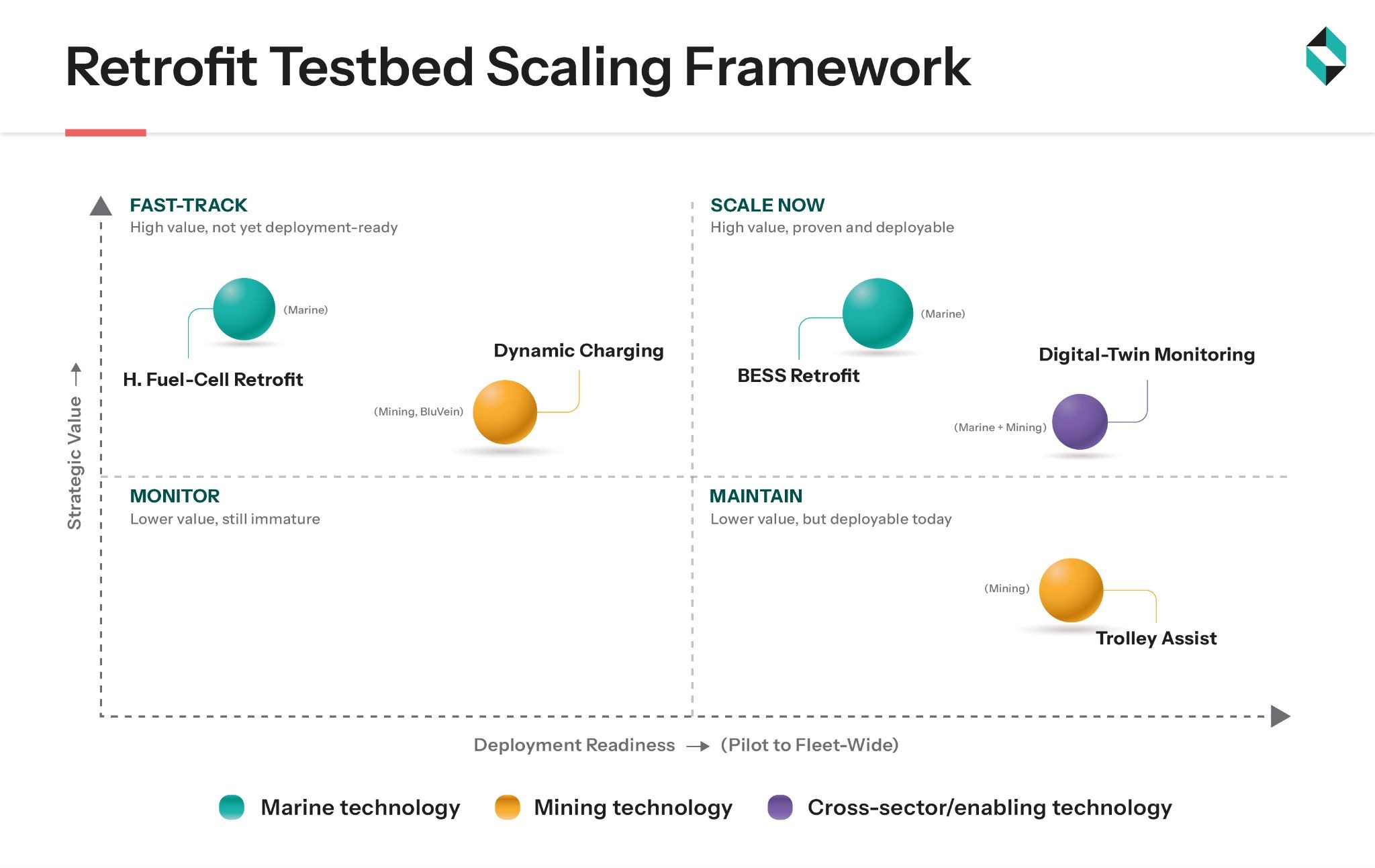
- Strategic Value vs. Deployment Readiness Matrix: Plot each technology by commercial upside against how close it is to fleet- or site-wide deployment, to separate genuine proving grounds from expensive science projects.
- Sequenced Capital Portfolio: Stage investment across a rolling program of retrofits, so lessons transfer between vessels and haul routes, and between marine and mining businesses inside the same group, instead of resetting with every new pilot.
Conclusion
Retrofit programs in marine and mining were never only about meeting a compliance deadline. They have become the operating environment in which next-generation decarbonization technology earns its commercial credibility, one vessel and one haul road at a time. The strategic question facing leadership teams is no longer whether their sector should host this experimentation. It is whether they are capturing the learning fast enough to compound an advantage before competitors and regulators close the gap.
To map your organization’s retrofit pilots against technology readiness and regulatory exposure, prioritize where capital should go next, and build the innovation and IP position that turns compliance-driven retrofits into a genuine competitive edge, our energy industry expert can help. Stellarix works with heavy-industry leadership teams across innovation strategy, IP and technology scouting, sustainability transition planning, and business strategy to convert isolated pilots into a repeatable source of advantage.
Let's Take the Conversation Forward
Reach out to Stellarix experts for tailored solutions to streamline your operations and achieve
measurable business excellence.