Retrofitting Heavy Industry: Parallel Decarbonization Pathways in Marine Vessels and Mining
Executive Summary:
Marine shipping and mining share a similar structural decarbonization constraint that cannot be resolved solely by newbuild strategies. Both operate massive fleets of long-lived assets: vessels with 20 to 25 years of service lives and haul trucks with 15-20+ years that will operate well beyond 2030. Retrofitting the existing fleet has become the more immediate lever, rather than waiting for cleaner replacements to cycle through.
Marine and mining industries are actively pursuing emerging retrofit opportunities. Marine shipping is placing its bet on hydrodynamic optimizations as well as alternative fuel conversions in addition to mechanical propulsion aids. Mining is adopting hybrid, hydrogen fuel-cell, and trolley-assist technologies. Regulatory approaches differ: shipping follows international and strict European standards, whereas mining depends on corporate net-zero commitments and national incentives.
Marine shipping and mining both have a similar structural decarbonization problem that newbuild strategies alone won’t solve. Both industries operate massive fleets of long-lived, capital-intensive assets: cargo vessels with 20 to 25 years of service lives, haul trucks, and excavators with 15-20+ year lives – that will be operating well beyond 2030, 2040, and, in some cases, 2050. Retrofitting the existing fleet has become the more immediate lever for cutting emissions for both industries, rather than waiting for cleaner replacements to cycle through. The two industries are also converging on a similar market signal: a substantial addressable retrofit opportunity is opening up alongside the newbuild market, as the snapshot below shows.

Why Retrofit Matters
Marine Vessels
Global shipping represents a significant portion of international trade conducted by vessels with lifespans of 20-25 years, suggesting that most emissions decreases this decade need to come from retrofitting existing ships rather than waiting for the replacement of aging vessels. Lloyd’s Register’s modeling suggests that between 9,000 and 12,900 large commercial vessels may need engine updates to attain decarbonization by 2050, and without faster progress, as many as 20,000 trading ships could still run on fossil fuels by that time. Everllence assesses that the fleet requires approximately 50GW of two-stroke retrofit potential comparable to around 2,000 large container vessels, bulk carriers, and tankers, with about 5,300 of the roughly 30,000 two-stroke engines on ships over 5,000 GT feasibly modifiable to zero or near-zero emission fuels.
Mining
Mining haul trucks are a concentrated source of industry emissions. ABB estimates today’s roughly 28,000 haul trucks emit 69 Mt of CO2 annually, and diesel-powered equipment is estimated to drive around 80% of a typical mine’s Scope 1 emissions. With average haul truck lifespans running 15-20+ years and OEM zero-emission trucks for the largest size classes still years from commercial-scale delivery, retrofitting the existing diesel fleet has emerged as the more immediate decarbonization lever for many operators. Underground mines carry an added incentive that is explored in the Economics section below:
Technology Landscape
Marine Vessel Technology Landscape
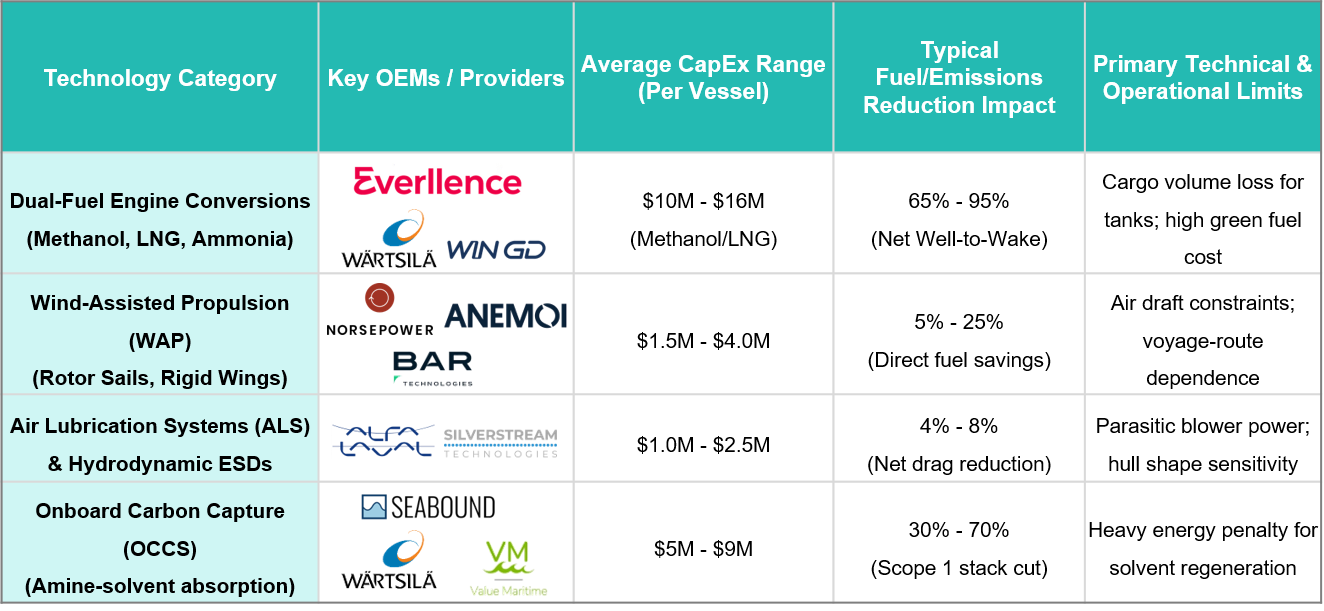
Decarbonizing existing merchant ships requires balancing energy density, structural space, yard downtime, and engine modification costs. No single technology suits all vessel types, so marine retrofits combine alternative fuel conversions, mechanical propulsion aids, and hydrodynamic optimizations.
Dual-Fuel Internal Combustion Engine Conversions
Converting legacy two-stroke diesel engines to green methanol, LNG, or ammonia enables substantial Scope 1 emissions reductions. Conversions involve replacing cylinder covers, installing specialized fuel injection valves, upgrading fuel supply control units, and adding dual-walled fuel piping. Conversions take 4-8 weeks in drydock, with methanol retrofits averaging $10M-$16M per vessel and complex LNG conversions reaching approximately $30.3M.
Wind-Assisted Propulsion Systems (WAP)
Wind-assisted propulsion relieves main engine loads using aerodynamic force, thereby delivering fuel savings regardless of the usage of primary fuel. Key WAP include Rotor Sails (Magnus Effect) and Rigid Wing & Suction Sails and can reduce fuel consumption by 5-30%.
Air Lubrication & Hydrodynamic Energy Saving Devices (ESDs)
Reducing frictional resistance between hull and sea surface lets vessels maintain transit speeds at lower engine loads. This includes Air Lubrication Systems (ALS) and Hydrodynamic Optimization (ESDs).
Onboard Carbon Capture & Storage (OCCS)
OCCS serves as a mid-life compliance solution for vessels where alternative fuel conversion is not economically feasible. Amine-based solvent systems absorb CO₂ directly from engine exhaust, then thermally compress it, and store it in onboard pressure tanks for port offloading.
Mining Equipment Technology Landscape
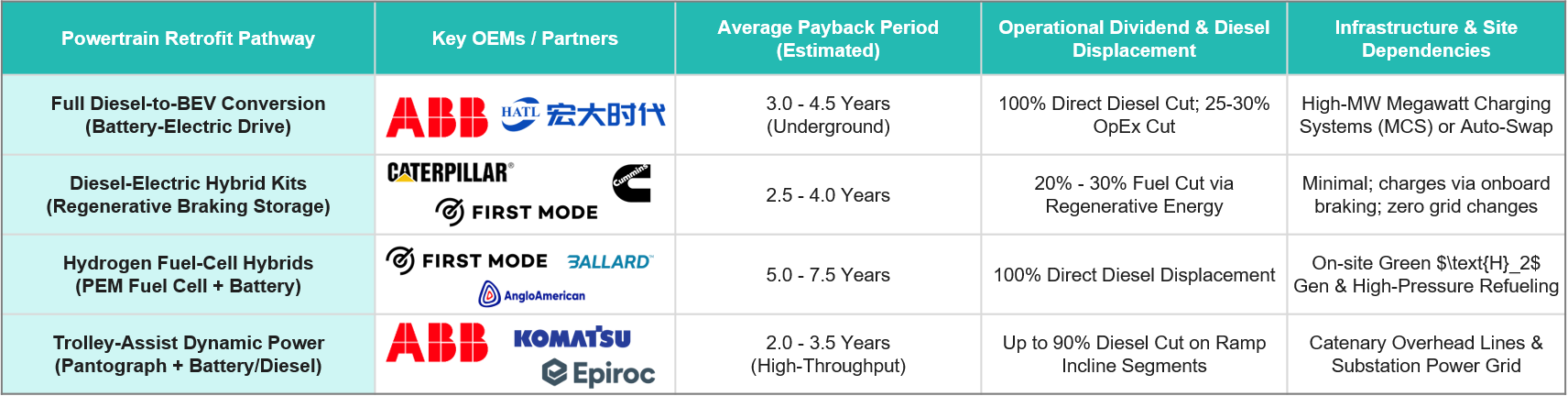
Decarbonization of heavy mining equipment requires addressing remote-site logistics, extreme duty cycles, along with high payloads and steep inclines. As haul trucks operate continuously in harsh pit conditions, OEMs and engineering firms are pursuing four pathways. These four pathways are battery-electric retrofits, hybrid regenerative powertrains, hydrogen fuel-cell systems, and dynamic trolley-assist networks.
Full Diesel-to-Battery Electric (BEV) Conversions
Converting diesel-mechanical or diesel-electric haul trucks to full battery-electric drive replaces the diesel engine, torque converter, and fuel tanks with modular liquid-cooled lithium-ion (LFP/NMC) battery packs, high-power traction inverters, and electric motors.
Diesel-Electric Hybrid Retrofit Kits
For remote mines, high-altitude open-pit mines that lack high-voltage grid connections, hybrid retrofit kits serve as a key stepping stone. The battery captures energy during downhill braking & retarding, which decreases consumption of diesel fuel by around 20-30%.
Hydrogen Fuel-Cell Hybrid Powertrains
Ultra-class surface haul trucks (200-400+ tonne payload) face payload penalties if retrofitted purely with heavy lithium batteries, making hydrogen fuel cells an energy-dense alternative. The nuGen™ ZEHS Platform, Anglo American, First Mode, and Ballard Power Systems retrofitted a 291-tonne Komatsu 930E-4 truck with a 2MW hydrogen fuel-cell/battery powertrain supplied by on-site solar-powered green hydrogen electrolysis.
Trolley-Assist & Dynamic Catenary Infrastructure
Trolley-assist technology enables heavy haul trucks to draw electrical power directly from overhead catenary power lines via a roof-mounted pantograph while navigating steep pit ramps. It increases ramp-climbing speeds by 50-100% and decreases diesel consumption by ~90% on trolleyed segments.
We perform technology landscape studies and scans for retrofit decarbonization to examine different pathways at Stellarix. These include analyzing dual-fuel engine conversions, air lubrication, OCCS, battery-electric powertrains, hydrogen fuel-cell hybrids, and more.
We map their technical readiness, use cases, and integration challenges across marine and mining fleets. Through technology scouting and IP analytics, we present a clear view of the competitive retrofit landscape to enable informed decisions regarding innovations worth adopting and investing in.
Regulatory and Corporate Drivers
Varied regulatory regimes in the marine and mining segment shape retrofit decisions. Shipping follows international requirements supplemented by strict European regulations. On the other side, mining depends on corporate net-zero pledges and national incentives instead of a global compliance deadline. Moreover, shipping owners encounter legal pressure, and mining operators retrofit in case of proper alignment amid economics and corporate strategy.
Marine Vessels: A Binding Global-Regional Stack
IMO criteria are founded on the worldwide standard: Since 2023, ships of 400 GT and above require EEXI certification, while ships of 5,000 GT and above receive annual CII ratings from A to E. A D rating for three consecutive years or an E rating in any year requires a corrective action plan. The IMO Net-Zero Framework remains on hold, creating uncertainty around future carbon pricing.
The EU Adds a Strict Regional Layer: Two overlapping regimes now apply to ships above 5,000 GT calling at EU/EEA ports:
- EU ETS: From 2026, it covers all emissions from intra-EU voyages, half of EU-to-non-EU voyage emissions, and all emissions at berth. It also includes methane and nitrous oxide, affecting LNG-fueled vessels with higher methane slip.
- FuelEU Maritime: It is effective since January 2025, and it targets well-to-wake GHG-intensity reductions of 2% in 2025, 6% by 2030, and 80% by 2050, with penalties of €2,400 per tonne of VLSFO-equivalent deficit.
- Limited alternative-fuel conversion capacity, concentrated in Asia, makes yard availability a major limitation and could push retrofit demand into a narrower, more expensive window.
Mining: Corporate Commitments Fill the Regulatory Void
With no global mandate equivalent to the IMO, mining retrofit decisions are driven primarily by company-level targets and national incentive frameworks.
ICMM Collective Commitment: The International Council on Mining and Metals, representing roughly 30 members and about a third of the global industry, has committed collectively to net-zero Scope 1 and 2 emissions by 2050 or sooner.
Company Targets Set the Actual Pace: Rio Tinto plans to eliminate new diesel haul trucks and locomotives by 2030 and achieve net zero by 2050. BHP targets at least a 30% reduction by FY2030, while Anglo American targets a 30% reduction by 2030 and carbon neutrality by 2040.
National Incentives are Emerging: Canada’s Budget 2025 Implementation Act, embraced in March 2026, introduced a 15% refundable Clean Electricity Investment Tax Credit and expanded Clean Technology credits to include non-road zero-emission vehicles used in mining and construction.
| Driver Type | Marine | Mining |
| Global Mandate | IMO EEXI/CII in force since 2023 | Net-Zero Framework pending adoption | None- voluntary led by ICMM (~30 members, ~1/3 of industry) |
| Regional / Company Overlay | EU ETS full compliance from 2026 | FuelEU Maritime since 2025 | National tax incentives (Canada) | company-set targets |
| Headline Deadline | EU ETS 100% allowance surrender from 2026 | IMO targets to 2050 | Rio Tinto: diesel phase-out by 2030 | BHP / Anglo: 30% cut by 2030 | ICMM: net zero by 2050 |
| Non-Compliance Cost | €2,400 per tonne VLSFO-equivalent deficit | EUA purchase obligations | Reputational and ESG capital cost – no direct regulatory fine |
Ecosystem and Players
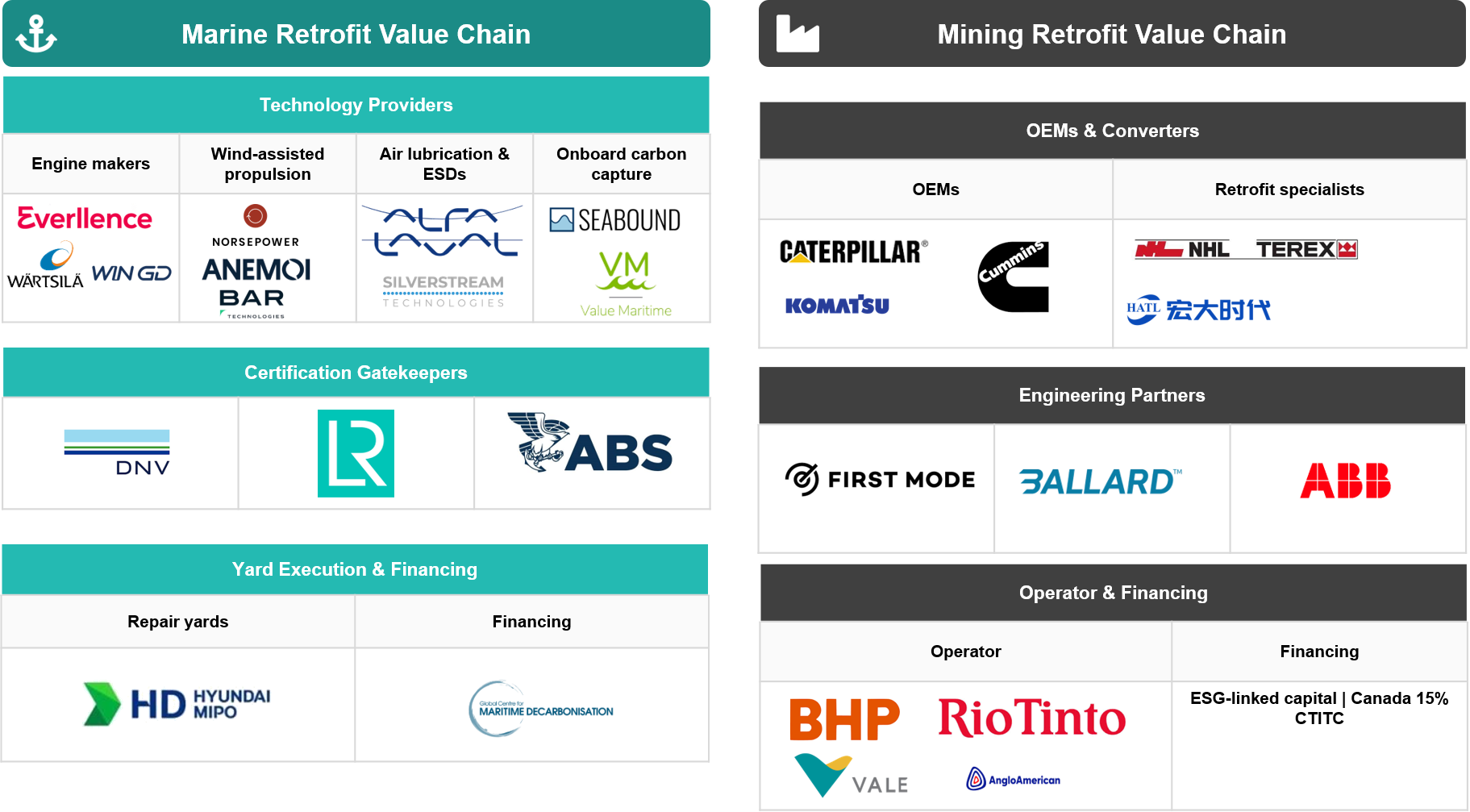
Retrofit delivery depends on an entire ecosystem of technology providers, certification bodies, engineering partners, and financing alternatives. In marine, classification societies and limited yard capacity play a key role, while in mining, OEM-operator partnerships and specialist converters matter more.
Economics and Business Models
Marine and mining have quite different retrofit economics. The key components of marine business cases are fuel-price spreads, charter structure, and avoided regulatory penalties-savings that are only realized if the owner takes advantage of them.
| Capital & Business Model | Target Asset Class | Upfront CapEx Requirement | Repayment / Value Creation Mechanism | Key Risk-Mitigation Advantages |
| Pay-As-You-Save (PAYS) (Unsecured Leases, e.g., FEET) | Commercial Shipping (WAP, ALS, ESDs) | 0% Upfront (100% Funded) | Lease payments tied to verified fuel cuts | Decouples financing from vessel mortgages |
| Battery/Equipment-as-a-Service (BaaS / EaaS) | Surface & Underground Mining Fleets (BEVs) | Zero Equipment CapEx | Fixed hourly or per-tonne operational fee | Shifts battery degradation & tech risk to OEM/provider |
| Shared-Savings & Performance Contracts | Bulk Carriers, Tankers, Haul Truck Fleets | Low to Zero Upfront | Shared percentage of monthly diesel savings | Aligns owner-charterer split-incentives |
| Compliance-Linked Financing | Maritime Containerships & Mining Off-Grid Sites | Standard Internal Corporate CapEx | Avoided FuelEU/EU ETS penalty offset | Direct compliance protection against escalating fines |
Marine:
- Charter structure determines who captures the savings: Voyage-chartered owners capture fuel savings from scrubbers or wind-assist directly; time-chartered owners need those savings reflected in the hire rate to benefit. That single structural factor explains why certain owners retrofit first and why retrofit-as-a-service and pay-as-you-save financing models are gaining traction.
Mining:
- The ventilation dividend makes underground the clearest ROI case in either industry: Eliminating diesel exhaust drops DPM concentrations from ~50µg/m³ to under 1µg/m³, cutting ventilation power demand by up to 80% and delivering USD 3-5 million in annual savings for a typical underground gold or base-metals mine. Surface mining, lacking that multiplier, must justify retrofit through fuel savings and productivity gains alone.
Case Studies
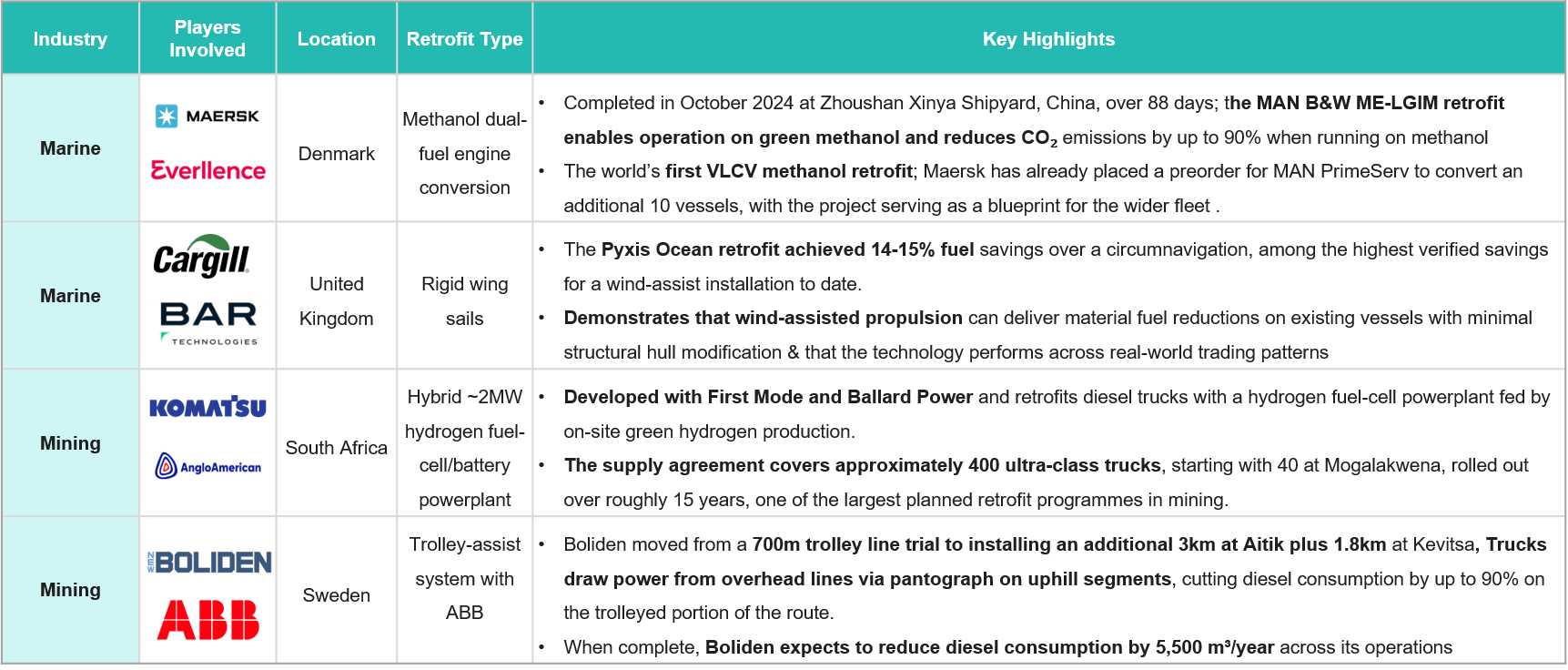
The retrofit pathways described above are not theoretical. Operators across both industries are already demonstrating that conversions can be delivered at commercial scale and that the lessons from early movers are shaping how the next wave of projects gets financed and executed.
Conclusion
As retrofit technologies mature, three prominent factors shape their adoption. Limited shipyard and converter capacity, project economics, and access to technology & infrastructure partners are prime factors influencing retrofitting decisions. In marine, fuel savings, charter structures, and regulatory needs play a crucial role in shaping investment decisions. Subsequently, in mining, economics depend on fuel savings and productivity improvements along with ventilation-related benefits. Overall, early projects can help operators build technical expertise, validate performance, and develop scalable retrofit strategies.
The next 24 to 36 months are crucial. Assembling a cross-functional team to evaluate retrofit opportunities across the site portfolio and identifying potential off-takers and technology partners within the operating regions are significant steps.
At Stellarix, we carry out comprehensive ecosystem mapping and stakeholder scans for retrofit delivery where we systematically review technology providers, engineering partners, certification bodies, yard operators, and financing vehicles shaping marine and mining retrofit value chains. Our techno-commercial expertise is helping clients bridge the gap between regulatory compliance and commercial viability. We help shipowners, charterers, mining executives, and site engineers translate IMO and EU regulatory timelines, corporate net-zero commitments, and national incentive frameworks into actionable retrofit strategies for their specific fleets or portfolios.
Let's Take the Conversation Forward
Reach out to Stellarix experts for tailored solutions to streamline your operations and achieve
measurable business excellence.