Powering the Future: The SMR Enterprise Roadmap
Executive Summary:
Small Modular Reactors (SMRs) are emerging as a strategic pillar for carbon-neutral, resilient power, bridging the gap between rising industrial electricity demand and decarbonization objectives. Installed capacity is expected to grow 15x, reaching 6 to 6.5 GW over the next decade, a clear sign that the SMR market is entering an aggressive acceleration phase.
The technology is moving beyond pilot projects. North American hyperscalers are committing billions to secure emissions-free, 24×7 power for AI data centers, while Asia drives state-backed deployments to support energy independence. Beyond electricity, the $1.5 trillion industrial heat market is also emerging as a significant opportunity for SMRs. However, regulatory fragmentation, supply chain concentration (notably for HALEU fuel), and FOAK cost premiums remain critical barriers. Securing the early-mover advantage is the way forward for energy-intensive industry players and investors aiming to dominate the next-gen energy infrastructure concerning SMRs.
Multiple Signs Pointing Towards the SMR Era
Globally, the demand for electricity is rising, with ~40 to 45% of electricity demand from industries driven primarily by an explosion in data centers, the transition of industries to electric arc furnaces, localization of advanced semiconductor and battery manufacturing plants, etc. This has significantly shifted the conversation for newer electricity generation sources, but with the decarbonization goals in focus, industrial growth and grid connectivity go hand in hand.
In this context, nuclear energy has become a strategic pillar for carbon-neutral energy sources. Nuclear technology has been around for many decades, but the real shift in adoption started in the past 5 years when climate goals and low-carbon energy sources really started to become the core for every industry. COP28 (28th UN Climate Change Conference) pushed nuclear energy as a prime low-carbon energy source, which was then recognized by 200 countries. For industries, reliability in the grid is most important. Larger nuclear plants do offer higher capacities, but also present a “single point of failure,” causing grid instability and industrial blackouts.
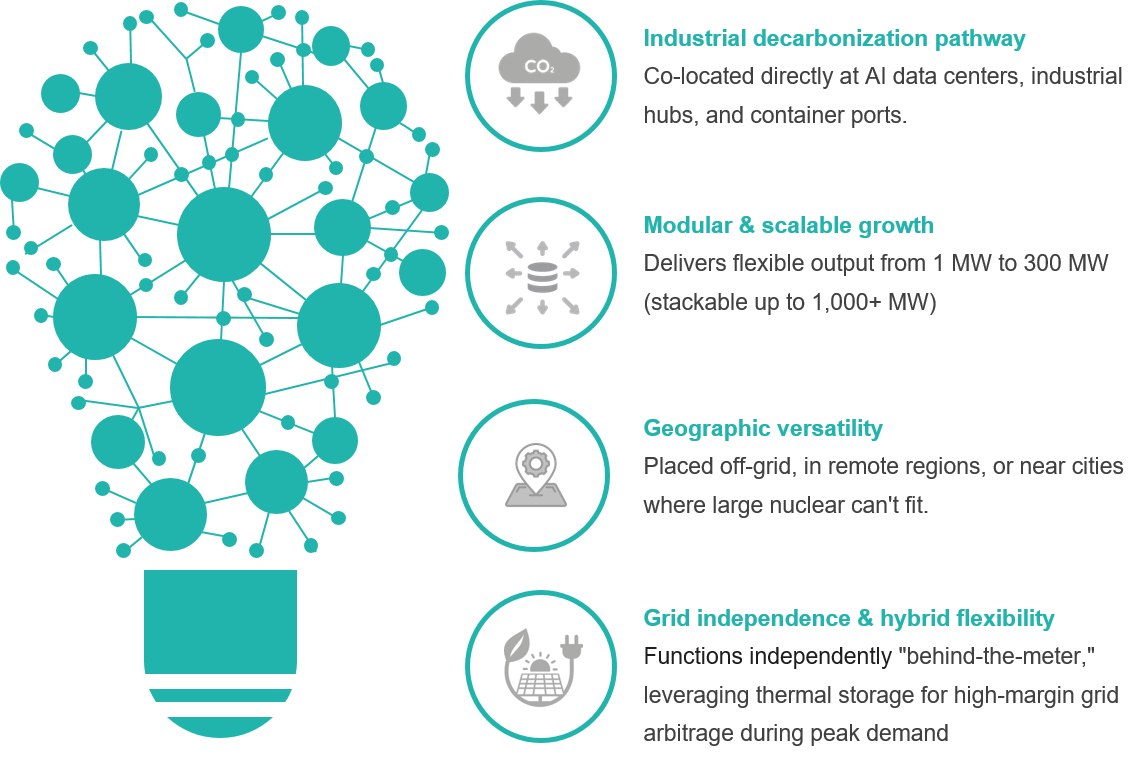
And this is exactly where Small Modular Reactors (SMRs) are playing a pivotal role. The SMR market is currently in an aggressive acceleration phase where it is expected that the installed capacities will grow 15x from its current ~400 MW (~7 billion valuation) to ~6 to 6.5 GW in the next 10 years. The main operating principle is smaller modules, flexible enough to be readily installed at the operating site without being dependent on grids. It ensures that if one unit fails, the other modules keep running to ensure a steady power supply. The SMR developers are focusing on factory-built, advanced modules with safety systems to enable faster, scalable, and affordable deployment on industrial sites. Globally, the “Bring Your Own Electricity” (BYOE) and “Behind The Meter” (BTM) strategies are being explored. Here, Western developers are focusing on early commercial rollouts for AI data centers, while Asian development relies heavily on government-controlled supply chains. China and Russia are at the forefront by utilizing government supply chains to operationalize the world’s first active commercial and floating SMR platforms. And this is just the start. SMRs have the potential to grow in multiple dimensions and have huge potential across different markets.
SMR Technology and Development Pipeline
SMRs are mini power generators that operate using a nuclear reaction for liquid heating and steam generation, which ultimately powers a turbine that generates electricity. However, today’s technological advancements offer variations on this operating theme, where different coolants, fuels, reactor designs, and safety features play a key role.
SMRs are defined by the International Atomic Energy Agency (IAEA), and it officially states that there are more than 80 SMR designs and concepts globally. These SMRs have a capacity up to 300MW and usually fall under these three generations listed below:
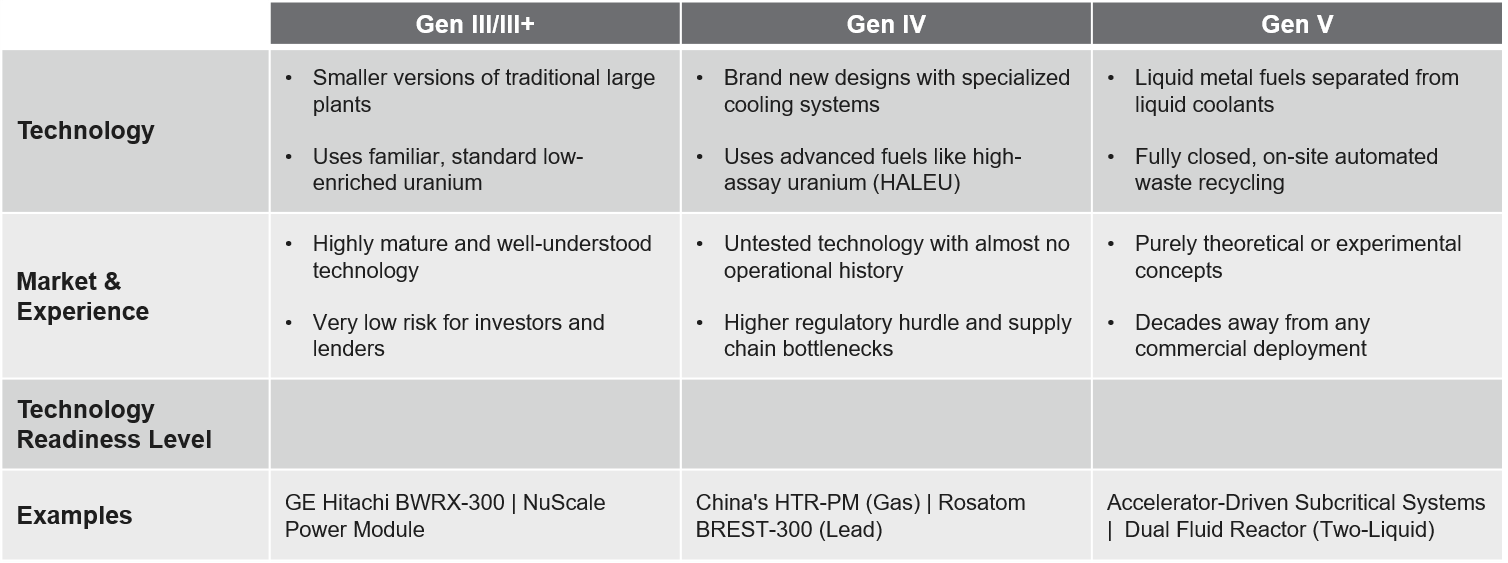
And, while historical generations define the broad evolutionary era of SMRs, the global market is practically divided into six distinct technical architectures according to the IAEA, with different coolant systems, operational maturities, and commercial manufacturers.
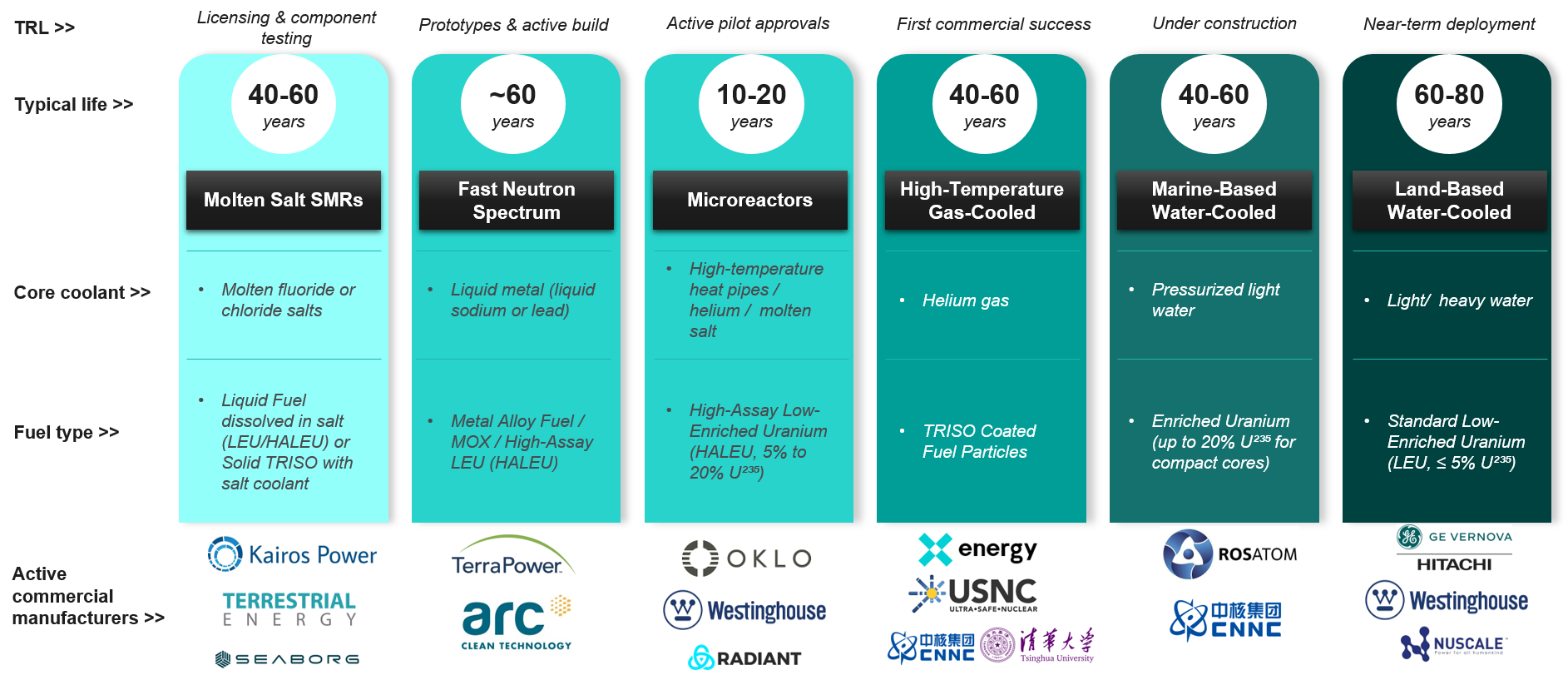
The above technical architectures can be further divided into two design-based pathways: water-cooled designs and non-water-cooled designs. The first pathway, “Water-cooled designs,” which incorporates integral pressurized light water reactors and boiling water reactors, is the one that has reached the near-term deployment status. These reactors usually operate with temperatures around 300°C and feature a compact design as they contain all the core components like steam generators, pumps, etc., integrated inside the primary reactor.
These reactors use the core, proven water cooling, and low-enriched uranium physics that have safely run nuclear plants for over 60 years; they seamlessly eliminate technological roadblocks and fit naturally into established supply chains and regulatory frameworks. This makes them a prime choice for early grid deployment, low-temperature desalination, district heating systems, behind-the-meter industrial operations like automated data centers, refining industries, pulp and paper mills, etc., as the reactor’s operational reliance is on natural water bodies that aligns perfectly with coastal and riverside industrial sites.
The second pathway is “non-water-cooled designs”. These include High Temperature Gas-Cooled Reactors (HTGR), Gas Cooled-Fast Reactors (GCFR), Liquid Metal Fast Reactors (LMFR), and Molten Salt Reactors (MSR). These reactors operate with higher temperatures ranging from 500°C to over 800°C. With higher temperature operations, safety features become a critical aspect of their designs. Reactors include safety architectures like TRISO fuel particles (encased in microscopic ceramic layers), which physically prevent core meltdowns even during a complete loss of power.
These reactors are not limited to electricity generation; they also supply direct heat to emission-heavy industries. They can directly fuel extreme thermal operations like cement manufacturing, hydrogen-steelmaking, glass blowing, etc. Also, when it comes to green hydrogen manufacturing, the steam from these reactors can be used to split water, drastically cutting energy requirements, ultimately featuring true zero-emission fuel manufacturing that is more economic.
Hyperscale AI data centers are also benefiting from them. These hubs require uninterrupted, 24×7 electricity supply, which current municipal grids are lacking due to transmission capacity limits. By deploying SMRs “Behind-The-Meter”, these data center operators can secure high-capacity power, which lets them bypass the multi-year transmission queue backlogs. And even for coastal or near-water-body deployment, these SMRs feature dry cooling designs. This makes these SMRs deployable in varied environments such as remote mining microgrids or even in landlocked industrial zones.
When it comes to global adoption of SMRs, the shift from design concept to prototyping is very evident. In North America, public and private entities are focusing on developments in SMR technologies in multiple aspects. The investment scale is also massive; over $130 billion has been invested by the USA alone. The U.S. Department of Energy (DOE) is also providing subsidies to this sector via its $900 million Gen III+ SMR Pathway to Deployment Program. This includes recent multi-million-dollar funding rounds awarded to eight domestic developers (including Constellation, BWXT, and Westinghouse) to secure local nuclear supply chains.
Hyperscalers are directly investing to secure emissions-free, 24×7 power for AI data centers. This includes Amazon’s $500 million investment in X-energy to support SMRs, Google’s multi-reactor purchase agreement with Kairos Power that brings 500 megawatts of carbon-neutral power online by 2035, and multi-gigawatt commitments from Meta and Microsoft for dedicated nuclear power campuses.
Beyond the applicability for data centers, the $1.5 trillion industrial heat market is also proving to be the opportunity area for SMRs. Dow Chemical and X-energy have already submitted a construction permit certificate to the U.S. Nuclear Regulatory Commission for the first-ever industrial nuclear heat project at a chemical facility in Seadrift, Texas.
On the other hand, Europe and Asia are focusing on state-backed SMR deployments worth over $130 billion to support critical energy independence. Considering the recent advancements, Europe’s previous stance on phasing out nuclear power seems to be changing. Aggressive deployments of over 40 SMR projects can be seen in the past 2 years, spurred by the energy crisis.
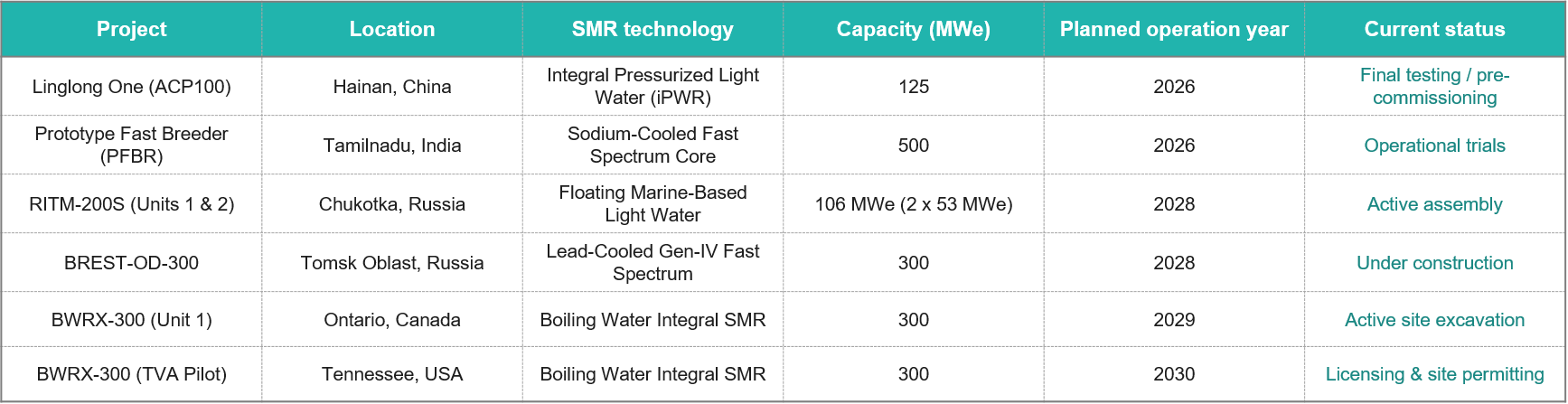
Whereas Asia has been the constant growth-focused engine for SMRs, backed by fossil-fuel disruptions and localized AI & manufacturing boom. China and India are the leading regions where over $25 billion has been invested in nuclear construction. China’s ~$23 billion annual nuclear budget directly funds the world’s first land-based commercial SMR, Linglong One, and the newly launched World’s First PWR-HTGR Dual-Coupling Hybrid SMR Project. Simultaneously, India has launched a dedicated ~$2.4 billion Nuclear Energy Mission to construct five indigenous Bharat Small Modular Reactors (BSMR) by 2033.
Apart from these, considering the geopolitical crisis and fuel supply shocks, ASEAN nations are establishing laws to allow SMRs. Singapore signed a major 2026–2031 IAEA capacity framework to fast-track safety standards, while the Philippines partnered directly with South Korea’s KHNP, which includes evaluating the potential deployment of Small Modular Reactors (SMRs).
These breakthroughs represent only a fraction of the global SMR momentum, with various other nations also rapidly developing their own modular reactor programs. As these evolving technical capabilities and application domains are proving the strategic value of SMRs, transitioning from prototypes to commercial deployments needs a multi-factor assessment. Their mass market deployment will depend on how effectively technology developers navigate upstream supply chain bottlenecks, optimizing CAPEX-OPEX structures, regulatory frameworks, and policies globally.
Supply, Demand, & Market Dynamics: The Big Movers
While the technical capabilities and expanding project pipelines indicate a promising future for SMRs, behind these lies a complex web of market dynamics that dictates how fast SMRs can scale globally. It needs a fluent navigation strategy through evolving regulations & policies, supply chain frictions, and changing value chain power dynamics.
Historically, nuclear power has been tightly regulated. Every manufacturer has to go through multiple approval doors, right from site approval to design approval; it is time-consuming. But with the aggressive developments and applications of SMRs, regulations & policies are changing.
Governing bodies across the globe are rewriting the rulebooks for SMRs to accommodate the micro-version of nuclear power. Within the USA, the Nuclear Regulatory Commission created a brand-new pathway called the Part 53 rule, which is a technology-inclusive licensing framework to accelerate the deployment of advanced nuclear reactors.
Also, when a design or a prototype was approved in the USA or Canada, for the developers to enter Asia or Europe, the design had to be started from scratch. This often contributed to a ~7-year delay and millions of dollars in re-engineering fees. This scenario is also changing now. USA, Canada, and the UK have signed agreements to conduct joint reviews of SMR designs (like the GE-Hitachi BWRX-300) instead of working in silos via IAEA’s Nuclear Harmonization and Standardization Initiative (NHSI).
Some of the biggest policy shifts can be observed in Asia, where governments are ending state monopolies to help heavy industries with capacity addition. For example, India’s new reforms to its atomic energy rules allow private entities to co-own and run indigenous Bharat Small Modular Reactors (BSMR). This has now been completely legalized for factories to install these compact reactors directly on their own property as private, behind-the-meter power plants.
As the regulatory scenario is improving, the upstream fuel and raw material supply chain is still struggling. The current non-water-cooled SMRs rely heavily on High-Assay Low-Enriched Uranium (HALEU), enriched between 5% and 20% U-235, to keep their physical core small and be able to operate at high temperatures without any need for refueling for over a decade. Historically, Russia was at the forefront of commercially producing HALEU, making the supply concentrated for global developers. And following the post-2022 geopolitical stir, the Western world was instantly cut off from this source. To break this monopoly, Western governments and fuel suppliers have launched multiple initiatives to regularize the supply chain again.
On one hand, the “Enrichment” infrastructure is being developed by the efforts of the USDOE by funding Centrus Energy Corp to produce HALEU domestically and by the US Congress’s $2.7 billion funds to subsidize domestic enrichment. Under this initiative, uranium giants like Urenco and Orano are actively constructing dedicated sites for HALEU production of multiple metric tons per year.
On the other hand, the missing “Deconversion” is also being targeted to complete the supply chain resilience. Although entities produce uranium hexafluoride, it’s a volatile gas. So, before an SMR can use it, this gas must undergo deconversion. This chemical process converts the volatile gas into a stable metal alloy or ceramic powder, which is then packed into reactor fuel pellets or TRISO pebbles. Companies like BWX Technologies or Framatome, with ample government backing, are establishing deconversion lines.
Apart from fuel, reactor manufacturing also introduces additional physical constraints. There is a need for heavy hydraulic presses to manufacture thick-walled steel Reactor Pressure Vessels for SMRs. Manufacturing capabilities are currently limited among global suppliers like Japan Steel Works and China First Heavy Industries. This concentration forces over 5 years of lead times; SMR start-ups need to ensure early order commitments that are essential for maintaining project construction schedules.
Stellarix imperative: Effective supply chain execution and risk assessment are now the two most prominent commercialization factors for SMRs, rather than just focusing on technological feasibility. Technology leaders and new entrants must move beyond isolated pilot projects towards a collaborative approach with commercial consortia across the value chain. Ultimately, the first mover advantage can also be gained by locking in capital investments from hyperscalers in AI computing and energy-intensive industries that are redefining the current energy landscape.
De-risking SMR Deployment
While SMRs offer unmatched carbon-neutral capacities, enterprise off-takers, and industrial power producers need to navigate through initial capital barriers while positioning nuclear hardware against complementary zero-carbon solutions such as Battery Energy Storage Systems (BESS).
Utility-scale solar, when combined with BESS, provides exceptionally lower-cost power when peak energy demand windows are considered. However, SMRs function differently. SMRs do not compete with BESS on a raw Levelized Cost of Electricity (LCOE) basis. Instead, they serve as a de-risking mechanism for grids and high-demand buyers (like AI data centers or energy-intensive industries) requiring continuous, 24×7 uninterrupted carbon-neutral power. SMRs essentially supply steady power, often at a 90% capacity factor, that avoids costly capacity overbuilds and 10- to 15-year battery replacement cycles.
SMRs are addressing the traditional “nuclear financing risks” through standardized factory fabrication that reduces construction timelines to 3 to 5 years and drops target Nth-of-a-Kind (NOAK) CAPEX to almost 50% versus $8,000–$12,000/kW for large-scale reactors.
However, initial deployments still need to overcome First-of-a-Kind (FOAK) associated cost premiums, which can temporarily inflate initial capital requirements before the supply chains truly mature in the coming decade.
Furthermore, developers are actively lowering financial barriers by securing private capital partnerships with hyperscale AI data centers and utilizing massive policy subsidies, such as the US IRA’s $15–$25/MWh Production Tax Credit and Europe’s Green Taxonomy financing structures. From the technology front, SMRs are being equipped with advanced passive safety mechanisms relying on gravity and natural cooling rather than complex active systems to levelize operational risk and regulatory approvals.
More importantly, the fuel supply chain is one of the prominent pathways to complete project de-risking. Many advanced SMR designs rely on High-Assay Low-Enriched Uranium (HALEU); diversifying this supply away from geopolitical stir is essential for long-term viability.
Ultimately, the companies should avoid treating SMRs and BESS as an “either/or” choice. They both operate to combat different energy demands. While battery storage stabilizes short-term voltage and frequency variations, it cannot economically supply continuous multi-day industrial operations. The most reliable strategy is to use SMRs to supply the primary 24×7 power baseline, while placing BESS downstream to smooth out sudden fluctuations and optimize total operating expenses.
Is Now the Definitive Tipping Point for SMR Investment?
SMRs are at the intersection of energy security, climate goals, and high-tech demand scrutinized by regulations. They are certainly not the replacement for BESS, but an insurance policy for companies that cannot afford a single second of downtime. The question now is not “Will SMRs work?” It is “Who will dominate the energy infrastructure for the coming years? And should I invest in SMRs?” Because investing in SMRs today can be compared with backing solar 15 years back or wind energy 10 years ago.
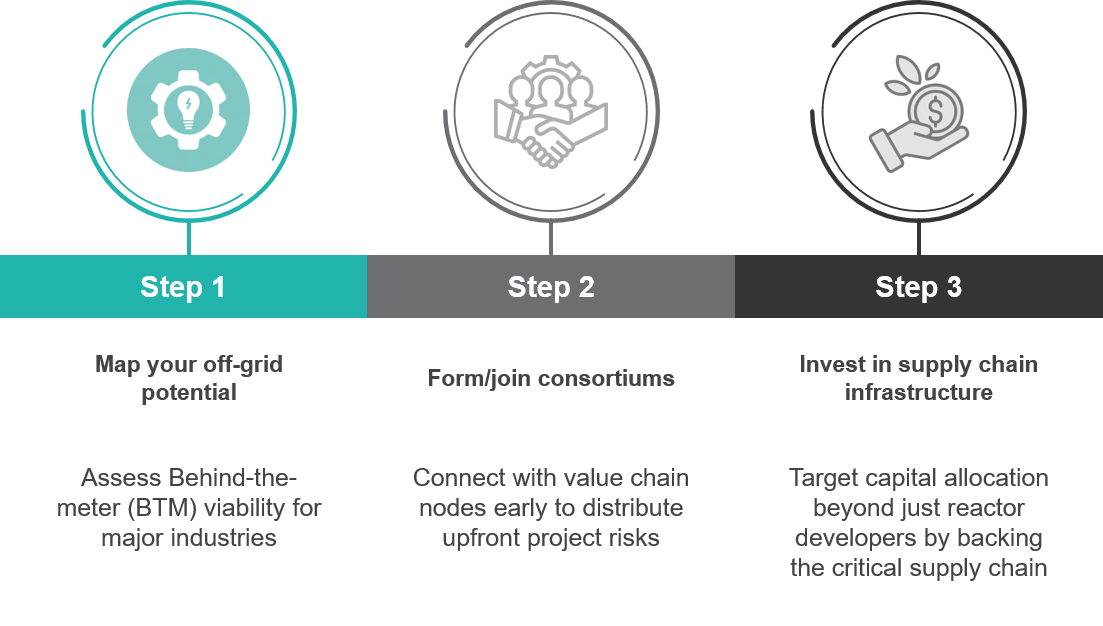
Investing in SMRs today will surely support the power supply transition with “Bring Your Own Electricity” (BYOE) and “Behind The Meter” (BTM) strategies.
Why is the time now?
- The early mover advantage is closing rapidly. As the waiting period for Nth-of-a-Kind (NOAK) target increases, investors can lose out on prime site parcels and, more importantly, on securing critical forging capacities and High-Assay Low-Enriched Uranium (HALEU) fuel allocations early.
- Early investors can leverage billions of dollars that are being poured by Western governments and the continuous streamlining of vendor design reviews. This can surely de-risk their initial capital before capacity pipelines fill up completely.
A step-wise approach can be followed by such executives/investors:
The Bottom Line
The transition to continuous, carbon-neutral energy will be led by those who secure their power source today; waiting for a mature market means paying for a 2x premium tomorrow. At Stellarix, we support chemicals & materials industry players like manufacturers, hyperscalers, industrial energy off-takers, and SMR developers in managing the complexities of this evolving landscape. We provide technology intelligence, supply chain risk assessment, regulatory foresight, and competitive benchmarking to assist you in evaluating opportunities, mitigating investment risks, and establishing a robust position within the SMR value chain.
Let's Take the Conversation Forward
Reach out to Stellarix experts for tailored solutions to streamline your operations and achieve
measurable business excellence.