Future of Sports Medicine: Competing for Recovery Ecosystem Leadership
Executive Summary
With the sports medicine market slated to cross $15 billion in the next few years, it is important to understand how competition dynamics will change in the next decade. For starters, it wouldn’t be a single breakthrough, but an ability to integrate wearables, digital rehabilitation, AI, and biologics into a single recovery ecosystem. Value will reside in connected platforms capable of delivering measurable outcomes, predictive intelligence, and continuous monitoring. Execution will be the new strategic differentiator: how well organizations coordinate their capabilities across the complete recovery journey to offer predictability, confidence, and a sustainable competitive edge. It also means that manufacturers must transition from the role of device providers to orchestrators of connected recovery and partnerships capable of delivering decision support and integrated visibility.
Next Decade in Sports Medicine Research
With the global sports medicine market projected to exceed USD 15.34 billion by 2033, innovation has progressed beyond being a barrier to growth. Access to AI-assisted rehabilitation, biologics, wearables, and predictive analytics has been significantly improved across the sports industry. The new challenge will involve integrating these capabilities into a fully integrated recovery ecosystem that provides quantifiable clinical results, enhances patient engagement, and enables sustainable competitive differentiation.
As sports medicine research continues to evolve, how can organizations identify the opportunities most likely to deliver meaningful and sustainable value over the next decade?
Advances in biologics, digital rehabilitation platforms, wearable monitoring technologies, predictive analytics, and personalized treatment approaches are transforming how injuries are prevented, treated, and managed. The industry is entering a phase in which the focus is shifting from generating innovation to identifying innovations that can deliver sustainable value throughout the evolving recovery journey.
Thus, the challenge for industry leaders has shifted from determining which technology will be easiest to implement to identifying the competitive advantage of recovery as it becomes data-driven, outcome-oriented, and integrated.
The Industry Shift: Transformation of Sports Medicine
Traditionally, success in sports medicine has been based on the quality of the procedure, the surgeon’s skill level, the effectiveness of the implant, and the ability to minimize complications. These factors will remain important, but the definition of value in sports medicine is changing.
Patients, providers, and payers are increasingly focused on what happens after treatment: recovery speed, return-to-activity rates, long-term outcomes, and re-injury prevention.
As a result, three structural shifts are reshaping the industry:
- From Episodic Recovery to Continuous Monitoring: Wearables, remote monitoring, and digital health technologies will continue to increase visibility into our health care experience outside of the clinic. Companies such as Catapult Sports, OneStep, and Sword Health are enabling continuous monitoring of patient movement, rehabilitation adherence, and return-to-play readiness through connected digital platforms.
- From Product to Platform: Value is moving more and more away from single products in favor of full solutions that integrate devices, software, analytics, and services. Companies such as Stryker, Zimmer Biomet, and Smith+Nephew have expanded beyond orthopedic implants by leveraging digital health initiatives, connected care solutions, and rehabilitation-focused offerings to support patients throughout the recovery pathway.
- From Repair to Performance Optimization: Organizations continue to shift their attention from just restoring functionality to aiding with performance and resilience and promoting lifelong musculoskeletal health. For example, Arthrex, Össur, and EXOS are all investing in ways to rehabilitate patients through performance-focused rehabilitation, to help prevent injuries through injury-prevention programming, to offer patients promising regenerative solutions, and to assist with return-to-play optimization strategies that go beyond typical treatment methods.
One trend we are observing is a growing emphasis on connecting technologies and stakeholders across the recovery pathway. As solutions become more advanced, the ability to coordinate them effectively may become an important source of strategic differentiation.
Where Future Value May Be Created?
Now moving fast, the sports medicine world shows constant progress. Backed by investors, firms focused on wearable devices for rehab and muscle care continue to grow. FDA-approved recovery tools are starting to appear in real patient settings. Instead of waiting, clinics begin using tech cleared for treatment support. Research on AI-guided therapy, biological treatments, and tissue repair gains ground steadily. Progress like this shifts focus toward how well teams bring these pieces together.
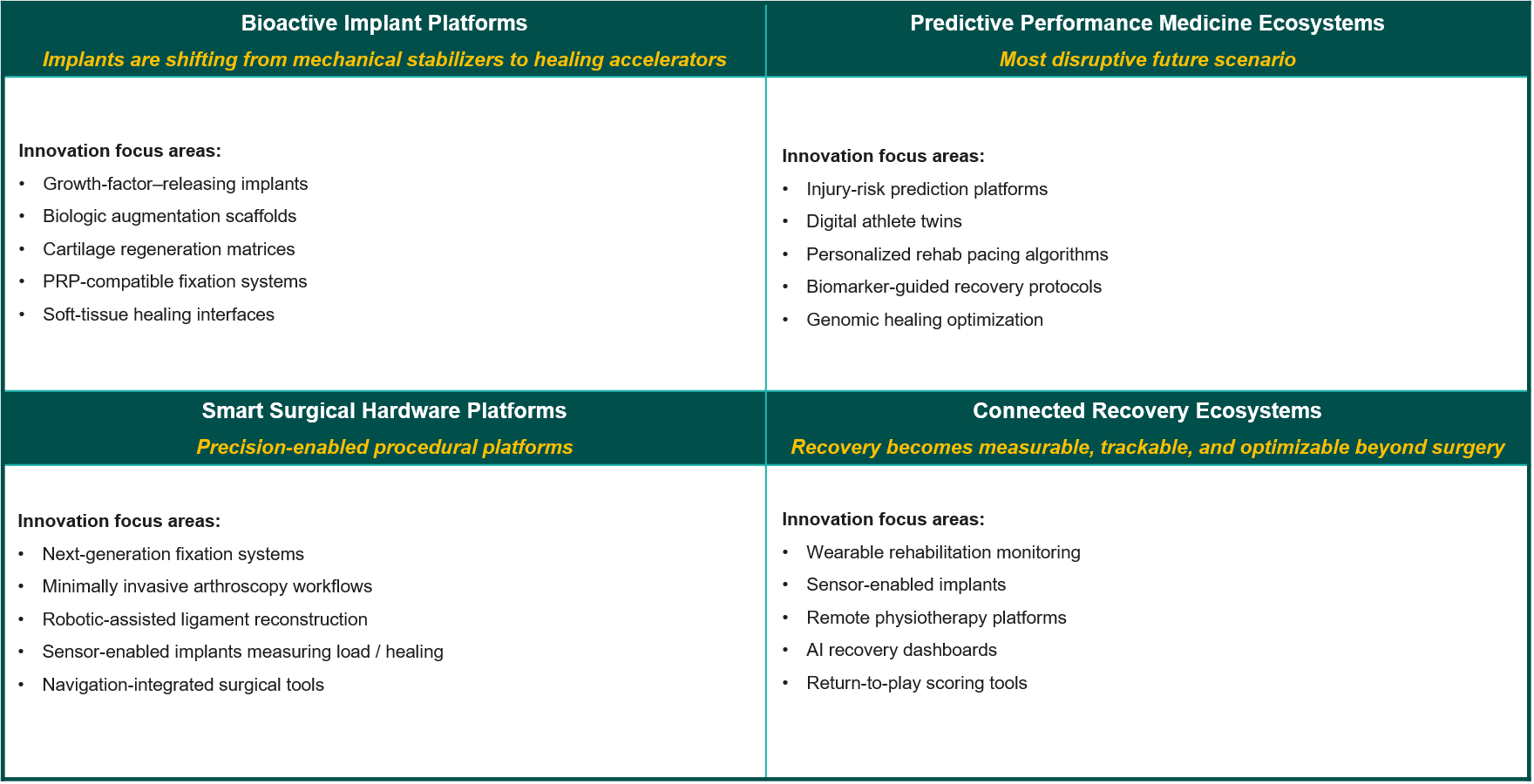
Several innovation pathways are shaping the future of sports medicine, including integrated recovery ecosystems, biologic-driven regeneration, data-enabled performance medicine, decentralized rehabilitation, and personalized treatment strategies.
It is important to understand how these converging trends aim to provide a coordinated, measurable, and outcome-based recovery experience, as this will help you develop your strategic plan.
The increasing use of wearable technology and remote monitoring systems by professional athletes, rehab programs, and musculoskeletal care providers is propelling us toward the transition to using data to drive recovery management. Focusing on integrating various capabilities into a unified recovery model is key to future success as a leader and will create competitive advantages.
The Real Gap: Capability vs Expectation
Although innovation continues to accelerate, many organizations are still building the capabilities needed to fully realize its potential.
Companies across the industry are investing heavily in AI, biologics, wearables, analytics platforms, and digital rehabilitation solutions. However, these investments often happen separately, leading to broken patient experiences, disconnected data streams, and limited growth potential.
Amid so much innovation, organizations continue to face challenges in data integration, interoperability, patient engagement, and outcome measurement. With so many ongoing difficulties, the introduction of technology alone cannot provide an organization with a competitive advantage.
At the same time, stakeholder expectations continue to rise. Patients want personalized recovery paths. Providers need actionable insights. Payers want to see measurable outcomes.
The challenge is shifting from just innovating to executing well. The organizations most likely to succeed in the future are those that can integrate advanced technologies into a unified operating model.
Across healthcare sectors, we often see that technology investments outpace operational integration. Gaining a competitive edge increasingly relies on managing data, clinical workflows, and partnerships within the ecosystem instead of just acquiring standalone technologies. Organizations that effectively connect these capabilities are more likely to deliver measurable patient outcomes, generate long-term recovery insights, and establish sustainable competitive differences.
Why is Approach Becoming More Important than Innovation?
The next phase of competition in sports medicine is unlikely to be determined solely by technological advancement.
Artificial intelligence, biologics, wearable devices, predictive analytics, and rehabilitation platforms are becoming increasingly accessible across the industry. As these capabilities mature, differentiation may depend less on access to innovation and more on the ability to deploy innovation effectively.
Organizations need to work through patient engagement, provider workflows, reimbursement policies, outcome measurement, and long-term recovery management. These capabilities often decide the extent to which an organization gets value from a technology investment.
In this context, execution has become the competitive differentiation. Organizations that will have a competitive edge are likely those that effectively integrate technologies, partners, and recovery paths, rather than just product-oriented companies.
While much of the industry’s attention remains focused on emerging technologies and innovation areas, a significant opportunity may lie in how organizations generate, connect, and apply insights across the recovery journey. The ability to link diagnosis, treatment, rehabilitation, and long-term patient management through coordinated data and decision-support capabilities may play an increasingly important role in creating value and improving recovery experiences.
How Organizations Can Win in the Recovery Economy?
As expectations for recovery continue to rise, a strategic question beyond innovation has emerged: how can we create faster, safer, more predictable, and more measurable recovery?
The pace of the race is quickening, spurred by growing investment in AI-based analytics, wearable monitoring, biologics, and digital rehabilitation in the sports medicine industry. Organizations have been slow to develop the necessary mechanisms to marshal these discrete capabilities into a full-fledged recovery plan, resulting in siloed patient journeys and poor line of sight into outcomes.
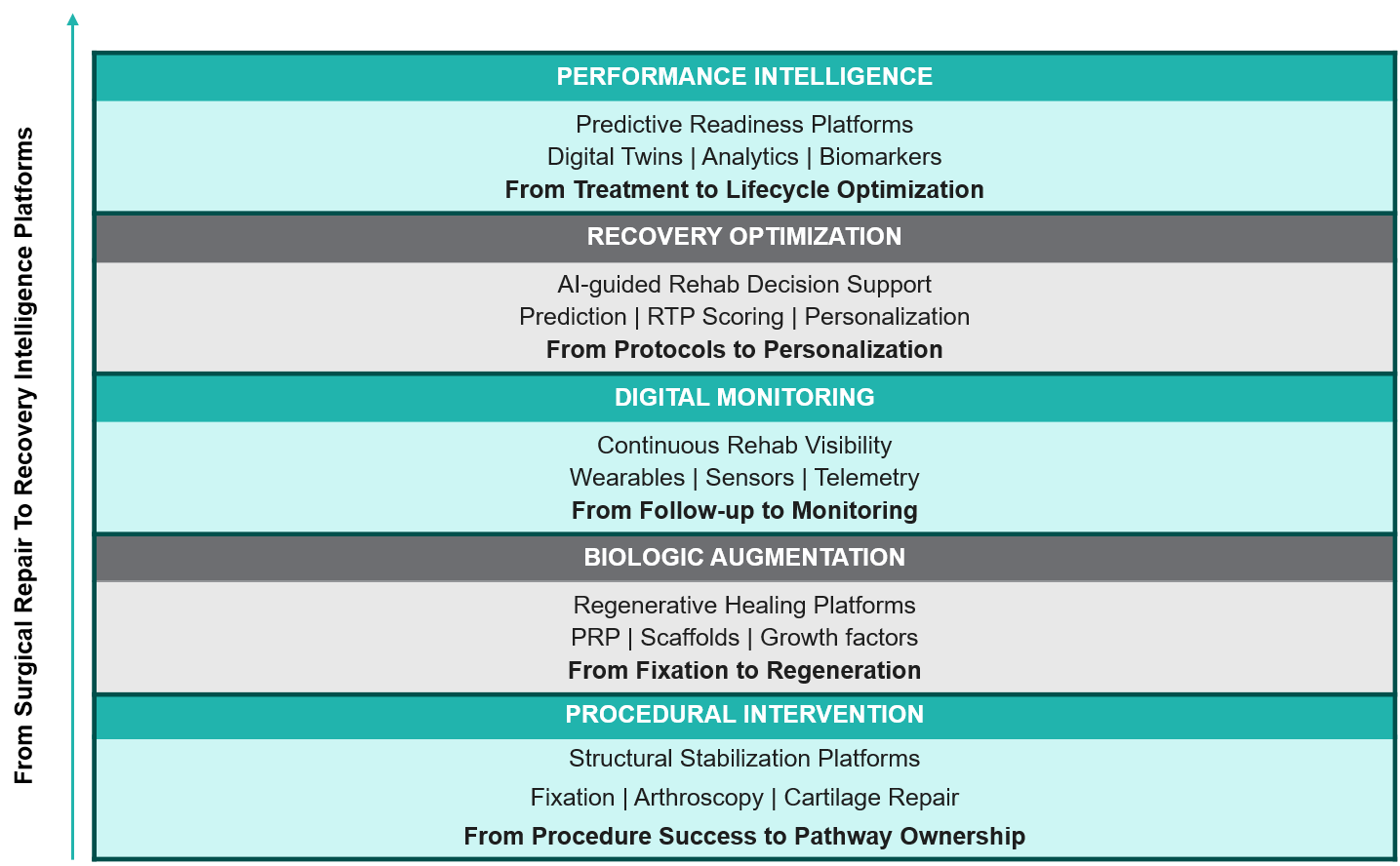
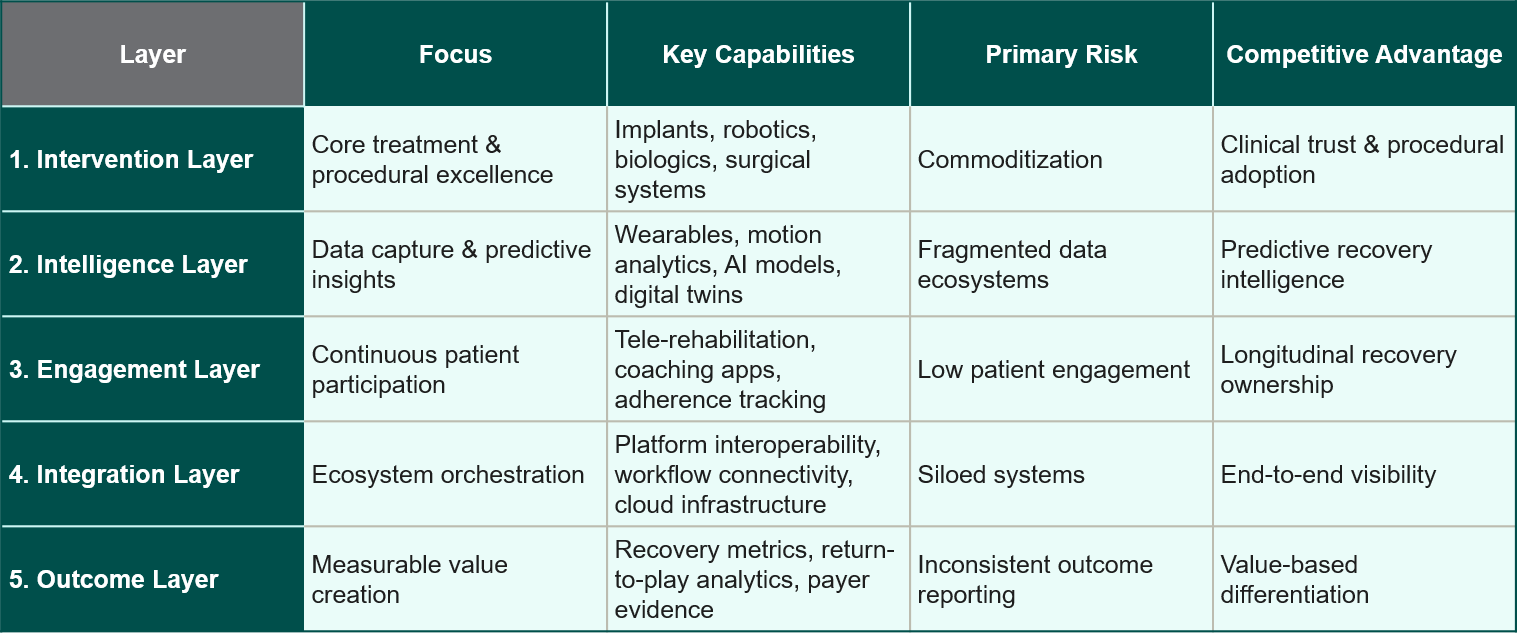
Organizations can evaluate their readiness across five interconnected layers of the future recovery ecosystem:
Layer 1: Recovery Visibility: Create mechanisms for sustained patient monitoring via wearables, digital rehabilitation technologies, and objective outcomes.
Layer 2: Recovery Intelligence: Convert clinical, biomechanical, and behavioral data into actionable information to support decision-making throughout the recovery process.
Layer 3: Adaptive Intervention: Allows the recovery plan to change in real time based on patient progress, risk factors, and functional demands. It moves away from fixed time periods.
Layer 4: Ecosystem Integration: Integrates providers, rehabilitation team members, digital health technologies, and monitoring devices to create a pathway to recovery.
Layer 5: Outcome Assurance: Success should be measured by the predictability of recovery, readiness to return to play, reduction in re-injury risk, patient confidence, and functional outcomes.
The organizations that can integrate these capabilities will be best positioned to provide what consumers are demanding: confidence that they are safe, on track, and will fully recover.
Conclusion
The future of sports medicine is unlikely to be defined by a single breakthrough technology. Instead, leaders will need to focus on integrating biologics, digital health, predictive analytics, rehabilitation platforms, and patient engagement into cohesive recovery ecosystems.
An increasingly important question is which organizations will play the most influential role in guiding recovery decisions and outcomes.
In today’s healthcare landscape, companies that only focus on products might find it tough to stand out. But if they can lead the way in understanding how patients recover, work well with other healthcare providers, and show real results, they might have a better chance of succeeding in the long run. This is because being connected to the entire healthcare system is becoming increasingly important. By being good at these things, companies can create a lasting competitive advantage.
Based on our observations, future leaders in sports medicine may be distinguished less by access to individual innovations and more by their ability to integrate multiple capabilities into a coordinated recovery experience. This suggests an opportunity to focus on innovation and on how it is applied across the patient journey.
The strategic question is no longer whether organizations should invest in AI, biologics, wearable technologies, or digital rehabilitation. It is where they intend to establish long-term influence within the recovery journey. Organizations that own recovery intelligence, ecosystem coordination, and measurable outcomes are likely to build more durable competitive advantages than those focused solely on product innovation. At Stellarix, we help MedTech organizations identify emerging innovation opportunities, benchmark competitive strategies, evaluate ecosystem maturity, and develop future-ready growth strategies that enable leadership in the evolving recovery economy.
Let's Take the Conversation Forward
Reach out to Stellarix experts for tailored solutions to streamline your operations and achieve
measurable business excellence.