How to Select the Right Innovation Partners?

Introduction: The Innovation Enigma
Most large companies proudly claim, “Innovation is part of our core identity.” Backed by committed R&D funding, organized procedures, and access to global networks, they are usually well-prepared to achieve steady innovation results.
However, mid-size, growth-focused organizations operate in a very different reality. They work with tighter financial bandwidth, leaner teams, and operational priorities that constantly compete for attention.
Even if leadership has the will to foster a strong innovation culture, internal bottlenecks within the organization remain. Decision-making processes take longer, the attitude of middle management towards risk-taking might be more conservative, and innovation processes are scattered across various actors. In other words, innovation initiatives are often limited in scope, inadequately resourced, and unable to realize their full potential.
For ambitious yet resource-constrained mid-size organizations, the right innovation partner simplifies, aligns, and accelerates their innovation execution and promotes a growth culture, without adding structural drag.
In this sense, the right choice of innovation partner for a mid-size company is not only a tactical decision. It is a strategic multiplier that fosters an innovation culture and an ecosystem built on its strengths, combined with the competencies of external consultants.
This article discusses how mid-size companies, despite constraints, can turn innovation into a repeatable growth engine through disciplined partner selection and governance, specifically by answering how to externalize with discipline.
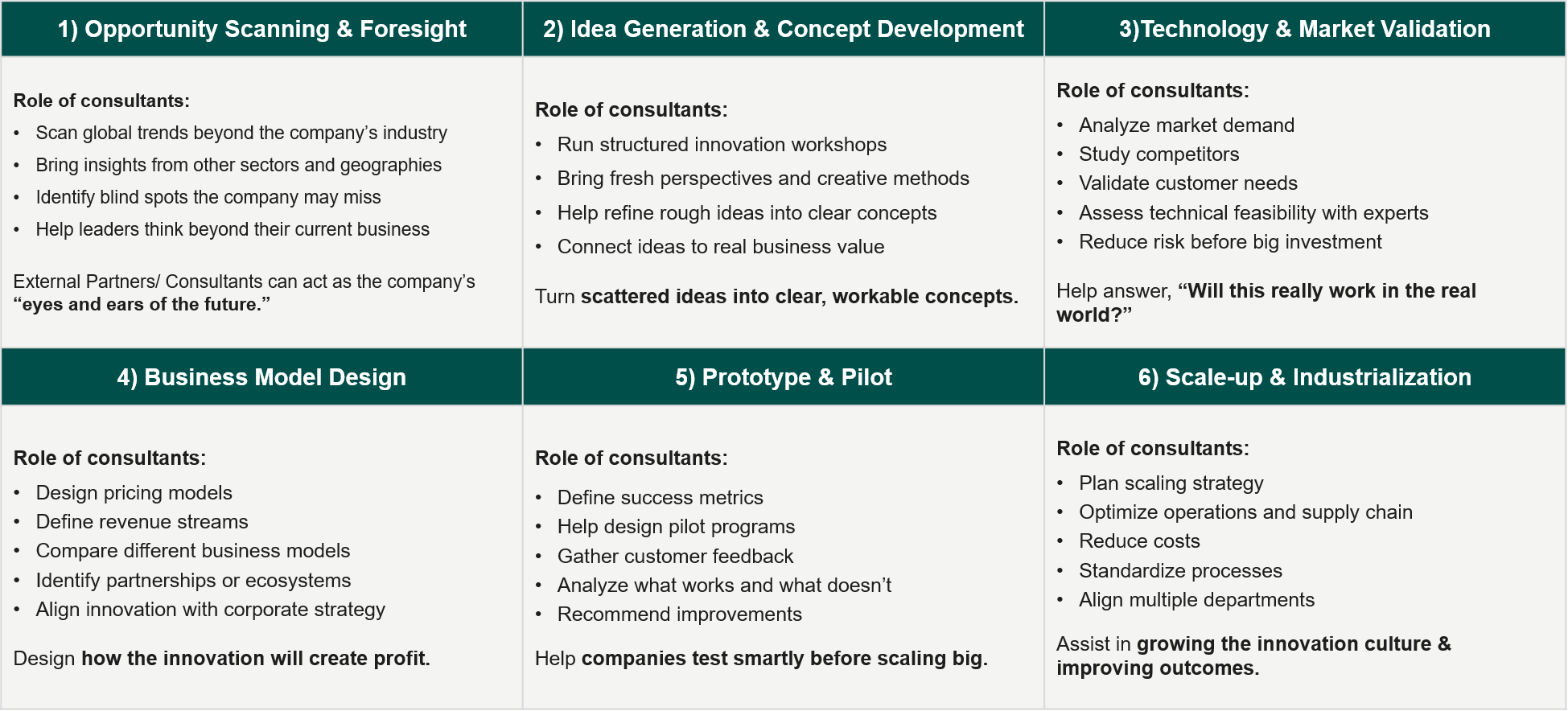
Which Activities can be Fully Outsourced, Safely Outsourced, and shouldn’t be Outsourced?
It is often observed and cited that total control over the innovation process quietly overloads internal teams, limits external insights, slows pilot experimentation, and weakens the innovation culture. Whereas, external partners (who bring a credible outside-in perspective) strengthen the strategic leverage over the process.
A more disciplined mid-size firm approach should own what core is (i.e., the key decision-making process, lessons learned), and share what is repetitive (i.e.,program marketing, engagement, portfolio management, documentation, etc.).
They should focus on building what strengthens capability, and outsource what is commoditized. This approach will accelerate the firm’s learning, reduce process friction, and free leadership to focus on what truly creates advantage. The following matrix can help to identify activities that mid-size innovation aspiring firms can control and outsource, to orchestrate their innovation program wisely:
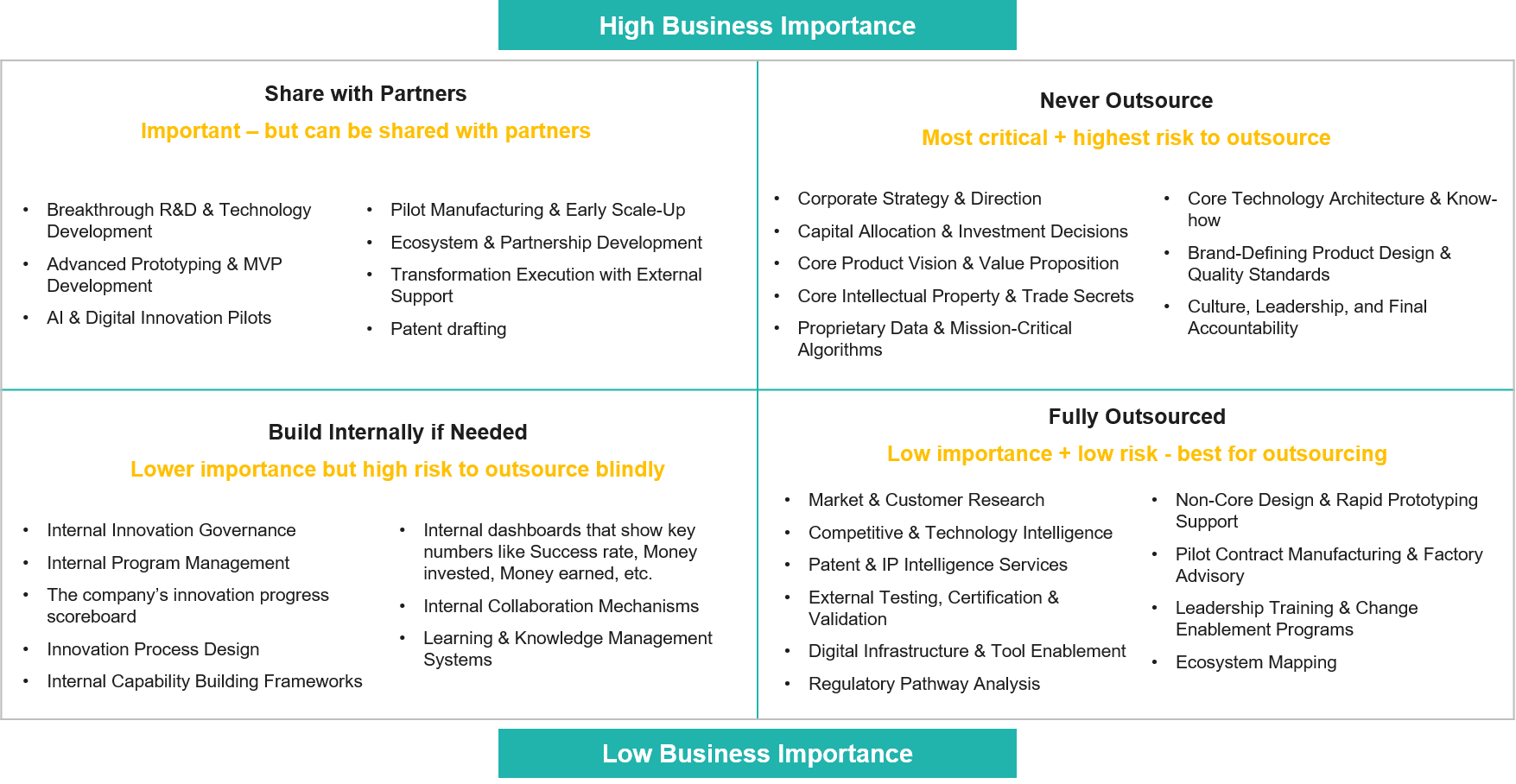
Who are the Various Innovation Outsourcing Partner Types, and What Services do they offer at Various Stages of the Innovation Cycle?
Innovation is a journey:
Opportunity >> Idea >> Validation >> Prototype >> Scale >> Protection
Different innovation partners take on various roles depending on the stage.
Mid-sized organizations should avoid outsourcing without careful consideration and instead choose the appropriate partner at the correct point in the innovation process.
1. Innovation Hubs & Incubators
They establish environments that link start-ups, companies, advisors, funders, and scientists.
How they help:
- Opportunity Scanning: Getting familiar with new technologies and developments
- Idea Generation: Hackathons, joint idea development conferences
- Start-up Scouting: Access to innovative early-stage endeavors
- Early Validation: Pilot collaboration opportunities
Best for: Expanding your innovation funnel and access to external ideas.
2. Accelerators (Start-up Accelerators / Corporate Accelerators)
They offer structured, time-bound programs designed to fast-track start-ups and innovation ventures.
How they aid:
- Idea Refinement: Facilitated guidance, expertise, and strategy development
- Market Validation: Testing with real users, finding pilot users, conducting pilot testing
- Business Model Development: Development of a comprehensive Go-To-Market strategy
Proof-of-Concept & Pilot Execution: Quick iteration to prove concepts quickly
Best for: Accelerating time to market through the process of structured experimentation (testing ideas), and getting to market sooner.
3. Prototyping Labs & Maker Spaces
High-level technical tools and equipment that allow designers/engineers to work in the full spectrum of product design/engineering disciplines.
How they help:
- Assess Technical Feasibility of Concepts: Either verifying that an idea can be developed or making a working prototype
- Prototype Development: Provides for rapid development using simulated environments to build minimum viable products (MVP)
- Testing & Iteration: Speeding up the iterative process to improve the design features of the product
Best for: Hardware or engineering-focused innovative companies.
4. Government Innovation & Start-up Programs
Policy-backed initiatives supporting entrepreneurship and innovation.
How they help:
- Greater Access to Seed Financing: Providing early-stage funding through either grants and/or incentives
- Regulatory Facilitation: Streamlining regulations, creating less complexity in meeting requirements
- Scaling Support: Providing market-access opportunities or export opportunities
Best for: Removing financial and compliance-related barriers for innovative or startup companies.
5. IP Search & Patent Intelligence Firms
Companies that specialize in providing patent analytic services and assisting with the development of an IP strategy.
How they help:
- Opportunity Stage: Help identify developing technologies that have no filed patents
- Validation Stage: Conduct a review of the patent landscape
- Pre-Launch: Conduct Freedom to Operate(FTO) analysis as a result of all available information
- Scale Stage: Assist with the creation of a proactive and reactive IP strategy.
Best for: Reducing the potential for legal exposure for a company while simultaneously identifying opportunities to further differentiate from competing companies.
6. Universities & Research Institutions
Academic research laboratories and institutes that are focused on applied research.
How they help:
- Early Discovery: Conduct leading-edge research
- Technical Validation: Validating scientific and technical rigor
- Deep-Tech Development: Long-term innovation programs
Best for: Advanced and frontier innovation.
7. Innovation & Strategy Consultants
Firms that structure, govern, and accelerate innovation processes.
How they help:
- Opportunity Identification: Market & tech landscape analysis and Theme prioritization
- Discovery: Discovering start-ups, ideas by engaging with Innovation Hubs & Incubators, accelerators, database providers, government incubators, etc.
- Engagement: Engaging with start-ups, idea holders, and handling conversations, documentation, etc.
- Portfolio Prioritization: Shortlisting start-ups & ideas, thus helping in making risk-free investment decisions
- Business Model Design: Monetization frameworks
- Scale & Integration: Governance and execution support
Best for: Turning innovation into a repeatable growth engine.
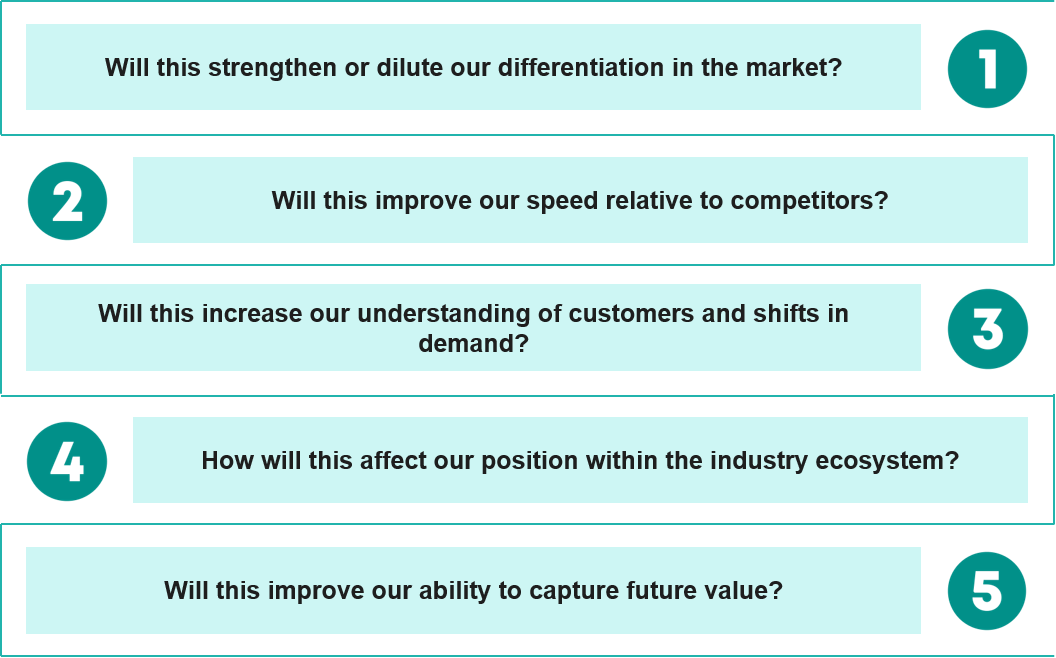
Which Market-critical Filters should be Used to Select an Innovation Partner?
Before selecting an external partner to support your innovation journey, leadership should rigorously evaluate key strategic market considerations. The selection of a partner will have a direct impact on your competitive approach, the speed of your progress, and the total value you eventually gain. It is essential to make sure that external support strengthens rather than weakens your unique value, speeds up your time-to-market compared to competitors, improves your direct knowledge of customers, solidifies your role in the larger industry network, and safeguards control over future revenue areas like intellectual property, data, and customer relationships.
The reason is simple: Bringing external partners into your innovation journey should increase your market power.
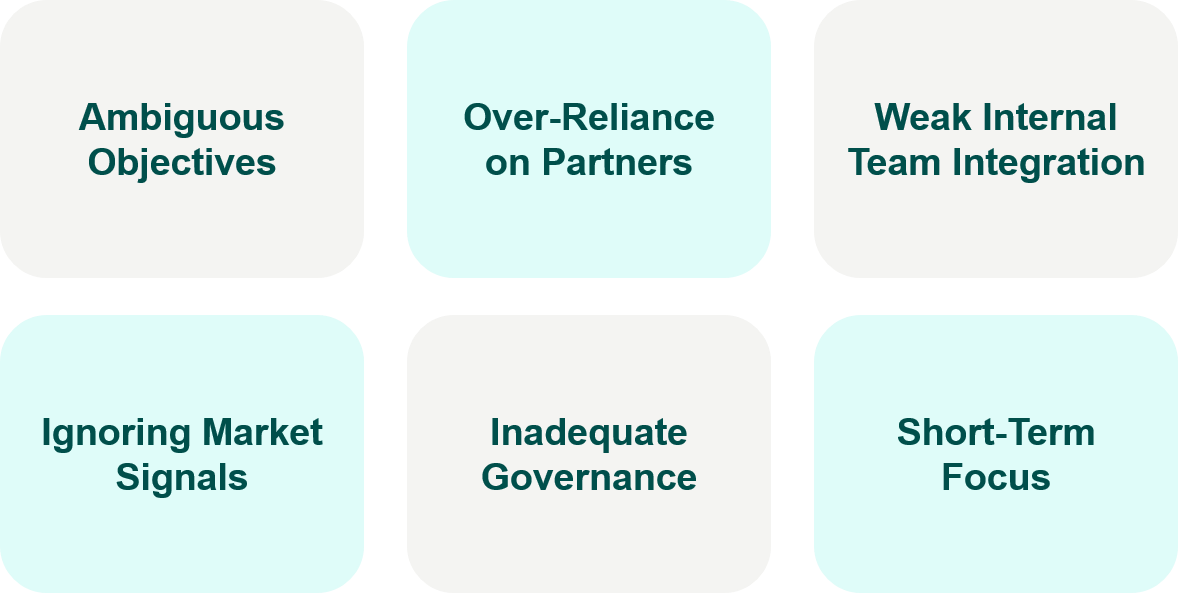
What are the Common Engagement Pitfalls that Should be Avoided When Working with Innovation Partners?
However, even the best outsourcing of innovation can lead to failure if key factors are ignored. The main reason for failures is internal factors such as misalignment, lack of clear objectives, and poor strategic coordination. The most common disadvantages of outsourcing innovation are:
Thus, it is clear that innovation is not failing because of the lack of ideas, intentions, and resources. It is failing because of poor orchestration and a lack of discipline.
At Stellarix, we work with mid-size growth-focused organizations to structure, govern, and accelerate their innovation ecosystems. Connect with us to continue the conversation. If your organization is reassessing how to structure, govern, and accelerate its innovation agenda, we invite you to connect with us for a focused discussion on innovation orchestration and partner strategy and assess how a structured orchestration framework can help you move from intent to scalable impact.
Let's Take the Conversation Forward
Reach out to Stellarix experts for tailored solutions to streamline your operations and achieve
measurable business excellence.