Automated Greenhouses and Vertical Farms: ROI, Economics, and Competitive Edge
Controlled Environment Agriculture (CEA), where agricultural investments feature stable, high-tech manufacturing processes, is the future of modern agriculture. A surge in automated greenhouse and vertical farming (VF) clearly denotes the significance of efficiency and automation for industry players, especially as energy, land, and labor costs continue to rise in smart agriculture.
VF is moving from a pilot phase to stable expansion as investment decisions are now closely tied to energy efficiency, resource optimization, and profitability. An accuracy rate of over 90 percent in crop-yield forecasting last year and a projected global value exceeding 55 billion U.S. dollars by 2032, CEA shows great potential for new and existing market players.
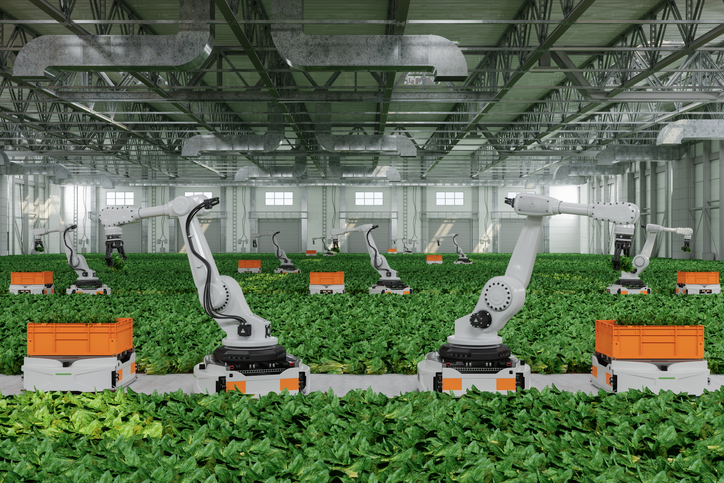
Robotics, IoT sensors, data-driven systems, digital twins, and climate-control systems are transforming modern agriculture into a scalable and efficient business. However, the economics of automated farming and VF have been challenging, as many early adopters and large companies have struggled not only with profitability but also with establishing successful business models.
Therefore, Agtech firms seeking to build resilient operations need a fundamental rethink of risk, yield, and cost structures.
How Controlled Environment Agriculture(CEA) Can Create High Economic Value?
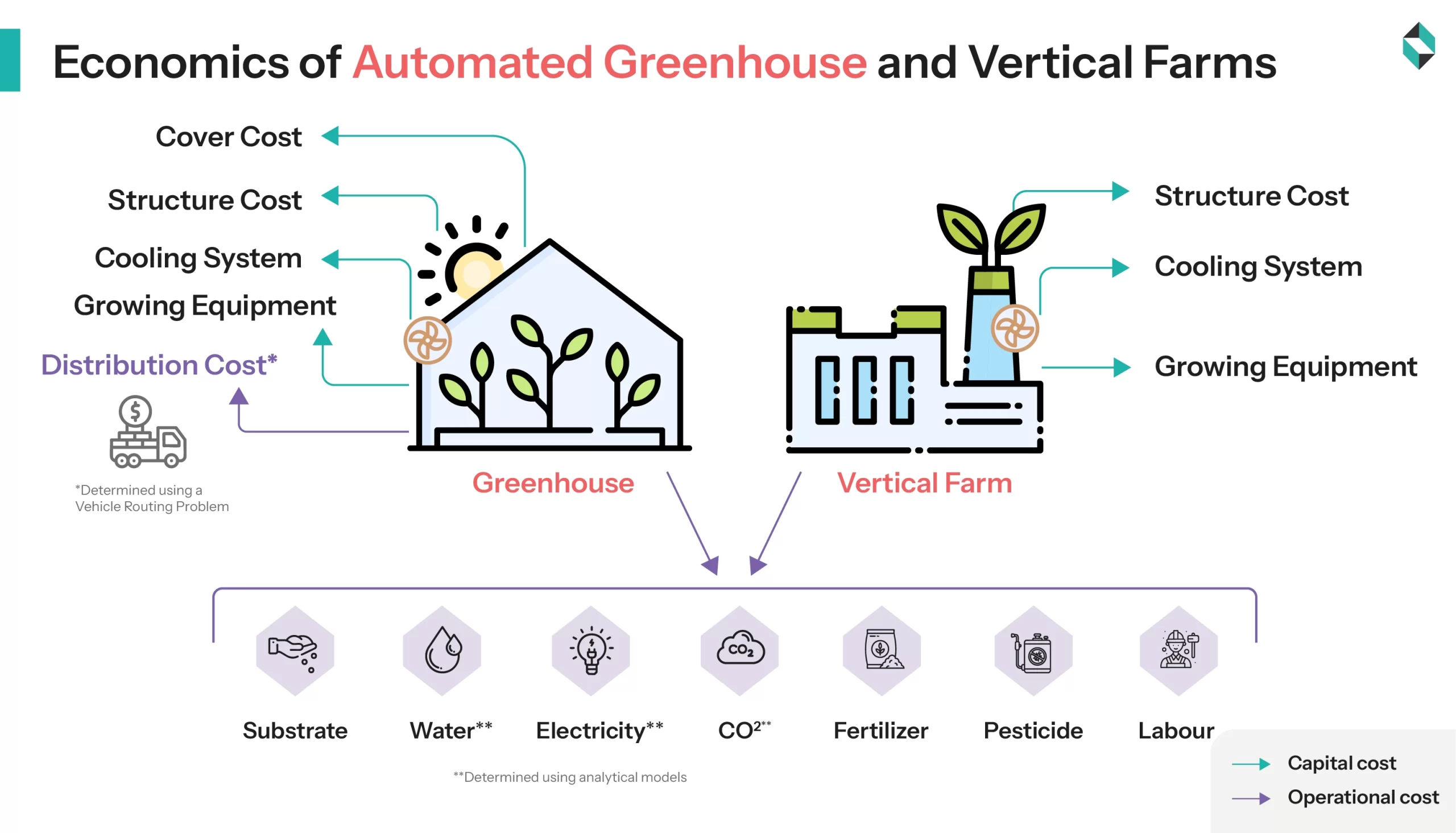
In automated greenhouse systems and indoor VF setups, energy costs are substantial. The financial foundation of CEA depends on balancing CapEx and OpEx.
CapEx covers technological and structural components such as:
- Automated HVAC systems
- LED lighting arrays
- IoT-driven systems
- CO2-regulation units.
Therefore, Agtech businesses that effectively manage these systems achieve scalability and efficiency gains over time despite initial investments.
For OpEx covering data analytics, labor, energy, and maintenance, automation reduces labor requirements by more than half. Also, automation helps with improving production cycles and yield uniformity in CEA setups.
An experiment pointed out that autonomous control systems increased cucumber yield by around 12% and cherry tomato energy efficiency by 20%. All these outputs directly contribute to high net profit margins for businesses.
Smart indoor farming systems typically incur higher setup costs of up to 68% more but reduce water consumption by up to 90%, and significantly reduce fertilizer loss. However, decision-makers should note that ROI differs depending on the crop and energy source, each having distinct payback periods.
By shifting agriculture from a variable-cost to a fixed-cost model and adopting a scale-driven approach, smart farming promotes margin expansion and production growth.
What are the Adoption Barriers?
- Building a fully automated system is capital-intensive, despite the operational savings it yields. Mid-sized operators need to focus on a robust business framework to ensure that ROI is not delayed.
- Energy intensity represents a significant obstacle to smart indoor farming, making profit margins susceptible to local electricity costs. Therefore, integrating wind, solar, and waste-heat recovery systems is crucial to stabilizing profits. Such integration is essential for maintaining consistent margins.
- Operational risk arising from the technical complexity of automation systems demands a competent workforce, consistent maintenance, and reliable data connections. Poor integration can adversely affect OpEx and ROI.
Strategic Implications
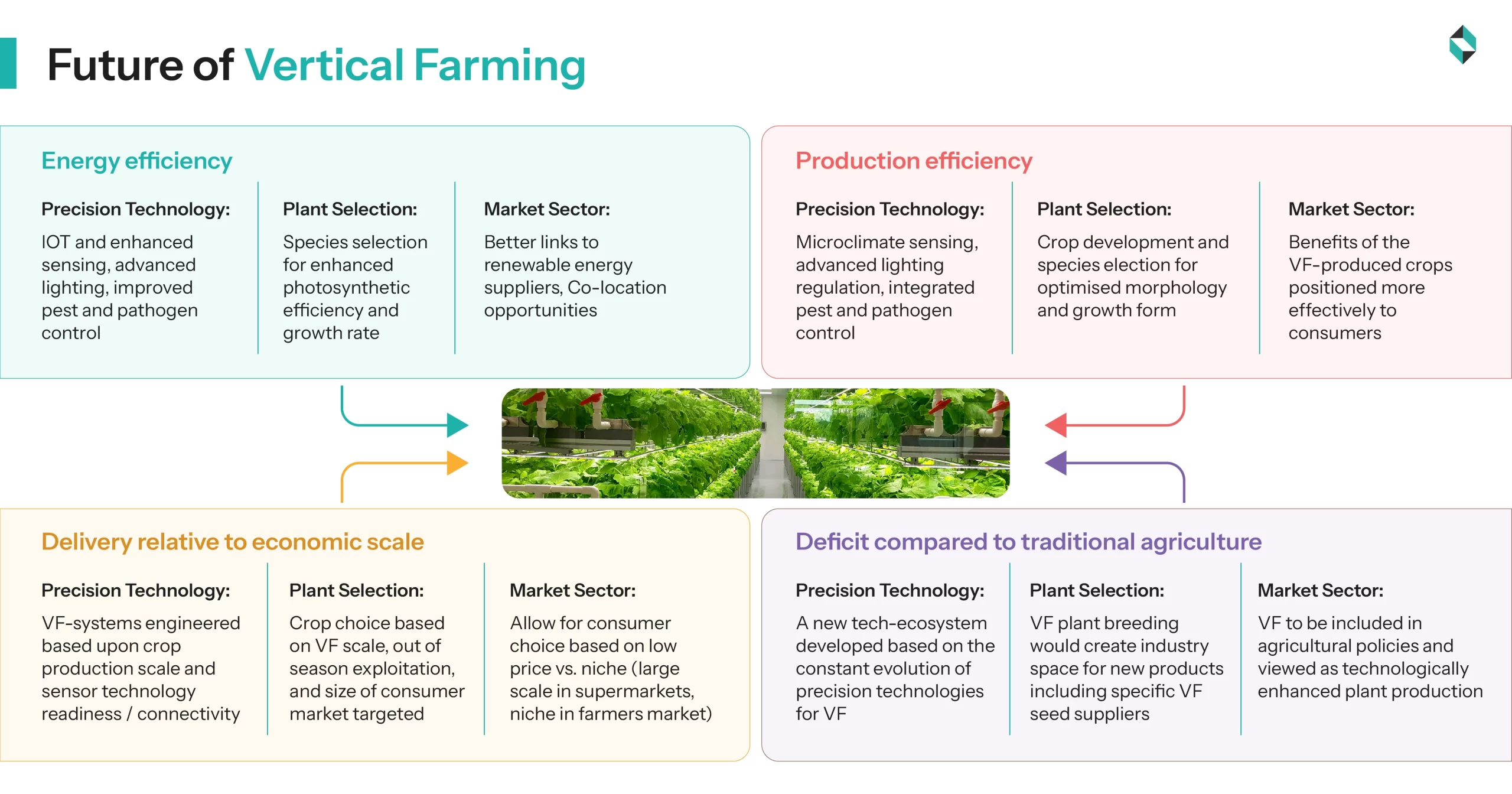
Robotics, Artificial Intelligence-enabled farm management, and modular multi-level greenhouses are shaping the future of smart indoor farming. Operators should focus on incorporating renewable energy sources into the VF system and automated greenhouses to evade the energy cost risks. Investment trends are indicating a move toward standardizing metrics and managing cost factors through scale and automation. Moreover, the pace of smart indoor farming adoption is closely associated with policy measures.
Business Opportunities for AgTech Firms
- Food retail chains can secure vertical integration for domestic supply.
- Agritech startups can offer automation-as-a-service by treating vertical farming and automated greenhouses as a blend of tech and agriculture.
- Investors supporting modular farms with stable ROI potential.
Final Words
The economics of Agritech transformation are shifting to favor businesses that can effectively manage energy risk, scale appropriately, and control capital expenditures. Vertical farming and automated greenhouses present an attractive opportunity at the intersection of supply chain resilience, sustainability, and food security. Technical overreach and early overcapitalization led to sector resets, fostering a healthier investment environment with disciplined operators and improved unit economics.
Stellarix helps Agritech companies manage the economics of smart farming by developing suitable business models to tackle challenges ranging from operational risks to profitability. Through our F&B consulting expertise, we aim to make your business future-proof by strengthening resilience and building a competitive advantage.
Let's Take the Conversation Forward
Reach out to Stellarix experts for tailored solutions to streamline your operations and achieve
measurable business excellence.