Grid Digitalization: Powering Scalable Infrastructure and Enterprise-level Innovation

The journey of electricity grids from analog infrastructure to digital power grids has been uneven. While the penetration of grid automation, smart meters, and digital substations is high in developed countries, the developing countries are still catching up. This out-of-balance equation opens up doors to unprecedented opportunities and challenges for innovation.
Digital technologies are driving substantial investments in smart grid infrastructure while upgrading operations through predictive analytics, automated responses, and real-time monitoring. Most importantly, they promise to revolutionize grid development by accelerating infrastructure deployment and reducing time-to-market. However, the fundamental question that most energy executives face is:
‘What kind of digitalization pathways could ensure measurable operational returns while compressing timelines and positioning utilities for growing complexities of grids?”
However, there is another critical question that this article answers: what distinguishes expensive technology pilots that fail from successful digitalized grids? We evaluate the status quo of grid-level digitalization, narrow down on how AI is reshaping power infrastructure requirements, the opportunities latent in critical gaps, and pin a strategic pathway for utilities to generate value from digital transformation.
The Multilayered Ecosystem: Converging AI Workloads, Stakeholders’ Expectations, and Grid Digitalization
The global smart grids market, the primary indicator of digitalization, was valued at $62.8 billion in 2024 and is expected to reach ~$211.4 billion by 2032 at a CAGR of 15.8%. This expected growth trajectory roots in the huge capital deployment by governments, tech innovators, and utilities that are redefining power infrastructure to accommodate evolving AI workloads, regulatory demands, and stakeholder demands. In 2024, data centers consumed ~415 terawatt-hours of electricity worldwide. This figure is expected to grow and almost exceed 1000 terawatt-hours by the end of this decade as AI training and inference projects grow exponentially.
It creates a huge predicament for grid operators as every single data center demands electricity equivalent to a new city. It is a big challenge that places additional pressure on already burdened power grid infrastructure. This challenge is an impediment to altering the arithmetic of grid investments.
Here is a brief summary of digital innovations forming the backbone of this transition:
| Innovation | Core Focus | Capabilties | USP |
| Advanced Metering Infrastructure | Communication and Smart Meters | Real-time power consumption monitoring | Every 15 mins two-way data exchange and remote disconnect features |
| Distribution Automation | Automatic Reclosers & Reclosers | Equips the grid for self-recovery and fault isolation | Brings down outage duration by 35-45% |
| Distributed Energy Resource Management (DERM) | DERMS Platforms | Control and consolidation of storage, solar, and EVs | VPPs orchestration |
| Grid-edge Intelligence | Edge Computing Equipment | Shorter response time and localized processing | Agile decision making |
| Blockchain for Energy Trading | Distributed Ledger | Transparency in settlements and peer-to-peer energy transactions | Supports the economics of microgrids |
| Advanced Grid Analytics | Big Data Platforms | Demand response optimization | Forecast accuracy improves up to 95% |
| Fiber Optic Sensing | Fault & Temperature Detection | Uninterrupted monitoring of transmission lines | Prevents equipment failures |
The integration of these innovations mirrors the evolving priorities of stakeholders across the power grid’s value chain. These stakeholders, along with their expectations, span:
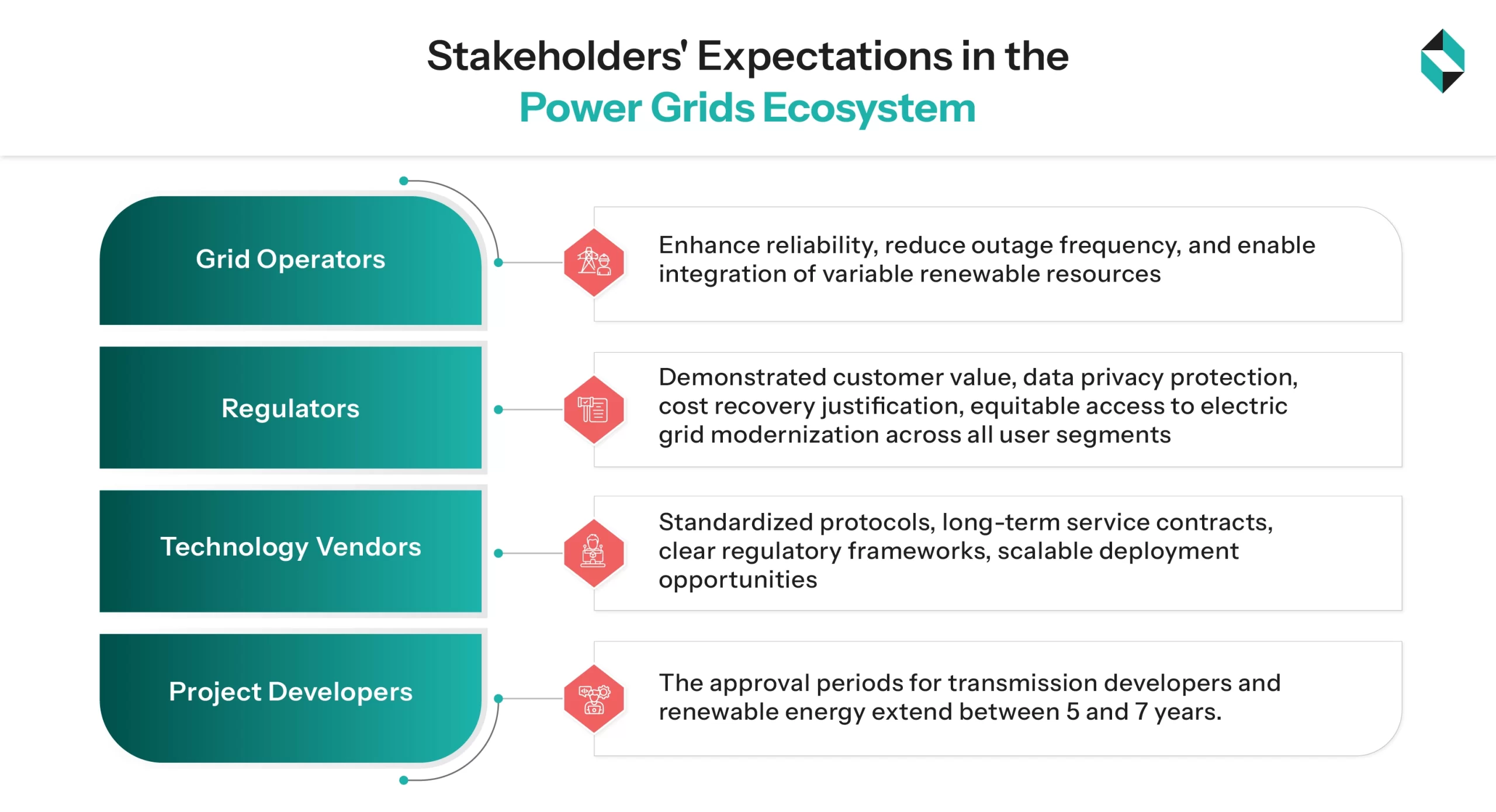
This interconnected network of expectations is fuelling the fundamental momentum towards electric grids’ modernization and thereby their digitalization.
“Success in grid digitalization will be by ability to shift the focus from technology procurement to business model innovation, from planning cycles to adaptive infrastructure, and from reactive security to proactive intelligence.” – Deepak Kumar Jain, Business Leader – Industrials, Mobility, and Hi-Tech Industry
How AI is Redefining Grid Digitalization Requirements?
The exponential rise of AI is altering the grid modernization strategy to a larger extent. A recent study suggests that AI data centers will consume ~68 gigawatts of power by the end of next year, which is equivalent to the total power capacity of California at present. What further complicates the situation is that the demand is centered in specific areas and lacks any kind of geographical uniformity.
The pace of their rise has direct implications for grid digitalization:
- Increasing Stress on Grids: The fluctuating and intensive power consumption by AI data centers for large-scale inference and model training places rapid load variations on the grid. They demand short-term forecasting methods to manage such requirements.
- Digital-twins Integration Becomes Mission-Critical: Utilities require virtual replicas of their grids to practice AI load simulations, assess grid stability under immense pressures, and predict infrastructure investments prior to capital allocation.
- Advanced Forecasting and ML Integration: The non-cyclic, complicated patterns and dynamic schedules make accurate predictions difficult inherently. Smart grid technology developers must develop sophisticated forecasting systems that can predict data centers’ consumption patterns.
Can Digitalization Collapse Grid Timelines?
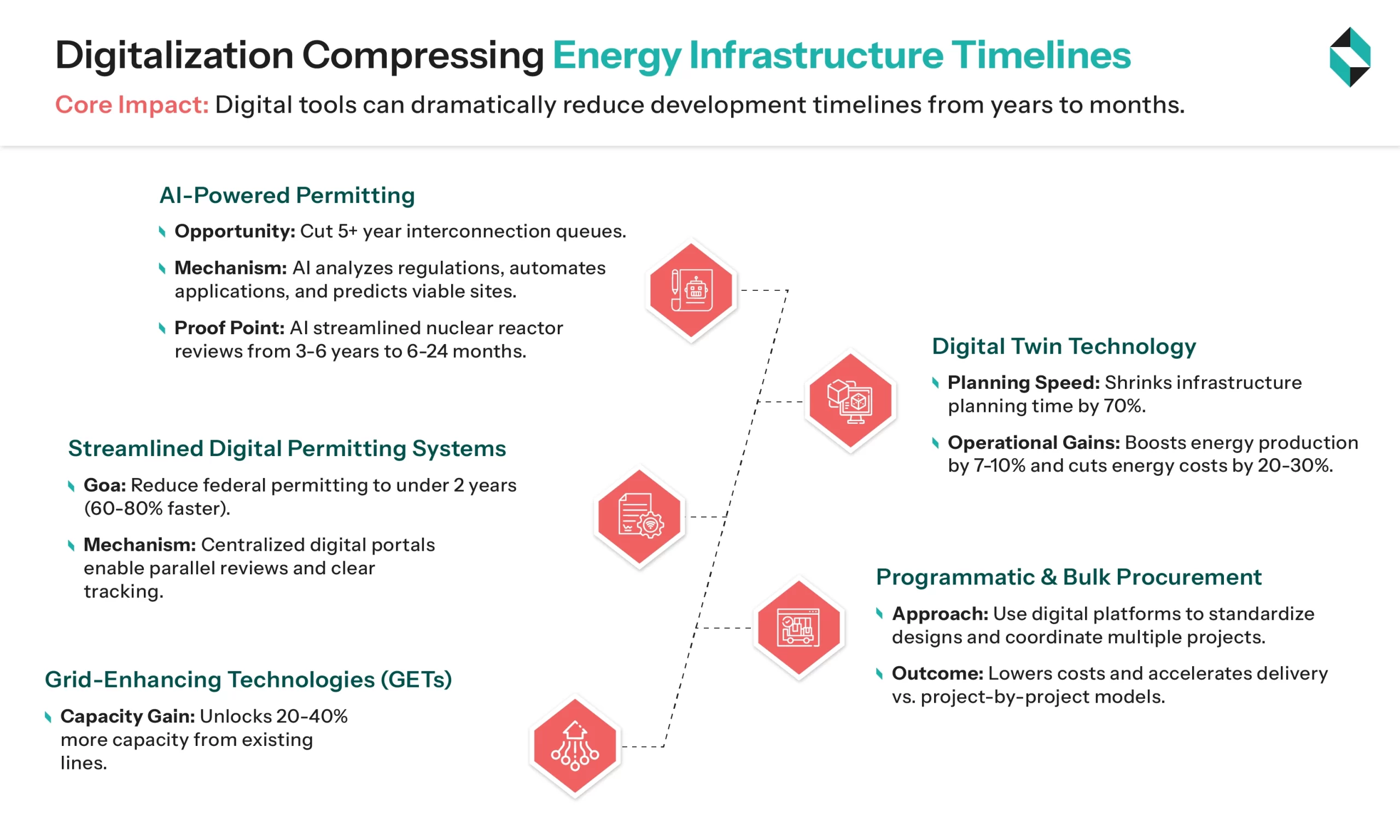
The conventional grid development timeline extends to years, making it one of the biggest barriers to energy transition. The convoluted maze of local governments, federal agencies, and state bureaus creates a fundamental mismatch in the clean energy generation timelines of 12-18 months and infrastructure needing 5-10 years to connect with them. However, digitalization offers substantial opportunities to compress these timelines, as shown below:
Are Digital Investments Generating the Promised Value for Smart Electric Grids?
Our team analyzed digitalization initiatives of over 35-40 utilities across Europe, APAC, and North America. Our assessment extended from comprehensive grid modernization programs to AMI rollouts, revealing that most of these entities achieved technical deployment milestones; however, they strive to capture the financial and operational value that such frameworks promise. There are several bridges awaiting to be crossed:
- Holistic optimization is still a distant possibility, as the data silos created by the integration of modern and legacy systems
- Data quality issues persist, along with actionable analytics limitations
- The workforce still lacks the capability; there is a severe lack of AI specialists and data scientists
- Cybersecurity risks multiply at an exponential scale, with attack surfaces expanding across millions of connected devices
- Infrastructure planning cycles fail to align with data center deployment timelines
It all narrows down to one simple decision-metric question: “How to overcome the gap between measurable grid performance and digital infrastructure investments during the most critical value realization window?”
Cybersecurity: The Growing Concern for Smart Energy Grids
The cybersecurity vulnerabilities resulting from digitalization completely contradict the value proposition of smart electricity grids. These include:
- An Expanding Attack Surface: The decentralization of grids is expanding the attack surface as each connected node is a potential entry point for malicious entities. Every distributed energy resource, IoT sensor, and smart meter represents a potential vulnerability ready to be exploited
- False Data Injection Attacks: Manipulated data is injected into grid systems that compromise their operational integrity, cause blackouts, and cause infrastructural damage. Conventional state estimation algorithms cannot detect these attacks.
- DDoS and DoS Attacks: Flooding a server with excessive traffic to delay readings, disrupt operations, and trigger outages becomes easier and more damaging due to the interconnected nature of smart grids.
- Man-in-the-Middle (MitM) Attacks: The increasing reliance of modern grids on IIoT makes them vulnerable to MitM attacks that can intercept as well as manipulate SCADA communications.
Other Barriers Limiting the Impact of the Grid Modernization Strategy
System Integration and Data Silos
Lack of standardized data models is the biggest barrier to seamless communication between customers, operations, and grid systems. Most proprietary vendor frameworks are creating lock-in effects that make them costly and rigid in long-term multi-vendor ecosystems.
AI Load Forecasting Inadequacies
Smart grids need to maintain non-spinning and spinning reserve margins to ensure reliability amidst rapid and large-scale load variations, leading to higher operational costs and complexity.
Speed-to-Power Pressure
When demand timelines compress, the grid systems go for the most rapid delivery, irrespective of the technology. This leads to tension between short-term tactical responses and long-term strategic digitalization plans to accommodate AI loads. It often leads to suboptimal technology choices, resulting in technical debts.
Interconnection and Permitting Bottlenecks
Multiple regulatory bodies are implementing policies requiring large data center customers to beat 85% of subscribed energy irrespective of the actual usage, leading to regulatory uncertainties and delaying digital grid investments.
What Kind of Emerging Developments will Help Unlock Digital Grid Value?
As the grid digitalization landscape matures, new strategic opportunities will emerge to bridge the gaps left by first-generation implementation barriers. They will pave multiple pathways to value creation, the most promising ones span:
- AI-driven Autonomous Grid Operations: Machine learning systems will eliminate the need for manual intervention. It will enable sub-second response to grid disturbances, which will be essential for AI workload volatility management.
- Advanced Threat Detection with Federated Learning: Privacy-preserving approaches blending federated learning along with cloud coordination enable utilities to train intrusion detection models without exposing sensitive grid data.
- Edge Intelligence Architectures: Local data processing reduces bandwidth and latency requirements that enhance privacy. It is pivotal for real-time threat detection and controlling decisions at the grid’s edge that has over a million nodes.
- Digital Twins for AI Load Planning: Advanced simulations combined with real-time operational data for optimizing grid planning specifically for AI-enabled utilities, workload scenarios, to assess infrastructure investments prior to capital commitment.
- Zero-trust Security Frameworks: These move beyond perimeter defense to verify each access request and assume breach. They are essential given the expanding attack surface due to millions of connected devices.
The Bottomline
In the next 5-7 years, the industry leaders will be skimmed for the ability to successfully monetize digital investments. These leaders will own a market edge through operational efficiency, enhanced reliability, and strategic AI partnerships.
The differentiating factor wouldn’t be volume of deployed capital or the technologies’ sophistication, but strategic clarity on the most value-yielding use cases, upgraded organizational capabilities for leveraging digital tools, and integration of value-generating platforms for complete grid infrastructure.
As an innovation and strategic partner, we are helping grid operators, utilities, and grid operators navigate the complexities of grid digitalization in an era dominated by AI applications. We have assisted clients through technology roadmaps, strategic assessments, cybersecurity framework design, and implementation blueprints. Our strategic intelligence is enabling:
- High-impact investments prioritization
- Integrated architectures designs
- Validate business models
- Navigate regulatory frameworks
- Architect cybersecurity resilience
Let's Take the Conversation Forward
Reach out to Stellarix experts for tailored solutions to streamline your operations and achieve
measurable business excellence.

