How Diagnostic AI is Enhancing Radiology Workflow with 45% Reduced Diagnostic Errors?

AI in Radiology: Redefining Clinical Landscape
Artificial intelligence (AI) implementation is turning the wheel of growth and returns in the MedTech sector at an unprecedented pace. From Generative AI transforming the MedTech industry to advanced AI technologies like intelligent workflow prioritization, radiomics, and predictive analytics, these innovations continue to drive change.
Radiologists often encounter challenges such as high diagnostic errors and cognitive bias; however, the implementation of AI tools helps decrease diagnostic errors by approximately 45% and cognitive bias by around 30%. Diagnostic AI has evolved from being an individualized tool to a smart co-pilot, swiftly integrated into the radiology workflow. This evolution aligns with the increasing demand for radiologists to enhance diagnostic accuracy and high throughput in a complex and demanding healthcare ecosystem.
Let us gain factual insights into how diagnostic AI is enhancing radiology workflows by improving efficiency through reduced errors in the healthcare domain. The blog specifically sheds light on the steps to integrate, the prominent challenges, and the core considerations for the effective use of AI in radiology.
How AI Improves Diagnostic Decision-Making for Smarter, More Profitable Radiology?
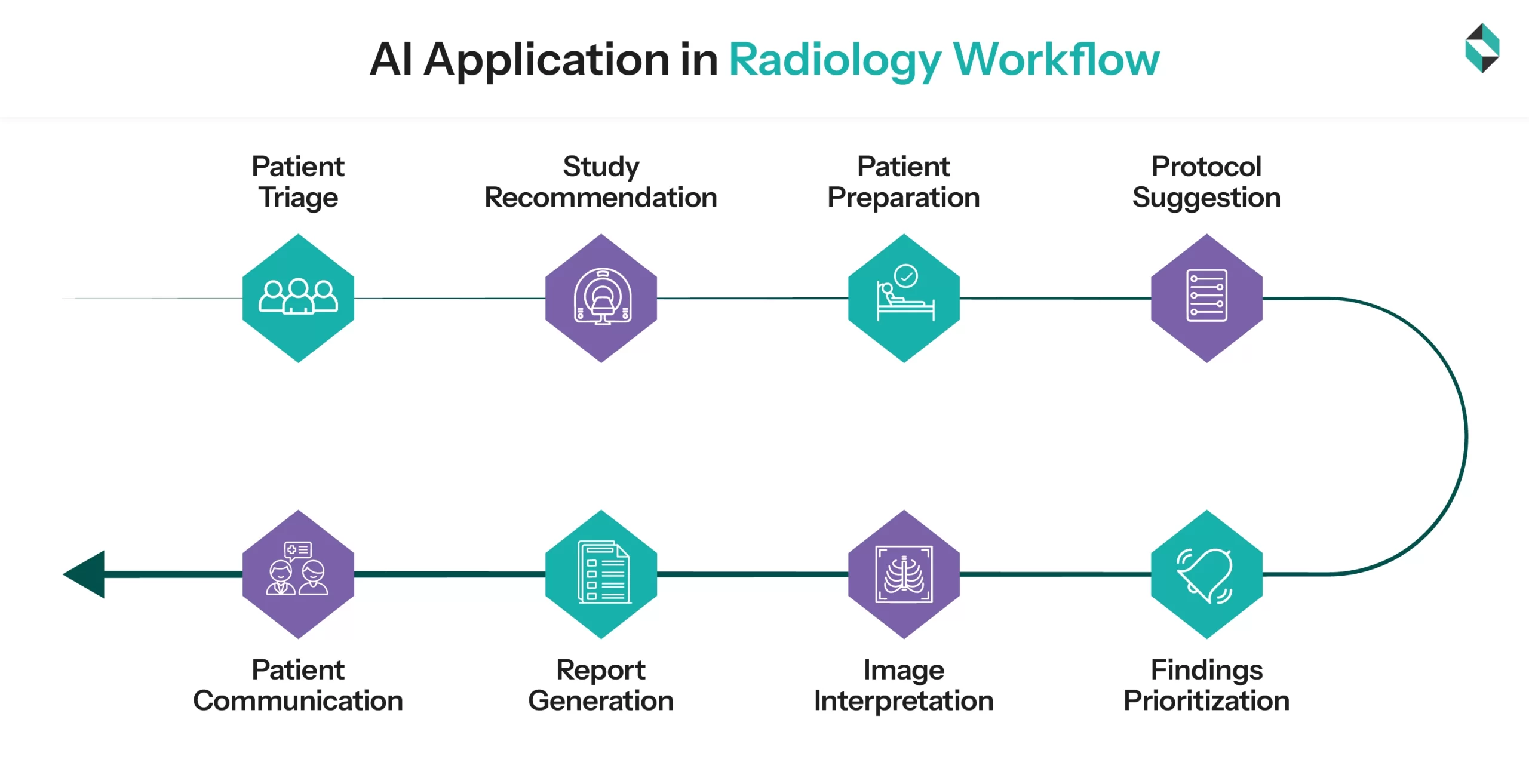
AI supports radiologists at several touchpoints in the imaging process, from patient triage to patient communication. Main functions are:
- Triage & Prioritization: AI tools immediately point out urgent pathologies from acute stroke to pneumothorax, facilitating quick routing of crucial cases in emergency workflow. For instance, in a recent research study, 8% of patients were identified as potential candidates for rare diseases, with a confirmation rate of approximately 75% for these diagnoses.
- Anomaly Detection: AI tools often identify overlooked abnormalities on X-rays and MRIs, reducing errors in complex cases.
- Quantification: AI aids in objective measurements like lung nodule size and brain volume, fostering consistency and precision in treatment planning and follow-ups.
- Report Automation: Structured report generation minimizes documentation efforts, accelerates reporting, and promotes standardization across teams.
Overall, AI-generated outputs remain overseen by radiologists, ensuring clinical integrity and accountability. The co-pilot model not only boosts efficiency but also reinforces radiologists’ key role in patient care by managing repetitive tasks and providing greater diagnostic insights.
Real-Life Use Cases of Diagnostic AI in Radiology
Clinical Utility
AI facilitates the identification of subtle gaps in complex studies, significantly reducing the likelihood of overlooked abnormalities. Additionally, in emergency settings, AI accelerates prioritization and triage, ultimately reducing diagnostic time. Evidence shows that using AI decreased diagnostic inaccuracies by 11%. Furthermore, in mammography and cancer cases, AI provides consistent interpretation, lowering inter-reader variability.
Operational Efficacy
AI handles repetitive identification tasks, such as vertebral fractures, allowing radiologists to focus their attention on more advanced interpretations. Additionally, standardized reporting helps reduce rework significantly due to the minimal need for downstream clarifications. It is noted that reporting turnaround time decreased by 30% with AI integration in the radiology workflow. Moreover, AI-equipped systems follow intelligent routing of cases based on modality and priority, thereby optimizing team efficiency and productivity.
What Challenges Radiology Teams Encounter in AI Adoption?
Technical Challenges:
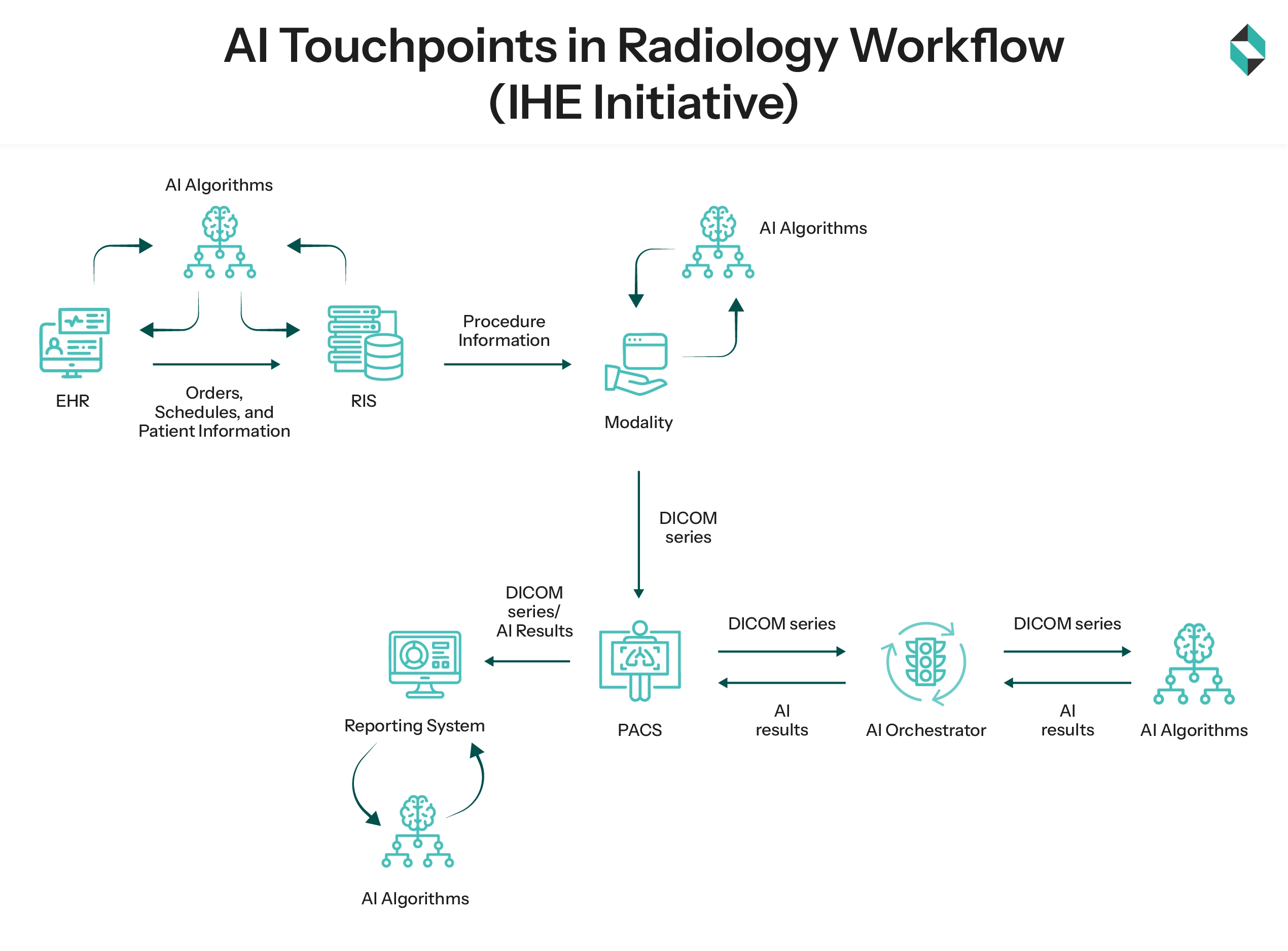
- Interoperability issues often obstruct healthcare providers in incorporating AI because AI integration with EHR, RIS, and PACS systems from different vendors requires compliance with varied standards like Digital Imaging and Communications in Medicine (DICOM) and Health Level (HL7).
- Security challenges often arise because several AI tools function off-site, demanding robust encryption, protection of de-identification workflows, and adherence to the Health Insurance Portability and Accountability Act (HIPAA).
Clinical Challenge:
- Workflow disruption and model-study matching are two pivotal issues that occur when an AI system is not integrated correctly, disrupting reading patterns.
Policy & Governance Challenges:
- There is an absence of a clear result review protocol that specifies how and when AI-generated outcomes are released, making them forbidden unless radiologists confirm them.
- The lack of clear policies on AI interaction creates governance problems and underscores the need for continuous oversight of AI performance and validation across various deployments.
What will Drive Operational Value for MedTech Industry Players?
AI in radiology renders value only when it aligns with how radiologists interact, interpret, and report imaging data. AI tools should provide interpretable results and reduce operational burden by being incorporated natively into diagnostic workflows. Standards-based and scalable integration is the way forward to ensure clinical excellence in AI deployment, where practices are aligned with clinical workflows and technical architecture. Careful consideration should be given to clinical, technical, and governance-related challenges to ensure robust AI integration and maximize its benefits. Enterprises can mitigate technical challenges through proper model interoperability and by utilizing the Integrating the Healthcare Enterprise Initiative (IHE), which comprises profiles such as AI Orchestrator and AI Results (AIR).
At Stellarix, we help healthcare industry leaders and companies address challenges related to technological integration and achieve operational excellence by adopting current next-generation technologies. Leveraging our exclusive advanced imaging solutions and R&D services expertise, we assist in deploying workflow-embedded AI systems in healthcare. This enables you to strengthen your competitive position through enhanced operational performance and innovation across the entire value chain.
Let's Take the Conversation Forward
Reach out to Stellarix experts for tailored solutions to streamline your operations and achieve
measurable business excellence.