How AI & Automation are Changing Cleaning Products Manufacturing?

AI innovations are tackling longstanding pain points for cleaning product manufacturers, from regulatory impediments to sustainability pressures. In the low-margin, high-volume cleaning products industry, high customer demand for smart, green cleaning solutions is aggravating challenges for market players.
A prompt transformation is taking place as AI-powered robots transition from pilot projects to mainstream deployment. In this transformational phase, the market outlook looks quite promising for the industry players. The global home & laundry care market is estimated to reach around US$206.83bn by the end of 2025, with an annual growth rate of 3.12%. In particular, the laundry care segment is anticipated to reach a market volume of US$110.02bn in 2025, with the US accounting for around US$33bn of that. These figures underscore the growth prospects of industrial cleaning.
While AI-driven and automated industrial cleaning products are effective and strategically vital, delivering a comprehensive, integrated, data-driven ecosystem poses both challenges and opportunities for industry players at present. Now, manufacturers need to re-engineer their operations, business frameworks, and product formulations to align with sustainability, intelligence, and evolving regulatory requirements.
This blog dives deep into emerging trends/innovations, potential challenges posed by AI and automation in the cleaning industry, and key factors shaping the future of this sector.
Emerging Trends in AI and Automation Shaping Cleaning Products Manufacturing
Product Innovation for Robotic Compatibility
Future-focused cleaning formulations must cater to robotic constraints, as autonomous cleaning is swiftly replacing human users. Thus, manufacturers must allocate their investments to high-viscosity, low-residue formulations, coupled with unit-dose water-soluble pods, to avert clogs in robotic dispensers.
QR-ingrained chemical cartridges enable robots to determine optimal dilution, chemical type, and application protocol, reducing human input and improving precision. Apart from this, AI-driven fragrance personalization, a prominent consumer differentiator, is enabling businesses to optimize laundry and home care product formulations for diverse customer bases based on skin compatibility and fragrance preferences.
AI-Driven Formulation and Sustainable R&D
The household cleaning sector in the US is projected to grow at an approximate CAGR of around 2.86% from 2025 to 2029. The core drivers influencing the cleaning sector’s growth are stringent health regulations and green cleaning trends.
Companies using AI technology are balancing environmental performance and compliance through rapid R&D innovations. AI-enabled predictive modelling shortens the R&D cycle for high-efficiency, green-chemistry formulas, enabling you to be the early mover and capture enticing market opportunities.
Further, in-silico formulation and automated lifecycle analysis are emerging trends in this field. AI frameworks assist in pre-screening for toxicity, environmental impacts, and cleaning efficiency, eliminating the need for animal testing. Furthermore, cleaning product manufacturers that use AI benefit from improved compliance with corporate ESG mandates and the FTC’s Green Guides by providing real-time data on carbon footprints during innovation.
Regulatory Compliance through AI Automation
Cleaning product manufacturers struggle to navigate a complex, fragmented regulatory landscape comprising state and federal laws. For instance, the Toxic Substances Control Act (TSCA) continued to be the focal point. In 2025, the US Environmental Protection Agency (EPA) finalized a regulation to prevent exposure to trichloroethylene (TCE) and to re-evaluate other chemicals, such as perchloroethylene (PCE).
Meanwhile, the Federal Insecticide, Fungicide, and Rodenticide Act (FIFRA) made it mandatory for manufacturers to submit annual production reports. At the state level, the California Cleaning Product Right to Know Act requires full ingredient disclosure on websites and product labels. Hence, the focus is shifting towards devising a sustainable AI-accelerated manufacturing ecosystem.
Smart Factories for Agility and ESG
AI-driven smart facilities mitigate risk factors, cut costs, and foster compliance. Organizations benefit from different AI features, such as predictive maintenance, tracking of energy and water usage via IoT sensors for EPA reporting, and hyper-personalized production. Thus, you can protect your margin on every production unit by eliminating waste and unplanned interruptions.
Robotics-as-a-Service (RaaS) & Chemical Management as a Service (CMaaS)
Labor pressures and demand for efficiency are accelerating robotics adoption. Devices like Pudu Robotics’ CC1 Pro (May 2025) integrate real-time dirt detection, UV-C disinfection, and retractable LiDAR for dynamic cleaning in complex spaces. AI janitor robots evolved from robotic vacuum cleaners. Further, manufacturers are exploring data and service provider spaces in the market, including analytics dashboards for clients, smart dispensers, and subscription models. This trend generates new revenue streams for cleaning product businesses that embrace AI tools.
| Trend Area | Description | Key Innovations / Examples |
| Product Innovation for Robotic Compatibility | Formulations optimized for robotic use | High-viscosity, low-residue, and unit-dose water-soluble pods to prevent clogs- QR-coded chemical cartridges for dilution and application automation- AI-driven fragrance personalization based on user preferences and skin compatibility |
| AI-Driven Formulation & Sustainable R&D | AI-assisted eco-friendly product development | In-silico formulation- Automated lifecycle analysis- AI tools for toxicity and environmental screening- Compliance support for ESG and FTC Green Guides |
| Regulatory Compliance through AI Automation | Automating compliance with evolving regulations | TSCA, FIFRA, and California SB 258 monitoring- AI-driven reformulation tagging- Auto-tracking of PFAS and other regional laws- Verified green claims to reduce greenwashing risks |
| Smart Factories for Agility and ESG | AI and IoT-enhanced manufacturing operations | Predictive maintenance- Energy and water usage tracking for EPA reporting- Customizable, demand-based production |
| RaaS & CMaaS Adoption | Service-oriented models for robotics and chemical management | Robotics like Pudu CC1 Pro with dirt detection, UV-C, and LiDAR- AI janitor robots evolving from traditional vacuums- Analytics dashboards, smart dispensers, and subscription services |
Navigating Roadblocks to AI Deployment for Meaningful Business Impact
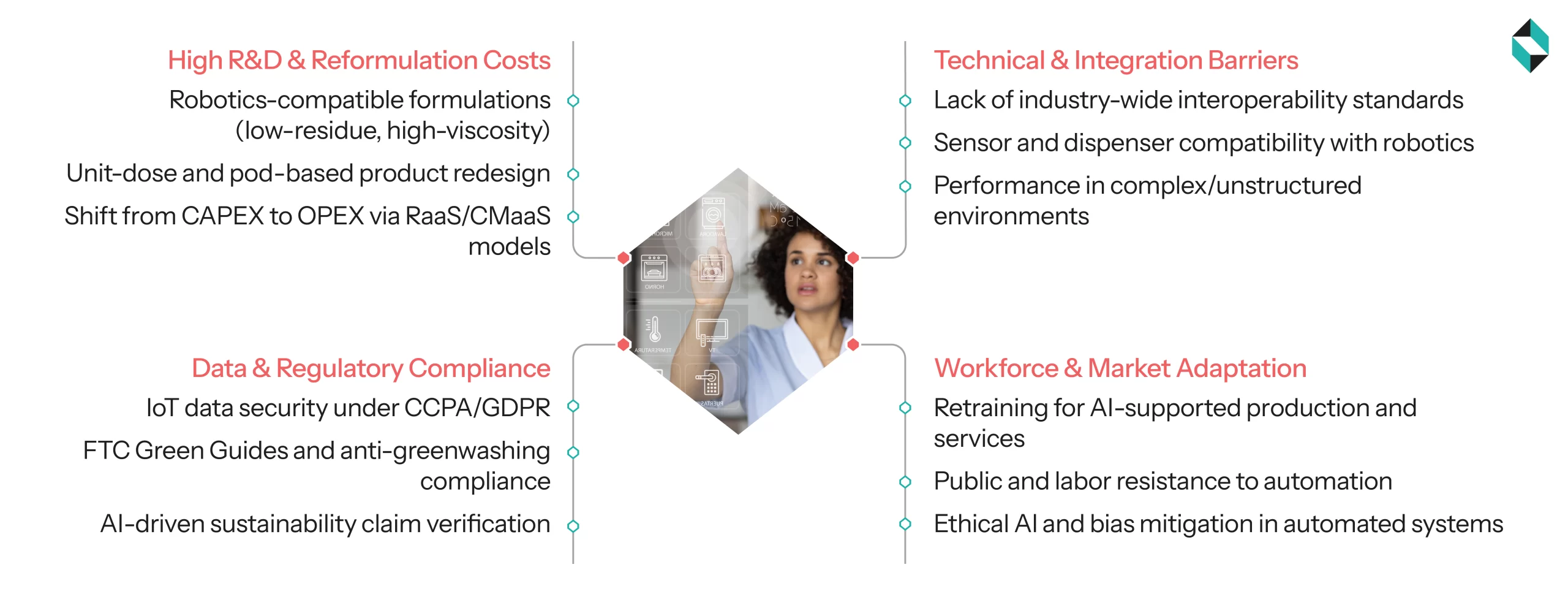
Figure: Barriers to AI & Automation Use in Cleaning Product Manufacturing
Financial Constraints and Implementation Barriers
- Substantial investment is needed to rebuild existing products and develop novel, robotics-compatible solutions, such as high-viscosity, low-residue formulas, which put an added burden on companies.
- To address this challenge, you can focus on adopting Robotics-as-a-Service (RaaS) and CMaaS models, turning capital expenditures into operating expenses.
- This subscription-based approach is seen across sectors such as healthcare, aviation, and retail. However, AI janitor robots still struggle to perform cleaning tasks, such as corner cleaning or navigating stairs, that explicitly require seamless human-robot collaboration. For instance, Heathrow Airport deploys RaaS robotic fleets to clean large areas, while human staff handle detailing tasks and oversight.
- Issues remain for cleaning product businesses in formulating products that meet the viscosity and solubility requirements of the automated dispensing system.
Data Privacy, Cybersecurity, and Compliance Concerns
- Autonomous cleaning robots equipped with LiDAR, stereoscopic cameras, and environmental sensors raise serious privacy and security concerns for businesses.
- Data security, privacy, regulatory compliance, and data storage issues are magnifying as AI integration advances amid evolving US regulatory measures.
- To address these concerns, you can opt for privacy-aware features like camera activation only in unoccupied zones and built-in data anonymization.
- GDPR-compliant encryption and secure cloud systems, under emerging state laws such as the California Consumer Privacy Act, have become the norm as businesses expect robust, transparent data protection in smart building and cleaning solutions.
Socio-ethical and Market-specific Barriers
- Increasing scrutiny of potential greenwashing and eco-friendly claims by industry players poses a major obstacle for manufacturers.
- You need to thoroughly follow the FTC Green Guides, as well as state-level laws that require verifiable, AI-supported data to validate eco-friendly product and process claims.
- A significant barrier to the adoption of next-gen AI and automation trends is workforce resistance rooted in job security fears and privacy issues. For instance, New York City’s push to deploy cleaning robots in public transit faced backlash over concerns about surveillance and job displacement.
- Questions are raised about the fairness of AI’s decision-making and the potential biases inherent in automated systems.
- Organizations opting for robust retraining programs and active community engagement ensure that automation complements rather than replaces frontline workers and aligns with labor standards.
Final Words
For cleaning product manufacturers, AI tools and automation technologies have taken a leap from being optional to strategic assets. They are pioneering the new era of unmatched quality control, hyper-personalization, and the most effective supply chain management. From robot-optimized formulations to data-driven business frameworks and compliance automation, AI technologies are opening new avenues for industry players. They are helping cleaning businesses navigate markets that are strictly governed by regulatory and sustainability requirements, which demand precision and rapid product development.
For manufacturers, success in the future will be defined by R&D centered on robotics-compatible, eco-friendly & viable formulations, and upskilling teams to sell data-driven service models (like Chemical Management as a Service) for better brand positioning and competitive edge.
Looking to transform your strategic approach to AI adoption and integration? Stellarix experts are helping several market players overcome major barriers to AI and automation adoption and develop a realistic financial roadmap to ensure strategic investments with improved ROI. Through customized solutions and expert R&D consulting, we are enabling companies to maximize the benefits of next-generation technologies while reducing associated risks.
Let's Take the Conversation Forward
Reach out to Stellarix experts for tailored solutions to streamline your operations and achieve
measurable business excellence.